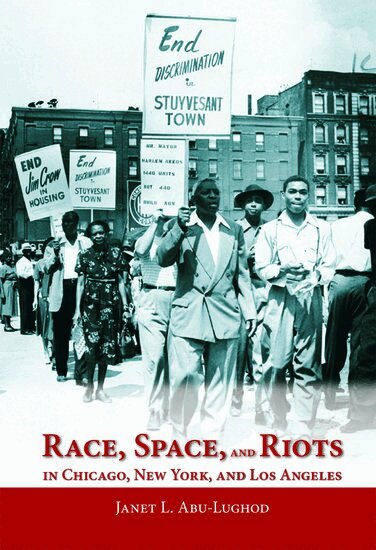
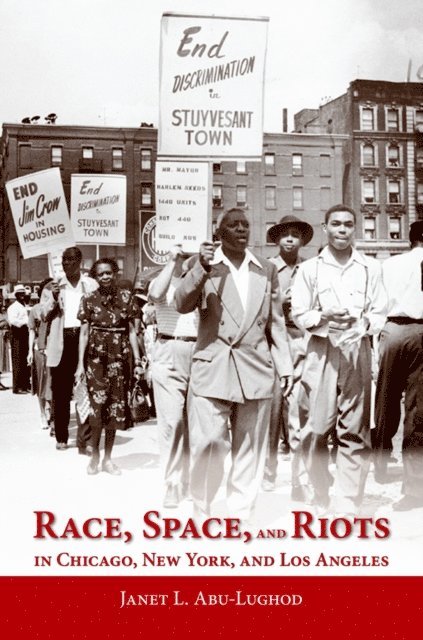
American society has been long plagued by cycles of racial violence, most dramatically in the 1960s when hundreds of ghetto uprisings erupted across American cities. Though the larger, underlying causes of contentious race relations have remained the same, the lethality, intensity, and outcomes of these urban rebellions have varied widely. What accounts for these differences? And what lessons can be learned that might reduce the destructive effects of riots and move race relations forward? This impressive, meticulously detailed study is the first attempt to compare six major race riots that occurred in the three largest American urban areas during the course of the twentieth century: in Chicago in 1919 and 1968; in New York in 1935/1943 and 1964; and in Los Angeles in 1965 and 1992. Race, Space, and Riots in Chicago, New York, and Los Angeles weaves together detailed narratives of each riot, placing them in their changing historical contexts and showing how urban space, political regimes, and economic conditions--not simply an abstract "race conflict"--have structured the nature and extent of urban rebellions. Building on her previous groundbreaking comparative history of these three cities, Janet Abu-Lughod draws upon archival research, primary sources, case studies, and personal observations to reconstruct events--especially for the 1964 Harlem-Bedford Stuyvesant uprising and Chicago's 1968 riots where no documented studies are available. By focusing on the similarities and differences in each city, identifying the unique and persisting issues, and evaluating the ways political leaders, law enforcement, and the local political culture have either defused or exacerbated urban violence, this book points the way toward alleviating long-standing ethnic and racial tensions. A masterful analysis from a renowned urbanist, Race, Space, and Riots in Chicago, New York, and Los Angeles offers a deeper understanding of past--and future--urban race relations while emphasizing that until persistent racial and economic inequalities are meaningfully resolved, the tensions leading to racial violence will continue to exist in America's cities and betray our professed democratic values."Well researched, clearly written, and even more comprehensive than it claims...offers readers a concise study of twentieth-century urban racial violence in the three selected cities and serves as a good starting point for those interested in researching urban racial violence in more depth."--African American Review"[Abu-Lughod] brings to this new book on riots an enormous amount of knowledge about the economic context of [New York, Chicago, and Los Angeles]...[this book] provide[s] good fodder for debate...[and] contains some provocative commentary and thoughtful discussion of riots, American style."--Political Science Quarterly"Seeks to shed light on the ever changing nature of race relations in American cities and in America at large... The individual chapters on politics, race relations and civil unrest in Chicago, New York, and Los Angeles are masterful, describing the long-term transformations of the each city's spatial, racial, and political character and locating each riot event within those transformative moments... ultimately a rewarding read."--Urban Affairs"In this new book, she [Abu-Lughod] neatly balances the historical facts of each of these cities with a deeply informed interpretation that clearly advances our knowledge of how both large and small riots unfold... rich with evidence and insight... As an urbanist, the author is without parallel when she dissects the U.S. federal effort to address the housing needs of the population."--Anthropological Quarterly"Abu-Lughod should be commended for her scholarly contribution and for drawing attention to these pivotal events as important signs or indicators of "tectonic shifts" (pp. 255, 260) taking place in the racial and political landscape of American cities...As Abu-Lughod convincingly argues, the future of urban areas, and the likelihood of future riots, will indeed depend on how American society chooses to deal with the enduring issues of racial and spatial inequality."--City & Community"Interesting and provocative... Abu-Lughod provides a detailed and compelling analysis of the grim consequences of racism in US society. Well-written and accessible, this book is a "must buy" for all university libraries. Summing Up: Essential."--Choice"Professor Abu-Lughod's well-documented study offers an unbiased historical account of six major American race riots. But this book is so much more... Race, Space, and Riots is not only superb scholarship, it is valuable wisdom on pragmatic strategies to prevent and cope with urban racial unrest."--The Journal of Blacks in Higher Education"Janet Abu-Lughod, a luminary in the field of urban sociology, has published a compelling comparative analysis of twentieth-century race riots in the nations' three largest cities... adroitly synthesizes enormous amounts of historical data from the three cities in question, and her comparative method is illuminating."--H-Net Reviews"With the drama of a storyteller and the rigor of a social scientist, Janet Abu-Lughod bares the institutional underbelly of ethnic conflict in America's three largest cities. She shows how long-standing patterns of repressive policing and unresponsive politicians can drive African Americans to riot--and how efforts at 'containment' have moved to prisons from the streets. This is not just a comparative history of urban conflict, but a call for new national priorities. It should be required reading for all students, teachers, and elected officials."--Sharon Zukin, author of The Cultures of Cities"Marshalling her unparalleled knowledge of the ecology, economy, culture and politics of New York, Los Angeles, and Chicago, Janet Abu-Lughod has produced the first in-depth comparative analysis of the major race riots that rocked America during the sweep of the twentieth century. Construing black-white clashes as 'urban disasters,' she skillfully reveals how the ramifying fissures of caste, class, and power were angled and entangled differently in these three cities. Her historically grounded case comparison invites us to move beyond structural accounts of collective violence to map the varied configurations of time, space, and conflict that cause, dampen, or thwart rioting. A fitting capstone to the lifework of the leading urban scholar of her generation, this bold book will stimulate scholars to revise their models of racial domination and urban protest."--Loic Wacquant, author of Body and Soul and Urban Outcasts"Janet Abu-Lughod, a truly original thinker among urbanists, offers a well-crafted analysis probing decades of riot and rebellion in Chicago, Los Angeles, and New York City. Abu-Lughod provides rich detail on riot contexts and trajectories, traces innovatively critical patterns (riots of control versus riots of rebellion) and explores sagely the racialized ecology and demography of major U.S. uprisings."--Joe R. Feagin, author of Ghetto Revolts and Systemic Racism"This profound examination of race and violence in America's three most important and global urban sites deepens our understanding of how distinctive spatial situations and political cultures affect the expression of discontent. Written by a brilliant scholar of cities, the book's learned comparisons of six racial conflagrations offer a model of engaged and systematic historical social science concerned with the deepest vectors of inequality in the United States."--Ira Katznelson, author of When Affirmative Action Was White"Janet Abu-Lughod's new book provides a superb scholarly study that compares and contrasts race riots through time and across cities. A penetrating look into the causes and consequences of American race riots, Abu-Lughod's study may well jolt readers by her somber conclusion that we should expect future race riots in our major cities, the breeding grounds for past riots, where problems are festering unabated. Abu-Lughod makes clear that if fundamental racial inequalities are not addressed, violent racial confrontations will flare once again, claming lives, destroying property, and sowing seeds of racial hatred that will make the pursuit of the American Dream appear to be pure folly. This is a scientific work that should influence public policy."--Aldon Morris, author of The Origins of the Civil Rights Movement