Jann K. Kleffner - Böcker
Visar alla böcker från författaren Jann K. Kleffner. Handla med fri frakt och snabb leverans.
7 produkter
7 produkter
2 178 kr
Skickas inom 5-8 vardagar
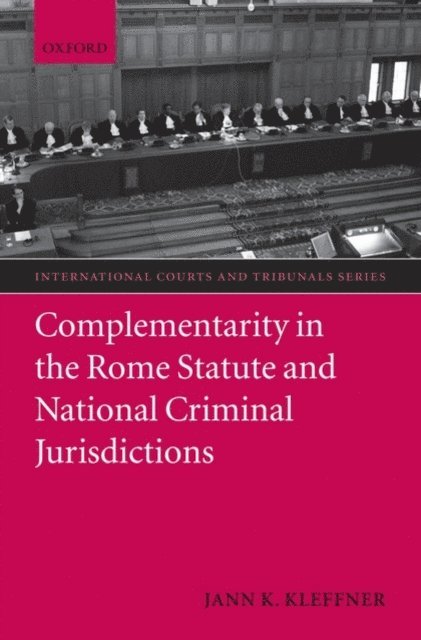
This book provides an in depth-examination of the principle of complementarity in the Rome Statute of the International Criminal Court and the implications of that principle for the suppression of genocide, crimes against humanity and war crimes on the domestic level. The book is set against the general background of the suppression of these crimes on the domestic level, its potential and pitfalls. It traces the evolution of complementarity and provides a critical and comprehensive analysis of the provisions in the Rome Statute and the Rules of Procedure and Evidence relevant to complementarity. In so doing, it addresses both substantive and procedural aspects of admissibility, while taking account of the early practice of the ICC. Further attention is devoted to the question whether and to what extent the Rome Statute imposes on States Parties an obligation to investigate and prosecute core crimes domestically. Finally, the book examines the potential of the complementary regime to function as a catalyst for States to conduct domestic criminal proceedings vis-à-vis core crimes.
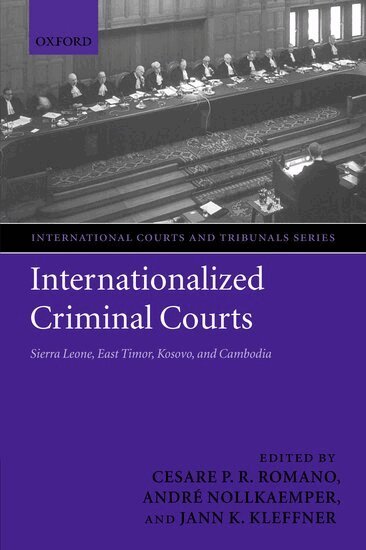
Internationalized Criminal Courts
Sierra Leone, East Timor, Kosovo, and Cambodia
Häftad, Engelska, 2004
1 088 kr
Skickas inom 5-8 vardagar
In response to the weaknesses of international tribunals and domestic courts in the prosecution of crimes such as genocide, crimes against humanity and war crimes, a new generation of "internationalized" criminal courts has been established. This book addresses three active and one putative jurisdiction of this kind in East Timor, Kosovo, Sierra Leone, and Cambodia.
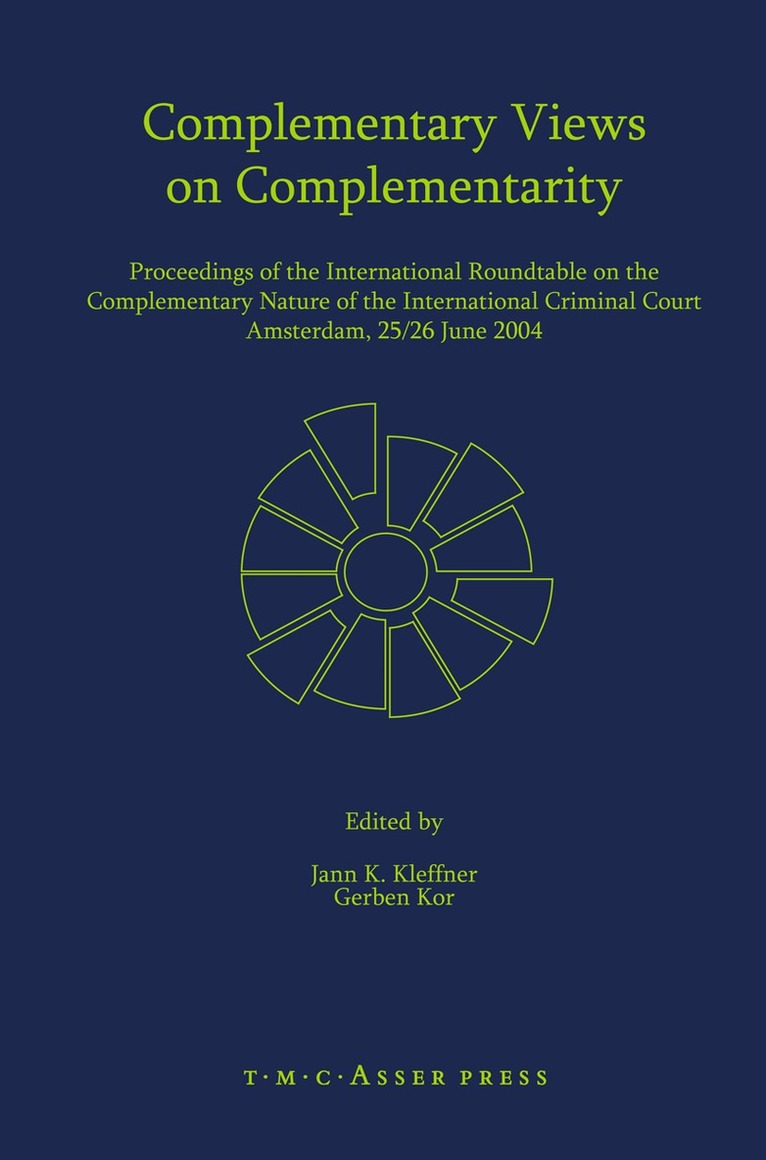
Complementary Views on Complementarity
Proceedings of the International Roundtable on the Complementary Nature of the International Criminal Court, Amsterdam 25/26 June 2004
Inbunden, Engelska, 2006
493 kr
Skickas inom 10-15 vardagar
One of the most fundamental precepts of the International Criminal Court is its complementary character. Complementarity defines the relationship between States and the Court. It denotes that cases are admissible before the International Criminal Court if a State remains wholly inactive or is unwilling or unable to investigate and prosecute genuinely crimes within the jurisdiction of the Court. Complementarity raises a myriad of questions, a discussion of which is widely held to stand central in understanding the Rome Statute of the International Criminal Court and the system of international criminal justice it establishes. With a view to address some of the most pertinent questions, the Amsterdam Center for International Law and the Department of Legal Philosophy at the Law Faculty of the Free University of Amsterdam held an international expert roundtable on the ‘Complementarity Principle of the Rome Statute of the International Criminal Court’ in June 2004. The roundtable provided a forum for high-level exchange between Ph.D. researchers and experts on the subject. As a framework for that exchange, a number of researchers presented a paper, which was commented upon by an expert. Questions addressed are: What role does complementarity play in ascertaining States’ consent to the Rome Statute? What is the relationship between complementarity and State sovereignty? What is the effect of complementarity on national repression of ICC crimes? What room, if any, does complementarity leave for non-criminal responses to ICC crimes, such as truth commissions and amnesties? How should complementarity be conceptualised in order to make the ICC a success? The papers and comments form the basis of the present book, which is the first to present a multidisciplinary view on complementarity. It is especially of interest to academics and advanced law students, as well as practitioners in the field of international criminal law, including judges, policy makers and government officials. Jann K. Kleffner is Assistant Professor of International Law at the Amsterdam Center for International Law, University of Amsterdam. Gerben Kor is Assistant Professor of Philosophy of Law, Free University of Amsterdam.
493 kr
Skickas inom 10-15 vardagar
This books provides an in-depth analysis of the international legal aspects of the use of depleted uranium (DU) ammunition and armour. The military use of DU has been surrounded by considerable controversy, mainly as regards the health and environmental risks that such use entails. The debate about DU has thus far been highly polarised, with one end of the spectrum rejecting any risk whatsoever and the other end suggesting that the use of DU leads to severe health and environmental consequences, including Gulf-War syndrome, whenever it is used. Rather than settling these controversies, the book takes as a starting point a precautionary approach in light of the considerable remaining scientific uncertainties. It examines various principles and rules of international law, which would be at play if the health and environmental concerns regarding the use of DU were to materialise.
1 451 kr
Skickas inom 10-15 vardagar
The world's only annual publication devoted to the study of the laws of armed conflict, the Yearbook of International Humanitarian Law provides a truly international forum for high-quality, peer-reviewed academic articles focusing on this highly topical branch of international law. The Yearbook also includes a selection of documents from the reporting period, many of which are not accessible elsewhere, and a comprehensive bibliography of all recent publications in humanitarian law and other relevant fields. Ease of use of the Yearbook is guaranteed by the inclusion of a detailed index.Distinguished by its topicality and contemporary relevance, the Yearbook of International Humanitarian Law bridges the gap between theory and practice and serves as a useful reference tool for scholars, practitioners, military personnel, civil servants, diplomats, human rights workers and students.
1 451 kr
Skickas inom 10-15 vardagar
The world's only annual publication devoted to the study of the laws of armed conflict, the Yearbook of International Humanitarian Law provides a truly international forum for high-quality, peer-reviewed academic articles focusing on this highly topical branch of international law. The Yearbook also includes a selection of documents from the reporting period, many of which are not accessible elsewhere, and a comprehensive bibliography of all recent publications in humanitarian law and other relevant fields. Ease of use of the Yearbook is guaranteed by the inclusion of a detailed index.Distinguished by its topicality and contemporary relevance, the Yearbook of International Humanitarian Law bridges the gap between theory and practice and serves as a useful reference tool for scholars, practitioners, military personnel, civil servants, diplomats, human rights workers and students.
493 kr
Skickas inom 10-15 vardagar
Warfare is usually theorised in the categories of jus ad bellum (justification for recourse to force) and jus in bello (rules applicable in armed conflict). The challenge of establishing fair and sustainable peace after conflict (jus post bellum) has received less attention in existing law and practice, although it has an established tradition in just war theory. This book sheds a fresh light on the use and relevance of the concept of jus post bellum in contemporary international law and policy. It examines the origins and foundations of the concept from an inter-disciplinary perspective. Moreover, it identifies some of the features and challenges of a framework governing transitions from conflict to peace, such as the treatment of sovereignty, accountability and local ownership, the relationship of jus post bellum to jus ad bellum and jus in bello and the role of human rights law and transitional justice.