Jeff Sebo - Böcker
Visar alla böcker från författaren Jeff Sebo. Handla med fri frakt och snabb leverans.
7 produkter
7 produkter
Saving Animals, Saving Ourselves
Why Animals Matter for Pandemics, Climate Change, and other Catastrophes
Inbunden, Engelska, 2022
386 kr
Skickas inom 5-8 vardagar
In 2020, COVID-19, the Australia bushfires, and other global threats served as vivid reminders that human and nonhuman fates are increasingly linked. Human use of nonhuman animals contributes to pandemics, climate change, and other global threats which, in turn, contribute to biodiversity loss, ecosystem collapse, and nonhuman suffering. Jeff Sebo argues that humans have a moral responsibility to include animals in global health and environmental policy. In particular, we should reduce our use of animals as part of our pandemic and climate change mitigation efforts and increase our support for animals as part of our adaptation efforts. Applying and extending frameworks such as One Health and the Green New Deal, Sebo calls for reducing support for factory farming, deforestation, and the wildlife trade; increasing support for humane, healthful, and sustainable alternatives; and considering human and nonhuman needs holistically. Sebo also considers connections with practical issues such as education, employment, social services, and infrastructure, as well as with theoretical issues such as well-being, moral status, political status, and population ethics. In all cases, he shows that these issues are both important and complex, and that we should neither underestimate our responsibilities because of our limitations, nor underestimate our limitations because of our responsibilities. Both an urgent call to action and a survey of what ethical and effective action requires, Saving Animals, Saving Ourselves is an invaluable resource for scholars, advocates, policy-makers, and anyone interested in what kind of world we should attempt to build and how.This is an open access title available under the terms of a CC BY-NC-ND 4.0 International license. It is free to read at Oxford Scholarship Online and offered as a free PDF download from OUP and selected open access locations.
1 294 kr
Skickas inom 10-15 vardagar
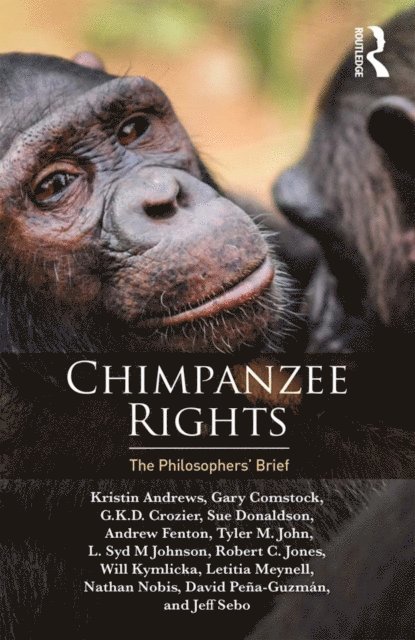
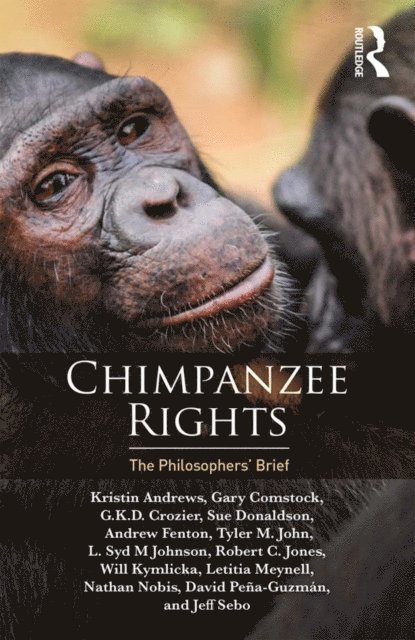
Since 2013, an organization called the Nonhuman Rights Project has brought before the New York State courts an unusual request—asking for habeas corpus hearings to determine whether Kiko and Tommy, two captive chimpanzees, should be considered legal persons with the fundamental right to bodily liberty.While the courts have agreed that chimpanzees share emotional, behavioural, and cognitive similarities with humans, they have denied that chimpanzees are persons on superficial and sometimes conflicting grounds. Consequently, Kiko and Tommy remain confined as legal "things" with no rights. The major moral and legal question remains unanswered: are chimpanzees mere "things", as the law currently sees them, or can they be "persons" possessing fundamental rights?In Chimpanzee Rights: The Philosophers’ Brief, a group of renowned philosophers considers these questions. Carefully and clearly, they examine the four lines of reasoning the courts have used to deny chimpanzee personhood: species, contract, community, and capacities. None of these, they argue, merits disqualifying chimpanzees from personhood. The authors conclude that when judges face the choice between seeing Kiko and Tommy as things and seeing them as persons—the only options under current law—they should conclude that Kiko and Tommy are persons who should therefore be protected from unlawful confinement "in keeping with the best philosophical standards of rational judgment and ethical standards of justice."Chimpanzee Rights: The Philosophers’ Brief—an extended version of the amicus brief submitted to the New York Court of Appeals in Kiko’s and Tommy’s cases—goes to the heart of fundamental issues concerning animal rights, personhood, and the question of human and nonhuman nature. It is essential reading for anyone interested in these issues.
346 kr
Skickas inom 10-15 vardagar
Since 2013, an organization called the Nonhuman Rights Project has brought before the New York State courts an unusual request—asking for habeas corpus hearings to determine whether Kiko and Tommy, two captive chimpanzees, should be considered legal persons with the fundamental right to bodily liberty.While the courts have agreed that chimpanzees share emotional, behavioural, and cognitive similarities with humans, they have denied that chimpanzees are persons on superficial and sometimes conflicting grounds. Consequently, Kiko and Tommy remain confined as legal "things" with no rights. The major moral and legal question remains unanswered: are chimpanzees mere "things", as the law currently sees them, or can they be "persons" possessing fundamental rights?In Chimpanzee Rights: The Philosophers’ Brief, a group of renowned philosophers considers these questions. Carefully and clearly, they examine the four lines of reasoning the courts have used to deny chimpanzee personhood: species, contract, community, and capacities. None of these, they argue, merits disqualifying chimpanzees from personhood. The authors conclude that when judges face the choice between seeing Kiko and Tommy as things and seeing them as persons—the only options under current law—they should conclude that Kiko and Tommy are persons who should therefore be protected from unlawful confinement "in keeping with the best philosophical standards of rational judgment and ethical standards of justice."Chimpanzee Rights: The Philosophers’ Brief—an extended version of the amicus brief submitted to the New York Court of Appeals in Kiko’s and Tommy’s cases—goes to the heart of fundamental issues concerning animal rights, personhood, and the question of human and nonhuman nature. It is essential reading for anyone interested in these issues.
2 088 kr
Skickas inom 10-15 vardagar
Food, Animals, and the Environment: An Ethical Approach examines some of the main impacts that agriculture has on humans, nonhumans, and the environment, as well as some of the main questions that these impacts raise for the ethics of food production, consumption, and activism. Agriculture is having a lasting effect on this planet. Some forms of agriculture are especially harmful. For example, industrial animal agriculture kills 100+ billion animals per year; consumes vast amounts of land, water, and energy; and produces vast amounts of waste, pollution, and greenhouse gas emissions. Other forms, such as local, organic, and plant-based food, have many benefits, but they also have many costs, especially at scale. These impacts raise difficult ethical questions. What do we owe animals, plants, species, and ecosystems? What do we owe people in other nations and future generations? What are the ethics of risk, uncertainty, and collective harm? What is the meaning and value of natural food in a world reshaped by human activity? What are the ethics of supporting harmful industries when less harmful alternatives are available? What are the ethics of resisting harmful industries through activism, advocacy, and philanthropy? The discussion ranges over cutting-edge topics such as effective altruism, abolition and regulation, revolution and reform, individual and structural change, single-issue and multi-issue activism, and legal and illegal activism. This unique and accessible text is ideal for teachers, students, and anyone else interested in serious examination of one of the most complex and important moral problems of our time.
549 kr
Skickas inom 10-15 vardagar
Food, Animals, and the Environment: An Ethical Approach examines some of the main impacts that agriculture has on humans, nonhumans, and the environment, as well as some of the main questions that these impacts raise for the ethics of food production, consumption, and activism. Agriculture is having a lasting effect on this planet. Some forms of agriculture are especially harmful. For example, industrial animal agriculture kills 100+ billion animals per year; consumes vast amounts of land, water, and energy; and produces vast amounts of waste, pollution, and greenhouse gas emissions. Other forms, such as local, organic, and plant-based food, have many benefits, but they also have many costs, especially at scale. These impacts raise difficult ethical questions. What do we owe animals, plants, species, and ecosystems? What do we owe people in other nations and future generations? What are the ethics of risk, uncertainty, and collective harm? What is the meaning and value of natural food in a world reshaped by human activity? What are the ethics of supporting harmful industries when less harmful alternatives are available? What are the ethics of resisting harmful industries through activism, advocacy, and philanthropy? The discussion ranges over cutting-edge topics such as effective altruism, abolition and regulation, revolution and reform, individual and structural change, single-issue and multi-issue activism, and legal and illegal activism. This unique and accessible text is ideal for teachers, students, and anyone else interested in serious examination of one of the most complex and important moral problems of our time.
218 kr
Skickas inom 7-10 vardagar
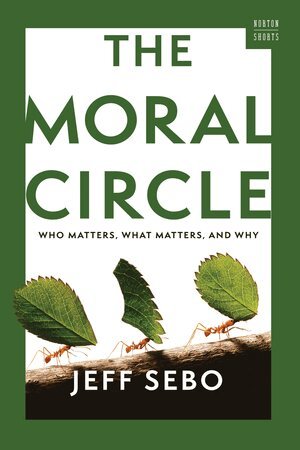
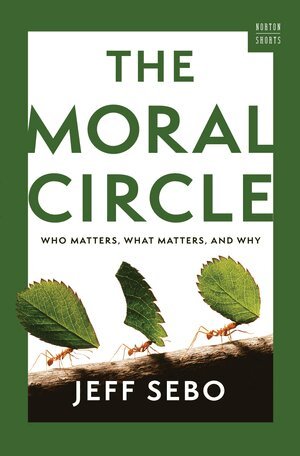
Today, human exceptionalism is the norm. Despite occasional nods to animal welfare, we prioritise humanity, often neglecting the welfare of a vast number of beings. As a result, we use hundreds of billions of vertebrates and trillions of invertebrates every year for a variety of purposes, often unnecessarily. We also plan to use animals, AI systems and other non-humans at even higher levels in the future. Yet as the dominant species, humanity has a responsibility to ask: Which non-humans matter, how much do they matter and what do we owe them in a world reshaped by human activity and technology?In The Moral Circle, philosopher Jeff Sebo challenges us to include all potentially significant beings in our moral community, with transformative implications for our lives and societies.This book explores provocative case studies such as lawsuits over captive elephants and debates over factory-farmed insects, and compels us to consider future ethical quandaries, such as whether to send microbes to new planets and whether to create virtual worlds filled with digital minds. Taking an expansive view of human responsibility, Sebo argues that building a positive future requires the shedding of human exceptionalism and radically rethinking our place in the world.
113 kr
Skickas inom 7-10 vardagar
Today, human exceptionalism is the norm. Despite occasional nods to animal welfare, we prioritise humanity, often neglecting the welfare of a vast number of beings. As a result, we use hundreds of billions of vertebrates and trillions of invertebrates every year for a variety of purposes, often unnecessarily. Yet as the dominant species, humanity has a responsibility to ask: Which non-humans matter, how much do they matter and what do we owe them in a world reshaped by human activity and technology?In The Moral Circle, philosopher Jeff Sebo challenges us to include all potentially significant beings in our moral community, with transformative implications for our lives and societies.This book explores provocative case studies such as lawsuits over captive elephants and debates over factory-farmed insects, and compels us to consider future ethical quandaries, such as whether to send microbes to new planets and whether to create virtual worlds filled with digital minds. Taking an expansive view of human responsibility, Sebo argues that building a positive future requires the shedding of human exceptionalism and radically rethinking our place in the world.A Norton Short