Jennifer Corrin - Böcker
Visar alla böcker från författaren Jennifer Corrin. Handla med fri frakt och snabb leverans.
5 produkter
5 produkter
1 082 kr
Skickas inom 5-8 vardagar
The only book of its kind, Introduction to South Pacific Law provides an overview of law in the South Pacific. It sets out the framework of South Pacific legal systems and also describes the substantive law on a broad range of topics.Examining both state laws and customary law, the book highlights common patterns and explains some of the principal differences between the laws and legal systems of the countries of the region.The introductory chapter looks at the development of South Pacific law and at South Pacific jurisprudence. Individual chapters are devoted to state laws, customary law, constitutional law, administrative law, criminal law, family law, contract law, torts law, land law, and court systems. The book makes extensive reference to legislative provisions and case law of individual jurisdictions.Including a discussion of recent changes in the law, this new edition of Introduction to South Pacific Law is a useful and up-to-date resource for all those interested in the law of the region.
1 152 kr
Skickas inom 5-8 vardagar
This book is a unique study of the law of contract in a range of South Pacific Island countries: Cook Islands, Fiji, Kiribati, Marshall Islands, Nauru, Niue, Papua New Guinea, Tokelau, Tonga, Tuvalu, Samoa, Solomon Islands and Vanuatu, to name a few.Whilst this law has yet to establish its own regional identity, it differs significantly from the law of contract which operates in England and Wales. Incorporating an up to date survey of local jurisprudence, this book discusses the common law principles with reference to both regional decisions and case law from England and Wales. Further, it explains how the law of contract differs from country to country within the South Pacific and highlights the areas where regional courts have chosen to follow national legal developments in other countries, such as Australia and New Zealand. Relevant legislation in operation is also discussed, including local enactments and statutes that have been introduced from overseas. In addition, a separate chapter is specifically dedicated to customary laws, exploring the question of whether there is a customary law of contract. It explains the role of customary laws and their place within State law hierarchies of laws in South Pacific legal systems. Subsequent chapters go on to explore the relationship between customary laws and particular State contract laws.Contract Law in the South Pacific is a valuable resource for students, academics and legal practitioners, both within and outside the region.
1 370 kr
Skickas inom 5-8 vardagar
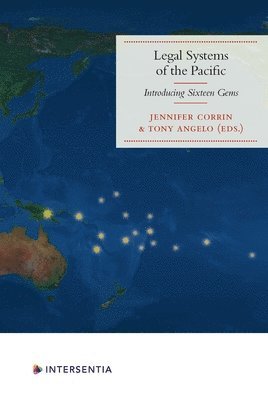
This book provides an overview of the legal systems of a selection of Pacific Island countries. It gives a general outline of each system, with emphasis on particularities and matters of current special interest, such as climate change and the environment. It offers easy reference and information about where to find more information on specific aspects of the legal system in each of those jurisdictions.With no new books written on these legal systems, namely the Cook Islands, Fiji, French Polynesia, Kiribati, Nauru, New Caledonia, Niue, Papua New Guinea, Pitcairn, Samoa, Solomon Islands, Tokelau, Tonga, Tuvalu, Vanuatu and Wallis and Futuna, for nearly 30 years, Legal Systems of the Pacific fills a gap in the literature and offers an 'insider' perspective on the legal system, with the majority of authors being indigenous or long-term residents of the countries in question.
1 370 kr
Skickas inom 5-8 vardagar
1 355 kr
Skickas inom 10-15 vardagar
This book deals with adoption laws and practices in small island developing states in the Pacific. It commences with an introductory chapter giving an overview of relevant laws and practices and pulling together the common themes and issues raised in the book. Each of the following chapters deals with adoption law and practice in a small South Pacific country. The countries in question all have plural legal systems, with systems of adoption and its closest customary law equivalent operating side by side. In most cases, there is an insufficiently developed relationship between the two systems, which has resulted in a number of problems. Additionally, international law adds another layer of complexity. Size and remoteness in the small states under discussion have a profound impact on local practices.