Jenny Wallensten – författare
Visar alla böcker från författaren Jenny Wallensten. Handla med fri frakt och snabb leverans.
3 produkter
3 produkter
Häftad, Svenska, 2011
768 kr
Skickas inom 5-8 vardagar
In recent years Greek religion has emerged as one of the main topics for the study of ancient Greek society as a whole. This flourishing interest is certainly due to the recognition of the centrality of religion to Greek culture: religious beliefs and practices were connected to almost every aspect of the Greek world. This volume brings together fourteen contributions from a group of upcoming international scholars, presented at a conference held in the Swedish Institute at Athens and the British School at Athens in 2008. The papers take a wide range of approaches: archaeological, epigraphic, iconographical, philological and historical. They demonstrate the diversity of the subject, covering such issues as nineteenth-century historiography, cult epithets, the pantheon, regionalism, polis religion, the performance of ritual, the use of music in ritual, the accessibility of sacred space, and the visual aspects of dedications. The contributions bring new theoretical perspectives, seek to better understand ritual, and highlight the variety of Greek religion.
Inbunden, Engelska, 2024
752 kr
Skickas inom 5-8 vardagar
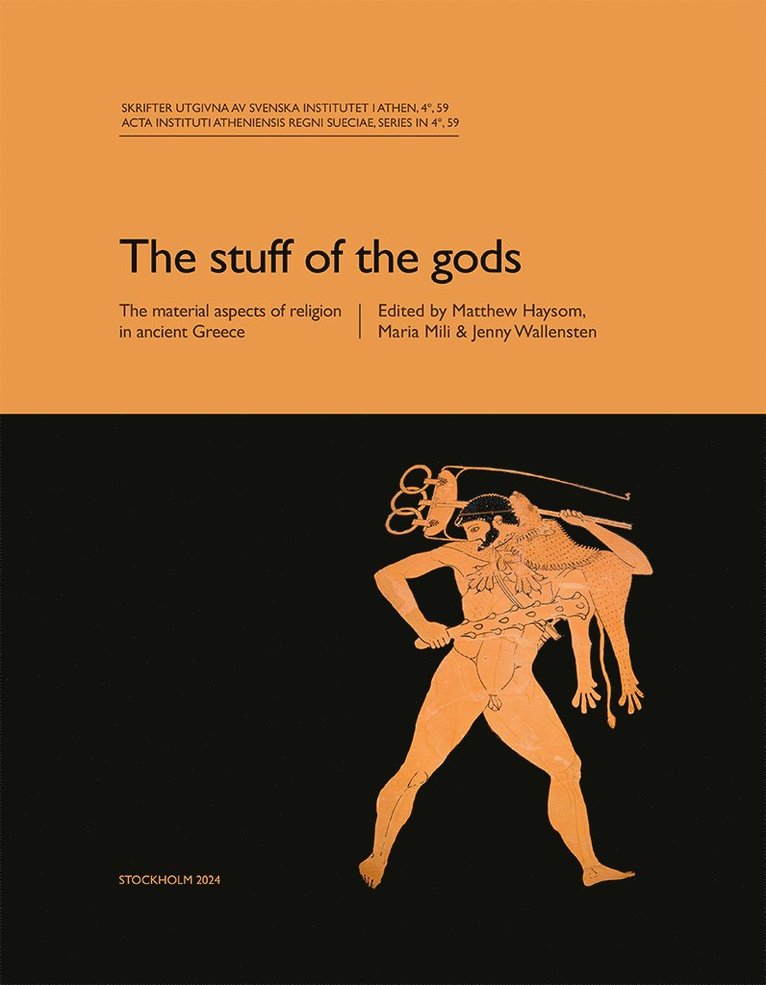
The “material turn” in the humanities and social sciences has brought about an expanded understanding of the material dimension of all cultural and social phenomena. In the Classics it has resulted in the breaking down of boundaries within the discipline and a growing interest in materiality within literature. In the study of religion cross-culturally new perspectives are emphasising religion as a material phenomenon and belief as a practice founded in the material world. This volume brings together experts in all aspects of Greek religion to consider its material dimensions. Chapters cover both themes traditionally approached by archaeologists, such as dedications and sacred space, and themes traditionally approached by philologists, such as the role of objects in divine power. They include a wide variety of themes ranging from the imminent material experience of religion for ancient Greek worshippers to the role of material culture in change and continuity over the long term. Contents Matthew Haysom, Maria Mili & Jenny Wallensten, ‘Introduction’, 7–14 Robin Osborne, ‘Stuff and godsense’, 15–24 Maria Mili, ‘Why did the Greek gods need objects?’, 25–34 Cécile Durvye, ‘Of things and men in the sanctuary of Aphrodite (Delos). Does the content of a sanctuary define the personality of the god?’, 35–45 Hedvig von Ehrenheim, ‘Incubation rituals. Creating a locality for the divine?’, 47–55 Petra Pakkanen, ‘Movable sacrality. Considerations on oscillating sacredness of material objects relating Greek sanctuaries’, 57–68 Gunnel Ekroth, ‘A room of one’s own? Exploring the temenos concept as divine property’, 69–82 Tyler Jo Smith, ‘Resistant, willing, and controlled. Sacrificial animals as “things” on Greek vases’, 83–95 Jenny Wallensten, ‘Decisive dedications. Dedications outside of sanctuary contexts’, 97–109 Caitlín E. Barrett, ‘The affordances of terracotta figurines in domestic contexts. Reconsidering the gap between material and ritual’, 111–132 Matthew Haysom, ‘Investigating the instability of religious material culture in Greek prehistory. The case of “bench shrines”’, 133–148 Catherine Morgan, ‘Adding buildings to Early Iron Age sanctuaries. The materiality of built space’, 149–166 Charlotte R. Potts, ‘An external view. Architecture and ritual in central Italy’, 167–180 Gina Salapata, ‘Ambiguity versus specificity in modest votive offerings’, 181–191 James Whitley, ‘Writing to the gods? Archaic votives, inscribed and uninscribed’, 193–213 Nassos Papalexandrou, ‘The asethetics of rare experiences in early Greek sanctuaries’, 215–223 Troels Myrup Kristensen, ‘Dephi and the omphalos. Materiality, replication and the mythistory of the Sanctuary of Apollo’, 225–234 Caroline Vout, ‘The stuff of crowded sanctuaries’, 235–246 ‘Index’, 247–248
Häftad, Engelska, 2024
715 kr
Tillfälligt slut
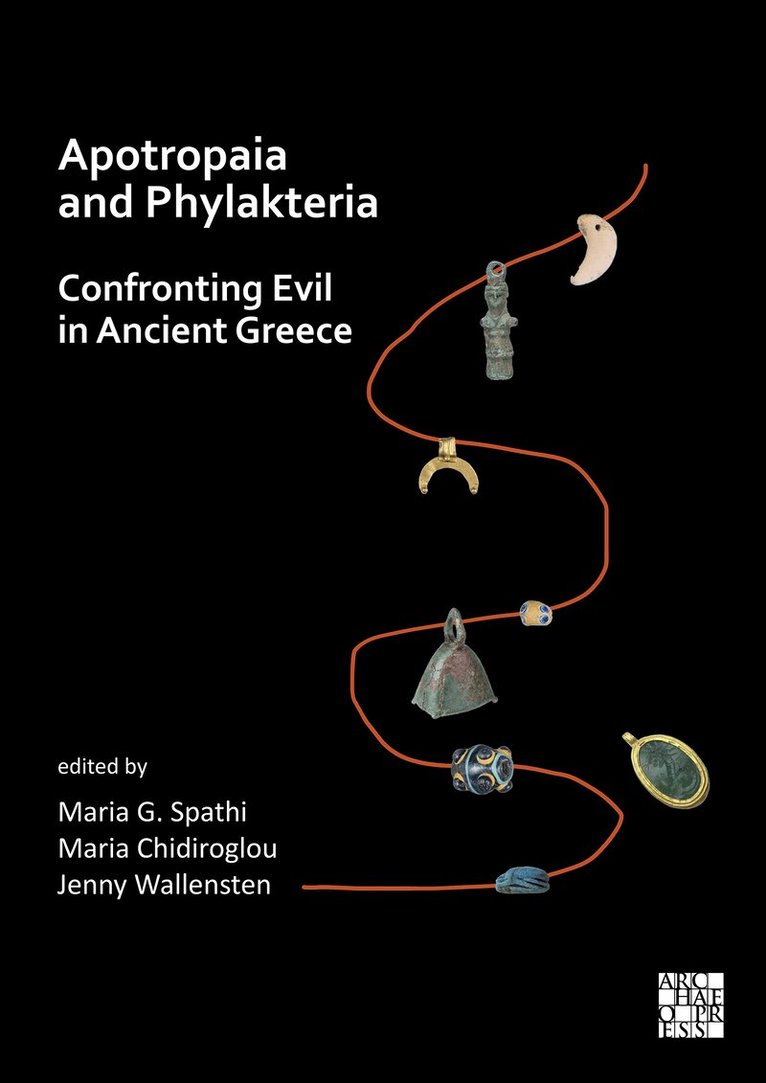
Apotropaia and Phylakteria: Confronting Evil in Ancient Greece is the outcome of the conference held in Athens in June 2021 and hosted by the Swedish Institute at Athens.The belief in the existence of evil forces was part of ancient everyday life and a phenomenon deeply embedded in popular thought of the Greek world. Fear of such malevolent powers generated the need for protection and we find clear traces of these concerns in both textual and archaeological sources. From the beginnings of literature, there is mention of ghosts and other daemonic beings that needed appeasement, and of ways of repulsing evil, such as the use of baskania and antibaskania (apotropaia). Repeatedly, we meet rituals of an apotropaic or prophylactic character conducted as part of everyday and family life, as for example on the occasion of a birth, marriage or death in the oikos (the cleansing of the house and household, libations and sacrifices in honour of oikos ancestors), and other practices that focused on the protection of the community as a whole, i.e. the Pharmakos ritual. Archaeology reveals an abundance of material objects thought to have the power to attract benevolent, and avert evil, forces. Traces of ritual practices necessary to ensure prosperity and avert personal disaster are manifest today in the form of amulets, certain semi-precious stones believed to protect women and children, eye-beads found in large numbers in many archaeological assemblages, possibly various types of terracotta figurines, such as nude female grotesques and various ithyphallic characters, to name a few. In addition, symbols and certain iconographic motifs, such as the phallus, the open hand, the Gorgoneion, images of triple Hekate, and Hermes, have been subject to a number of differing interpretations relative to apotropaic power.