Jeremy Cohen - Böcker
Visar alla böcker från författaren Jeremy Cohen. Handla med fri frakt och snabb leverans.
15 produkter
15 produkter
555 kr
Skickas inom 5-8 vardagar
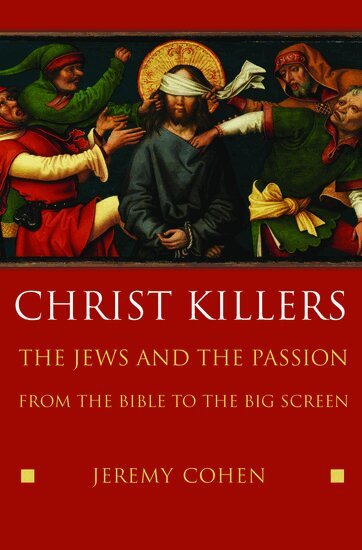
The New Testament accounts of Jesus' crucifixion have stood at the bedrock of Christianity since it's birth in the 1st century, and they remain among the essential foundations of Western culture in the 21st. These Gospel narratives of the Passion - the arrest, trial, scourging, and execution of Jesus - cast the Jews as those responsible, directly and indirectly, for the death of their Messiah and the son of God. Cohen tracks the image of the Jew as the murderer of the Messiah and God from its origins to its most recent expressions. A great deal has been written about Christian anti-Semitism, its roots, and its horrific consequences in world history. This is the first book, however to focus on the powerful myth that has driven so much murderous hatred. An important addition to the literature on Jewish-Christian relations, it should appeal to a wide variety of readers in both communities.
315 kr
Skickas inom 7-10 vardagar
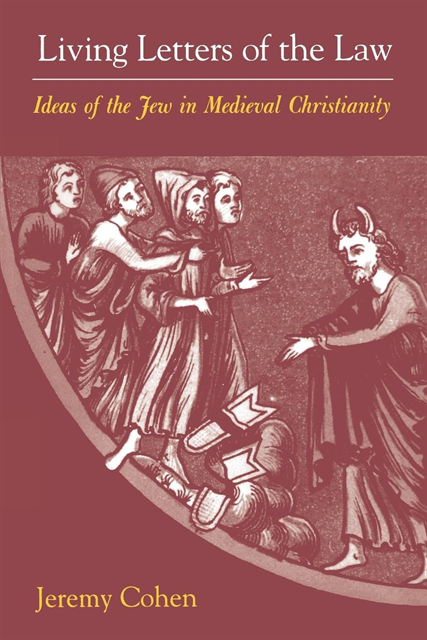
In "Living Letters of the Law", Jeremy Cohen investigates the images of Jews and Judaism in the works of medieval Christian theologians from Augustine to Thomas Aquinas. He reveals how - and why - medieval Christianity fashioned a Jew on the basis of its reading of the Bible, and how this hermeneutically crafted Jew assumed distinctive character and power in Christian thought and culture. Augustine's doctrine of Jewish witness, which constructed the Jews so as to mandate their survival in a properly ordered Christian world, is the starting point for this illuminating study. Cohen demonstrates how adaptations of this doctrine reflected change in the self-consciousness of early medieval civilization. After exploring the effect of twelfth-century Europe's encounter with Islam on the value of Augustine's Jewish witnesses, he concludes with a new assessment of the reception of Augustine's ideas among thirteenth-century popes and friars.Consistently linking the medieval idea of the Jew with broader issues of textual criticism, anthropology, and the philosophy of history, this book demonstrates the complex significance of Christianity's 'hermeneutical Jew' not only in the history of antisemitism but also in the broad scope of Western intellectual history.
329 kr
Skickas inom 10-15 vardagar
"Cohen argues that it was in the thirteenth century that a fundamental shift occurred in the Christian perception of both Judaism and Jews in Western Europe, and he attributes this change to the activities of the newly-formed mendicant orders—the Dominicans and Franciscans. In order to make this case as effectively as he does, the author has to approach his problem from two different perspectives—that of the historian of the medieval church, and that of the Jewish historian. Each of these approaches has its own scholarly literature, its own emphases, its own particular blind spots. It is the principal quality of this book that it focuses a steady, clear light on those dark corners, and will make sense to a variety of readers.... Cohen's views will be taken seriously. Indeed, the calm and sensible tone of this book may help stimulate a new scholarly debate."—American Jewish History
2 661 kr
Skickas inom 3-6 vardagar
It is not unusual for communication and media researchers to study law or legal issues, nor is it uncommon for legal scholars to study communication law. But it is something of a departure for the two to commingle, which is what Cohen and Gleason have accomplished in this innovative volume. Social Research in Communication and Law is a practical guide for conducting research involving both legal and communication questions. Offering rich citations and examples from existing literature, this engaging volume shows communication law scholars how to make more effective use of the methodologies employed in communication science. Topics addressed include reconciling communication and law, social research approaches to libel, and theories pertaining to freedom of expression. Cohen and Gleason have produced a valuable book that can be effectively used to supplement courses in communication law, history, sociology, and media ethics. In addition, scholars and researchers in the above fields will also benefit from this unique volume. "Cohen and Gleason provide a practical guide for conducting research involving both legal and communication questions. The book shows communication law scholars how to make more effective use of the social science methodologies." --Journal of Broadcasting and Electronic Media
1 714 kr
Skickas inom 3-6 vardagar
It is not unusual for communication and media researchers to study law or legal issues, nor is it uncommon for legal scholars to study communication law. But it is something of a departure for the two to commingle, which is what Cohen and Gleason have accomplished in this innovative volume. Social Research in Communication and Law is a practical guide for conducting research involving both legal and communication questions. Offering rich citations and examples from existing literature, this engaging volume shows communication law scholars how to make more effective use of the methodologies employed in communication science. Topics addressed include reconciling communication and law, social research approaches to libel, and theories pertaining to freedom of expression. Cohen and Gleason have produced a valuable book that can be effectively used to supplement courses in communication law, history, sociology, and media ethics. In addition, scholars and researchers in the above fields will also benefit from this unique volume. "Cohen and Gleason provide a practical guide for conducting research involving both legal and communication questions. The book shows communication law scholars how to make more effective use of the social science methodologies." --Journal of Broadcasting and Electronic Media
Sanctifying the Name of God
Jewish Martyrs and Jewish Memories of the First Crusade
Häftad, Engelska, 2006
380 kr
Skickas inom 10-15 vardagar
How are martyrs made, and how do the memories of martyrs express, nourish, and mold the ideals of the community? Sanctifying the Name of God wrestles with these questions against the background of the massacres of Jews in the Rhineland during the outbreak of the First Crusade. Marking the first extensive wave of anti-Jewish violence in medieval Christian Europe, these "Persecutions of 1096" exerted a profound influence on the course of European Jewish history.When the crusaders demanded that Jews choose between Christianity and death, many opted for baptism. Many others, however, chose to die as Jews rather than to live as Christians, and of these, many actually inflicted death upon themselves and their loved ones. Stories of their self-sacrifice ushered the Jewish ideal of martyrdom-kiddush ha-Shem, the sanctification of God's holy name-into a new phase, conditioning the collective memory and mindset of Ashkenazic Jewry for centuries to come, during the Holocaust, and even today.The Jewish survivors of 1096 memorialized the victims as martyrs as they rebuilt their communities during the decades following the Crusade. Three twelfth-century Hebrew chronicles of the persecutions preserve their memories of martyrdom and self-sacrifice, tales fraught with symbolic meaning that constitute one of the earliest Jewish attempts at local, contemporary historiography. Reading and analyzing these stories through the prism of Jewish and Christian religious and literary traditions, Jeremy Cohen shows how these persecution chronicles reveal much more about the storytellers, the martyrologists, than about the martyrs themselves. While they extol the glorious heroism of the martyrs, they also air the doubts, guilt, and conflicts of those who, by submitting temporarily to the Christian crusaders, survived.
Historian in Exile
Solomon Ibn Verga, "Shevet Yehudah," and the Jewish-Christian Encounter
Inbunden, Engelska, 2016
835 kr
Skickas inom 10-15 vardagar
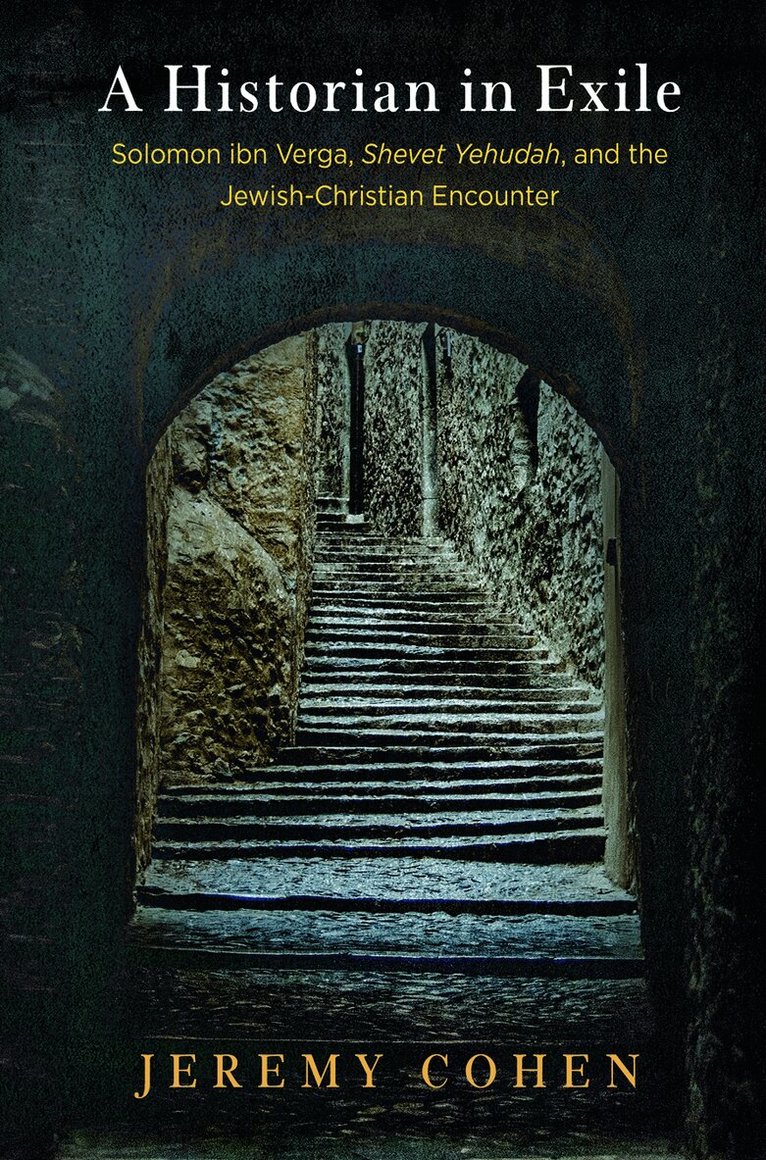
Solomon ibn Verga was one of the victims of the decrees expelling the Jews from Spain and Portugal in the 1490s, and his Shevet Yehudah (The Scepter of Judah, ca. 1520) numbered among the most popular Hebrew books of the sixteenth century. Its title page lured readers and buyers with a promise to relate "the terrible events and calamities that afflicted the Jews while in the lands of non-Jewish peoples": blood libels, disputations, conspiracies, evil decrees, expulsions, and more.The book itself preserves collective memories, illuminates a critical and transitional phase in Jewish history, and advances a new vision of European society and government. It reflects a world of renaissance, reformation, and global exploration but also one fraught with crisis for Christian majority and Jewish minority alike. Among the multitudes of Iberian Jewish conversos who had received Christian baptism by the end of the fifteenth century, ibn Verga experienced the destruction of Spanish-Portuguese Jewry just as the Catholic Church began to lose exclusive control over the structures of Western religious life; and he joined other Europeans in reevaluating boundaries and affiliations that shaped their identities.In A Historian in Exile, Jeremy Cohen shows how Shevet Yehudah bridges the divide between the medieval and early modern periods, reflecting a contemporary consciousness that a new order had begun to replace the old. Ibn Verga's text engages this receding past in conversation, Cohen contends; it uses historical narrative to challenge regnant assumptions, to offer new solutions to age-old problems, to call Jews to task for bringing much of the hostility toward them upon themselves, and to chart a viable direction for a people seeking a place to call home in a radically transformed world.
959 kr
Skickas inom 10-15 vardagar
Providing a discussion of the Jewish experience in Mediterranean and Western societies over the last 2000 years, these papers concentrate on the doctrinal substance of the Jewish-Christian dispute in the order that it developed.
364 kr
Skickas inom 7-10 vardagar
Providing a discussion of the Jewish experience in Mediterranean and Western societies over the last 2000 years, these papers concentrate on the doctrinal substance of the Jewish-Christian dispute in the order that it developed.
365 kr
Skickas inom 3-6 vardagar
1 525 kr
Skickas inom 7-10 vardagar
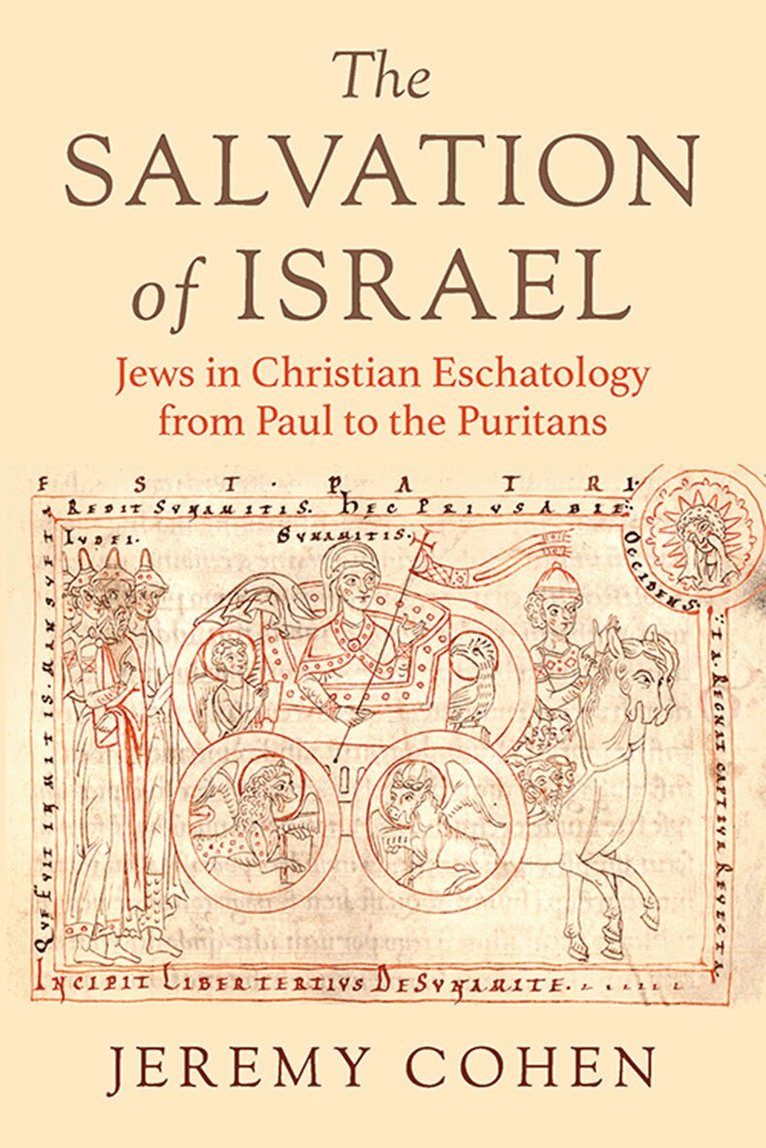
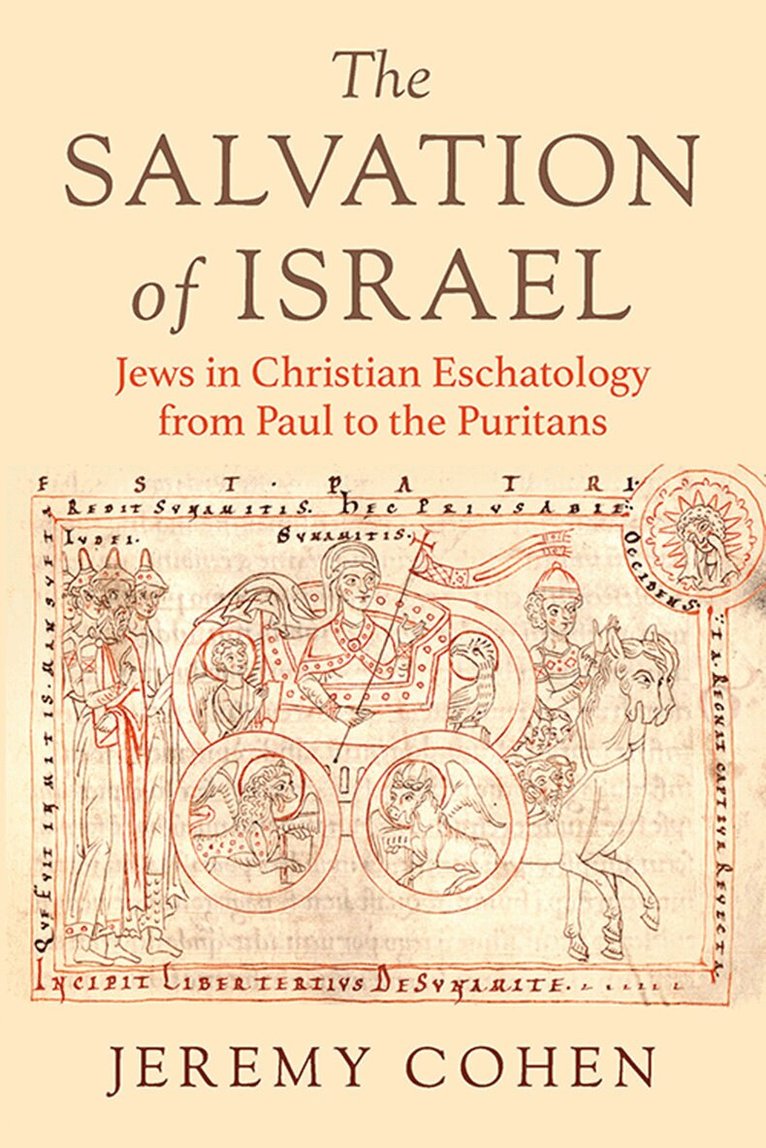
The Salvation of Israel investigates Christianity's eschatological Jew: the role and characteristics of the Jews at the end of days in the Christian imagination. It explores the depth of Christian ambivalence regarding these Jews, from Paul's Epistle to the Romans, through late antiquity and the Middle Ages, to the Puritans of the seventeenth century. Jeremy Cohen contends that few aspects of a religion shed as much light on the character and the self-understanding of its adherents as its expectations for the end of time. Moreover, eschatological beliefs express and mold an outlook toward nonbelievers, situating them in an overall scheme of human history and conditioning interaction with them as that history unfolds.Cohen's close readings of biblical commentary, theological texts, and Christian iconography reveal the dual role of the Jews of the last days. For rejecting belief and salvation in Jesus Christ, they have been linked to the false messiah—the Antichrist, the agent of Satan and the exemplary embodiment of evil. Yet from its inception, Christianity has also hinged its hopes for the second coming on the enlightenment and repentance of the Jews; for then, as Paul prophesized, "all Israel will be saved."In its vast historical scope, from the ancient Mediterranean world of early Christianity to seventeenth-century England and New England, The Salvation of Israel offers a nuanced and insightful assessment of Christian attitudes toward Jews, rife with inconsistency and complexity, thus contributing significantly to our understanding of Jewish-Christian relations.
342 kr
Skickas inom 10-15 vardagar
The Salvation of Israel investigates Christianity's eschatological Jew: the role and characteristics of the Jews at the end of days in the Christian imagination. It explores the depth of Christian ambivalence regarding these Jews, from Paul's Epistle to the Romans, through late antiquity and the Middle Ages, to the Puritans of the seventeenth century. Jeremy Cohen contends that few aspects of a religion shed as much light on the character and the self-understanding of its adherents as its expectations for the end of time. Moreover, eschatological beliefs express and mold an outlook toward nonbelievers, situating them in an overall scheme of human history and conditioning interaction with them as that history unfolds.Cohen's close readings of biblical commentary, theological texts, and Christian iconography reveal the dual role of the Jews of the last days. For rejecting belief and salvation in Jesus Christ, they have been linked to the false messiah – the Antichrist, the agent of Satan and the exemplary embodiment of evil. Yet from its inception, Christianity has also hinged its hopes for the second coming on the enlightenment and repentance of the Jews; for then, as Paul prophesized, "all Israel will be saved."In its vast historical scope, from the ancient Mediterranean world of early Christianity to seventeenth-century England and New England, The Salvation of Israel offers a nuanced and insightful assessment of Christian attitudes toward Jews, rife with inconsistency and complexity, thus contributing significantly to our understanding of Jewish-Christian relations.
Swing Jazz Violin with Hot-Club Rhythm: 18 Arrangements of Great Standards for Violin, Violin Trio, and String Quartet Book/Online Audio [With 2 CDs]
Häftad, Engelska, 2008
301 kr
Skickas inom 3-6 vardagar
324 kr
Skickas inom 5-8 vardagar
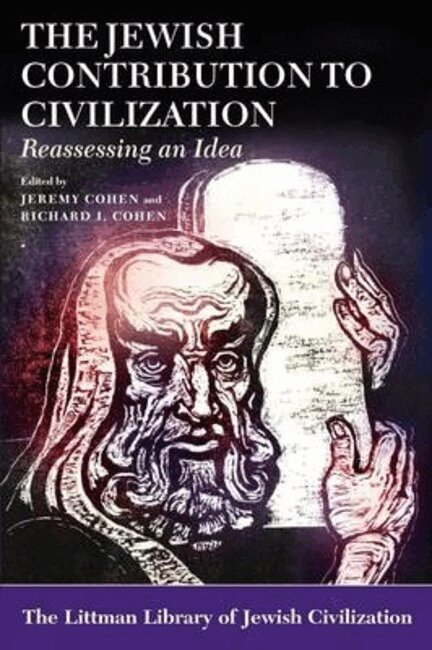
The biblicalidea of a distinct ‘Jewish contribution to civilization’ continues to engageJews and non-Jews alike. This book seeks neither to document nor to discreditthe notion, but rather to investigate the idea itself as it has been understoodfrom the seventeenth century to the present. It explores the role that theconcept has played in Jewish self-definition, how it has influenced thepolitical, social, and cultural history of the Jews and of others, and whetherdiscussion of the notion still has relevance in the world today.The bookoffers a broad spectrum of academic opinion: from tempered advocacy to reasoneddisavowal, with many variations on the theme in between. It attempts toillustrate the centrality of the question in modern Jewish culture in general,and its importance for modern Jewish studies in particular.Part Iaddresses the idea itself and considers its ramifications. Richard I. Cohenfocuses on the nexus between notions of ‘Jewish contribution’ and those of‘Jewish superiority’‚ David N. Myers shifts the focus from ‘contribution’ to‘civilization’, arguing that the latter term often served the interests ofJewish intellectuals far better, and Moshe Rosman shows how the currentemphasis on multiculturalism has given the idea of a ‘Jewish contribution’ newlife. Part II turns to the relationship between Judaism and other monotheisticcultures. Elliott Horowitz’s essay on the sabbath serves as an instructivetest-case for the dynamic and complexity of the ‘contribution’ debate and apointer to more general, theoretical issues. David Berger expands on these inhis account of how discussion of Christianity’s Jewish legacy developed in thelate nineteenth and twentieth centuries, and Susannah Heschel shows how theJewish–Christian encounter has influenced the study of other non-Western‘others’. Daniel Schroeter raises revealing questions about the altogetherEurocentric character of the ‘contribution’ discourse, which also bore heavilyon perceptions of Jews and Judaism in the world of Islam. Part III introducesus to various applications and consequences of the debate. Yaacov Shavit probesthe delicate balance forged by nineteenth-century German Jewish intellectualsin defining their identity. Mark Gelber moves the focus to the present andconsiders the post-war renewal of German Jewish culture and the birth ofGerman-Jewish studies in the context of the ‘contribution’ discourse. Bringingthe volume to its conclusion, David Biale compares three overviews of Jewishculture and civilization published in America in the twentieth andtwenty-first-centuries.
286 kr
Skickas inom 5-8 vardagar
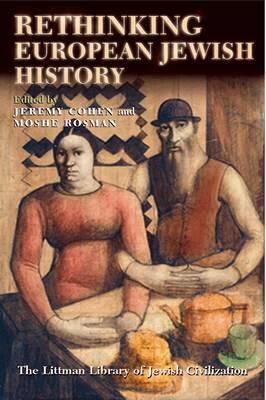
National Jewish Book Awards Winnerof the Anthologies and Collections Award, 2009.Europe has changed greatly in the last century.Political, social, and ideological transformations have not only redrawn themap of the continent but have rewoven the fabric of its culture. These changeshave nourished widespread reassessment in European historical research: interms of its presuppositions, its methodologies, its directions, its emphases,and its scope. The political boundaries between nations and states, along withthe very concepts of 'nation' and 'boundary', have changed significantly, andthe self-consciousness of ethnic minorities has likewise evolved in newdirections. All these developments have affected how the Jews of Europeperceive themselves, and they help to shape the prism through which historiansview the Jewish past.Thisvolume looks at the Jewish past in the spirit of this reassessment. Part Ireconsiders the basic parameters of the subject as well as some of itsfundamental concepts, suggesting new assumptions and perspectives from which toconduct future studies of European Jewish history. Topics covered here includeperiodization and the definition of geographical borders, antisemitism, genderand the history of Jewish women, and notions of assimilation. Part II isdevoted to articulating the meaning of 'modernity' in the historyof European Jewry and demarcating key stages in its crystallization.Contributors here reflect on the defining characteristics of a distinct earlymodern period in European Jewish history, the Reformation and the Jews, and thefundamental features of the Jewish experience in modern times.Parts III and IV present two scholarly conversations as case studies for theapplication of the critical and programmatic categories considered thus far:the complex web of relationships between Jews, Christians, and Jewish convertsto Christianity (Conversos, New Christians, Marranos) in fifteenth-centurySpain; and the impact of American Jewry on Jewish life in Europe in the twentiethcentury, at a time when the dominant trend was one of migration from Europe tothe Americas.Thistimely volume suggests a new framework for the study of Jewish history andhelps to contextualize it within the mainstream of historical scholarship.CONTRIBUTORS: Ram Ben-Shalom, Miriam Bodian, JeremyCohen, Judah M. Cohen, David Engel, Gershon David Hundert, Paula Hyman, MaudMandel, David Nirenberg, Moshe Rosman, David B. Ruderman, Daniel Soyer