Jiri Benovsky - Böcker
Visar alla böcker från författaren Jiri Benovsky. Handla med fri frakt och snabb leverans.
7 produkter
7 produkter
2 088 kr
Skickas inom 10-15 vardagar
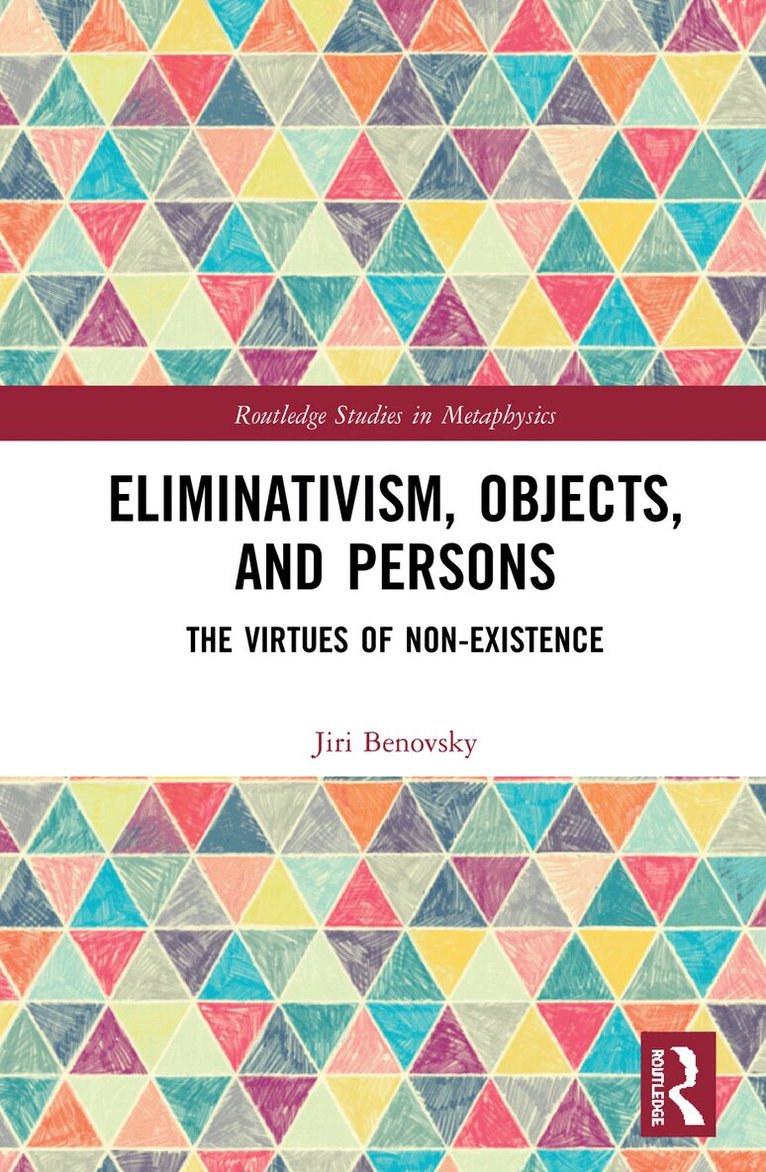
In Eliminativism, Objects, and Persons, Jiri Benovsky defends the view that he doesn't exist. In this book, he also defends the view that this book itself doesn't exist. But this did not prevent him to write the book, and although in Benovsky's view you don't exist either, this does not prevent you to read it. Benovsky defends a brand of non-exceptionalist eliminativism. Some eliminativists, typically focusing on ordinary material objects such as chairs and hammers, make exceptions, for instance for blue whales (that is, living beings) or for persons (that is, conscious organisms). Benovsky takes one by one all types of allegedly existing objects like chairs, whales, and persons and shows that from the metaphysical point of view they are more trouble than they are worth—we are much better off without them. He thus defends an eliminativist view about ordinary objects as well as the 'no-Self' view, where he explores connections between metaphysics, phenomenology, and Buddhist thought. He then also considers the case of aesthetic objects, focusing on musical works and photographs, and shows that the claim of their non-existence solves the many problems that arise when one tries to find an appropriate ontological category for them, and that such an eliminativist view is more natural than what we might have thought. The arguments provided here are always topic-specific: each type of entity is given its own type of treatment, thus proving a varied and solid foundation for a generalized, non-exceptionalist, full-blown eliminativist worldview.
630 kr
Skickas inom 10-15 vardagar
In Eliminativism, Objects, and Persons, Jiri Benovsky defends the view that he doesn't exist. In this book, he also defends the view that this book itself doesn't exist. But this did not prevent him to write the book, and although in Benovsky's view you don't exist either, this does not prevent you to read it.Benovsky defends a brand of non-exceptionalist eliminativism. Some eliminativists, typically focusing on ordinary material objects such as chairs and hammers, make exceptions, for instance for blue whales (that is, living beings) or for persons (that is, conscious organisms). Benovsky takes one by one all types of allegedly existing objects like chairs, whales, and persons and shows that from the metaphysical point of view they are more trouble than they are worth—we are much better off without them. He thus defends an eliminativist view about ordinary objects as well as the 'no-Self' view, where he explores connections between metaphysics, phenomenology, and Buddhist thought. He then also considers the case of aesthetic objects, focusing on musical works and photographs, and shows that the claim of their non-existence solves the many problems that arise when one tries to find an appropriate ontological category for them, and that such an eliminativist view is more natural than what we might have thought. The arguments provided here are always topic-specific: each type of entity is given its own type of treatment, thus proving a varied and solid foundation for a generalized, non-exceptionalist, full-blown eliminativist worldview.
641 kr
Skickas inom 10-15 vardagar
Panpsychism claims that mentality is ubiquitous to reality, and in combination with dual-aspect monism it claims that anything, from fundamental particles to rocks, trees, and human animals, has two aspects: a physical aspect and a mental aspect.
324 kr
Skickas inom 10-15 vardagar
Some of the limits discussed concern our senses (our different perceptual modalities), some concern vagueness and fuzzy boundaries between different types of works of art, some concern the amount of human intention and intervention in the process of creation of an artwork, and some concern the border between art and science.
1 703 kr
Skickas inom 5-8 vardagar
How do ordinary objects persist through time and across possible worlds? How do they manage to have their temporal and modal properties? These are the questions adressed in this book which is? "guided tour of theories of persistence". The book is divided in two parts. In the first, the two traditional accounts of persistence through time (endurantism and perdurantism) are combined with presentism and eternalism to yield four different views, and their variants. The resulting views are then examined in turn, in order to see which combinations are appealing and which are not. It is argued that the 'worm view' variant of eternalist perdurantism is superior to the other alternatives. In the second part of the book, the same strategy is applied to the combinations of views about persistence across possible worlds (trans-world identity, counterpart theory, modal perdurants) and views about the nature of worlds, mainly modal realism and abstractionism. Not only all the traditional and well-known views, but also some more original ones, are examined and their pros and cons are carefully weighted. Here again, it is argued that perdurance seems to be the best strategy available.
Meta-metaphysics
On Metaphysical Equivalence, Primitiveness, and Theory Choice
Inbunden, Engelska, 2016
536 kr
Skickas inom 10-15 vardagar
Metaphysical theories are beautiful. At the end of this book, Jiri Benovsky defends the view that metaphysical theories possess aesthetic properties and that these play a crucial role when it comes to theory evaluation and theory choice.Before we get there, the philosophical path the author proposes to follow starts with three discussions of metaphysical equivalence. Benovsky argues that there are cases of metaphysical equivalence, cases of partial metaphysical equivalence, as well as interesting cases of theories that are not equivalent. Thus, claims of metaphysical equivalence can only be raised locally. The slogan is: the best way to do meta-metaphysics is to do first-level metaphysics.To do this work, Benovsky focuses on the nature of primitives and on the role they play in each of the theories involved. He emphasizes the utmost importance of primitives in the construction of metaphysical theories and in the subsequent evaluation of them.He then raises the simple but complicated question: how to make a choice between competing metaphysical theories? If two theories are equivalent, then perhaps we do not need to make a choice. But what about all the other cases of non-equivalent "equally good" theories? Benovsky uses some of the theories discussed in the first part of the book as examples and examines some traditional meta-theoretical criteria for theory choice (various kinds of simplicity, compatibility with physics, compatibility with intuitions, explanatory power, internal consistency,...) only to show that they do not allow us to make a choice.But if the standard meta-theoretical criteria cannot help us in deciding between competing non-equivalent metaphysical theories, how then shall we make that choice? This is where Benovsky argues that metaphysical theories possess aesthetic properties – grounded in non-aesthetic properties – and that these play a crucial role in theory choice and evaluation. This view, as well as allthe meta-metaphysical considerations discussed throughout the book, then naturally lead the author to a form of anti-realism, and at the end of the journey he offers reasons to think better of the kind of anti-realist view he proposes to embrace.www.jiribenovsky.org
536 kr
Skickas inom 10-15 vardagar
Metaphysical theories are beautiful. At the end of this book, Jiri Benovsky defends the view that metaphysical theories possess aesthetic properties and that these play a crucial role when it comes to theory evaluation and theory choice.Before we get there, the philosophical path the author proposes to follow starts with three discussions of metaphysical equivalence. Benovsky argues that there are cases of metaphysical equivalence, cases of partial metaphysical equivalence, as well as interesting cases of theories that are not equivalent. Thus, claims of metaphysical equivalence can only be raised locally. The slogan is: the best way to do meta-metaphysics is to do first-level metaphysics.To do this work, Benovsky focuses on the nature of primitives and on the role they play in each of the theories involved. He emphasizes the utmost importance of primitives in the construction of metaphysical theories and in the subsequent evaluation of them.He then raises the simple but complicated question: how to make a choice between competing metaphysical theories? If two theories are equivalent, then perhaps we do not need to make a choice. But what about all the other cases of non-equivalent "equally good" theories? Benovsky uses some of the theories discussed in the first part of the book as examples and examines some traditional meta-theoretical criteria for theory choice (various kinds of simplicity, compatibility with physics, compatibility with intuitions, explanatory power, internal consistency,...) only to show that they do not allow us to make a choice.But if the standard meta-theoretical criteria cannot help us in deciding between competing non-equivalent metaphysical theories, how then shall we make that choice? This is where Benovsky argues that metaphysical theories possess aesthetic properties – grounded in non-aesthetic properties – and that these play a crucial role in theory choice and evaluation. This view, as well as allthe meta-metaphysical considerations discussed throughout the book, then naturally lead the author to a form of anti-realism, and at the end of the journey he offers reasons to think better of the kind of anti-realist view he proposes to embrace.www.jiribenovsky.org