Joao Pedro Quintais – författare
1 987 kr
Skickas inom 3-6 vardagar
1 752 kr
Läs direkt efter köp
In addition to proving virtually impossible, online enforcement of copyright may be undesirable because it risks encroaching upon fundamental rights and freedoms. However, the problem remains that creators are often not fairly remunerated for the online use of their works. This book addresses the urgent need to study pragmatic legal solutions that enable Internet users to access works in the digital environment, while assuring remuneration to rights holders and promoting the development of the information society.
This study examines legalisation schemes that favour remunerated access over exclusivity and enforcement for large-scale online use by individuals. It investigates whether and to what extent these schemes (referred to as alternative compensation systems) are admissible under EU copyright law and consistent with its objectives, responding to such questions as the following in depth:
- What existing copyright schemes provide an alternative to the exclusive right in copyright law?- What online rights apply to the activities of Internet users?- What types of models exist for the legalisation of online use of copyright works?- How can the public interest shape the scope of protection of copyright?- Can and should we legalise non-commercial file sharing and online use in EU copyright law?The book carefully examines these questions in light of EU primary law, relevant directives (with a focus on the InfoSoc Directive), case law (especially that of the CJEU), and legal literature in the field of copyright. The analysis culminates with a proposed blueprint for a compensated limitation for non-commercial individual use that is consistent with EU copyright law.
As a thoroughly researched and balanced response to the urgent need to rethink EU copyright law in light of its lack of social acceptance and technological adequacy, this book will be of inestimable value to lawyers, policymakers, and scholars in the field, as well as to interest groups involved in discussions for reform and modernisation of EU digital copyright law.
"1 752 kr
Läs direkt efter köp
In addition to proving virtually impossible, online enforcement of copyright may be undesirable because it risks encroaching upon fundamental rights and freedoms. However, the problem remains that creators are often not fairly remunerated for the online use of their works. This book addresses the urgent need to study pragmatic legal solutions that enable Internet users to access works in the digital environment, while assuring remuneration to rights holders and promoting the development of the information society.
This study examines legalisation schemes that favour remunerated access over exclusivity and enforcement for large-scale online use by individuals. It investigates whether and to what extent these schemes (referred to as alternative compensation systems) are admissible under EU copyright law and consistent with its objectives, responding to such questions as the following in depth:
- What existing copyright schemes provide an alternative to the exclusive right in copyright law?- What online rights apply to the activities of Internet users?- What types of models exist for the legalisation of online use of copyright works?- How can the public interest shape the scope of protection of copyright?- Can and should we legalise non-commercial file sharing and online use in EU copyright law?The book carefully examines these questions in light of EU primary law, relevant directives (with a focus on the InfoSoc Directive), case law (especially that of the CJEU), and legal literature in the field of copyright. The analysis culminates with a proposed blueprint for a compensated limitation for non-commercial individual use that is consistent with EU copyright law.
As a thoroughly researched and balanced response to the urgent need to rethink EU copyright law in light of its lack of social acceptance and technological adequacy, this book will be of inestimable value to lawyers, policymakers, and scholars in the field, as well as to interest groups involved in discussions for reform and modernisation of EU digital copyright law.
"2 886 kr
Läs direkt efter köp
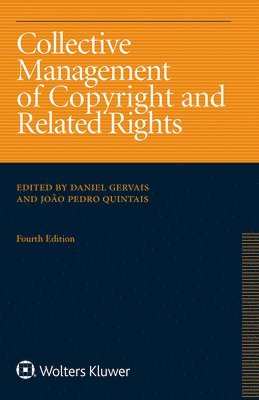
Over the past three decades, collective management organizations (CMOs) have become the nerve centres of copyright licensing in virtually every country. Their expertise and knowledge of copyright law and management have proven essential to making copyright work in the digital age. But they have also been at the centre of debates about their effectiveness, transparency and governance. This book provides an in-depth analysis of the various operational CMO models, their rights and obligations vis-à-vis authors, other right-holders and users, the acquisition of the legal authority to license and (most importantly) the rights to license digital uses of protected material, and the creation (or improvement) of information systems to deal with the increasingly complex tasks of rights management and licensing.
All chapters have been updated since the third (2015) edition and several new chapters have been added, including a new chapter on the economics of collective management and a chapter on limitation-based remuneration rights. Factors considered include the following:
cases where the unavailability of adequate licensing options makes authorized use of material protected by copyright or a related right difficult or impossible taking transaction costs into account;
the growing importance of extended repertoire systems and different forms of collective licensing with extended effect;
transnational and multi-territorial licensing;
the relationship among collective management, rights to remuneration, and the ways in which CMOs acquire authority to license;
the threat of monopolies or regional oligopolies for the management of online music rights;
the impact of new technologies on collective rights management and licensing; and
the role of ''families'' such as the International Confederation of Societies of Authors and Composers (CISAC) and the International Federation of Reproduction Rights Organizations (IFRRO).
The analysis covers the 1996 WIPO Copyright Treaties, the US Digital Millennium Copyright Act, the Santiago Agreement, relevant EU policy documents and legislative instruments – including the 2014 Collective Rights Management Directive and 2019 Copyright in the Digital Single Market Directive –and the work of the UN Committee on Economic, Social and Cultural Rights. Part I presents a number of horizontal issues that affect collective management in almost every country. Part II is organized geographically, focusing on systems that are representative of the main models used in different countries and regions. Each country- or region-specific chapter provides a historical overview and a description of existing CMOs and their activities, provides financial information where available, describes how CMOs are supervised or controlled by legislation, and offers reflections on the challenges facing CMOs in that country or region. Some of these national and regional commentaries are the only such sources of information available in English.
Whatever the future of copyright, it is clear that users will continue to want access and the ability to legally reuse material, and that authors and other rights holders will want to ensure that they can place some reasonable limits on those uses, including the ability to monetize commercially relevant uses. CMOs will certainly be critical intermediaries in this process. The fourth edition of this important resource, with its key insights into the changing nature of collective management, will be of immeasurable value to anyone involved in shaping collective management policy or dealing with the increasingly complex legal issues that arise in copyright matters in the digital age, and even more in the age of artificial intelligence and the training of large language models.
2 886 kr
Läs direkt efter köp
Over the past three decades, collective management organizations (CMOs) have become the nerve centres of copyright licensing in virtually every country. Their expertise and knowledge of copyright law and management have proven essential to making copyright work in the digital age. But they have also been at the centre of debates about their effectiveness, transparency and governance. This book provides an in-depth analysis of the various operational CMO models, their rights and obligations vis-à-vis authors, other right-holders and users, the acquisition of the legal authority to license and (most importantly) the rights to license digital uses of protected material, and the creation (or improvement) of information systems to deal with the increasingly complex tasks of rights management and licensing.
All chapters have been updated since the third (2015) edition and several new chapters have been added, including a new chapter on the economics of collective management and a chapter on limitation-based remuneration rights. Factors considered include the following:
cases where the unavailability of adequate licensing options makes authorized use of material protected by copyright or a related right difficult or impossible taking transaction costs into account;
the growing importance of extended repertoire systems and different forms of collective licensing with extended effect;
transnational and multi-territorial licensing;
the relationship among collective management, rights to remuneration, and the ways in which CMOs acquire authority to license;
the threat of monopolies or regional oligopolies for the management of online music rights;
the impact of new technologies on collective rights management and licensing; and
the role of ''families'' such as the International Confederation of Societies of Authors and Composers (CISAC) and the International Federation of Reproduction Rights Organizations (IFRRO).
The analysis covers the 1996 WIPO Copyright Treaties, the US Digital Millennium Copyright Act, the Santiago Agreement, relevant EU policy documents and legislative instruments – including the 2014 Collective Rights Management Directive and 2019 Copyright in the Digital Single Market Directive –and the work of the UN Committee on Economic, Social and Cultural Rights. Part I presents a number of horizontal issues that affect collective management in almost every country. Part II is organized geographically, focusing on systems that are representative of the main models used in different countries and regions. Each country- or region-specific chapter provides a historical overview and a description of existing CMOs and their activities, provides financial information where available, describes how CMOs are supervised or controlled by legislation, and offers reflections on the challenges facing CMOs in that country or region. Some of these national and regional commentaries are the only such sources of information available in English.
Whatever the future of copyright, it is clear that users will continue to want access and the ability to legally reuse material, and that authors and other rights holders will want to ensure that they can place some reasonable limits on those uses, including the ability to monetize commercially relevant uses. CMOs will certainly be critical intermediaries in this process. The fourth edition of this important resource, with its key insights into the changing nature of collective management, will be of immeasurable value to anyone involved in shaping collective management policy or dealing with the increasingly complex legal issues that arise in copyright matters in the digital age, and even more in the age of artificial intelligence and the training of large language models.
3 387 kr
Skickas inom 5-8 vardagar