Johann Gotschl – författare
Visar alla böcker från författaren Johann Gotschl. Handla med fri frakt och snabb leverans.
6 produkter
6 produkter
Inbunden, Engelska, 1992
868 kr
Skickas inom 10-15 vardagar
Erwin Schroedinger has been described as one of the greatest figures of theoretical physics, but there is another side to the man: not only did his work revolutionize physics, it also radically changed the foundations of our modern world-view, modern biology, philosophy of science, philosophy of the mind, and epistemology. This book explores the lesser-known aspects of Schroedinger's thought, revealing the physicist as a philosopher and polymath whose ideas anticipated the current merging of the natural and the social sciences and the humanities. 13 renowned scientists and philosophers have contributed to the volume. Part I reveals the philosophical importance of Schroedinger's work as a physicist. Part II examines his theory of life and of the self-organization of matter. Part III shows how Schroedinger's ideas have influenced contemporary philosophy of nature and our modern view of the world, drawing a picture of the ongoing synthesis of nature and culture.
Inbunden, Engelska, 1995
976 kr
Skickas inom 10-15 vardagar
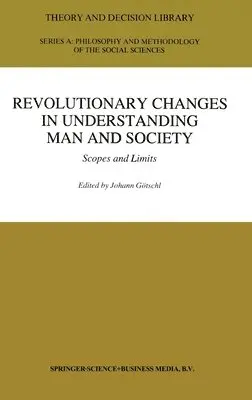
After the unification of physical theories in a grand unified theory, the theories of evolution began to unify not only all social sciences but also the natural with the social sciences. This text provides an analysis of the new trends which lead into the 21st century, together with a critique of the received view. Presented here are 16 papers, two of which written by Nobel laureates. The first part, "Characteristic Features in Economic Science", criticizes the present status of traditional economic theories. "Discovery, Creativity, Cognition, and Computation: Basic Structure", the second part, opens up perspectives for the role of the new dynamic structures for the modern social sciences and philosophy. Part III, "Towards a Science of Man and Society: Philosophical and Methodological Foundations", offers the philosophical consequences that are triggered by the breakthrough of modern ideas.
E-bok
PDF, Tyska, 2013570 kr
Läs direkt efter köp
Grundlagenfragen wissenschaftlicher Theorien zählen zu den "nicht leicht" beantwortbaren Problemen, bietet doch bereits ihre Formulierung ein Feld des Disputes, und gelangen erst recht die Lösungsvorschläge nur selten in den Rang generell akzeptierter Annahmen. Natürlich gibt es verschiedene Gründe und Gründe verschiedenen Gewichtes, warum Philosophen und Physiker gemeinsam versuchen, bestimmte Fragen zu behandeln. Und es ist nur zu bekannt, daß einige solcher Fragen eher von Physikern und einige eher von Philosophen gestellt werden, ohne daß man sich auf diesem Gebiet über klare Grenzen des wissenschaftlichen Kosmos einig wäre. Aber sicherlich werden einige Probleme von beiden "Seiten" aufgeworfen und dies nicht zuletzt und bisweilen in der Hoffnung, sie auch vereint am ehesten einer Lösung näher bringen zu können. Ob solche Hoffnung rational berechtigt ist, mag hier nicht untersucht werden. Obiichermaßen wird die Meinung akzeptiert, daß theoretische Probleme selbst auf metatheoretischer Ebene analysiert werden. Aber seit gewisse Elemente der kanoni schen Auffassung empirisch-wissenschaftlicher Theorien in zunehmendem Maße be zweifelt werden und entsprechend dem Prinzip ''ab esse ad posse valet iIIatio'' auch be zweifelt werden ''können'', fragt es sich, ob eine Charakterisierung des Verhältnisses von Theorie und Metatheorie angemessen ist, die den Objektbereich durch das Zweisprachen modell empirisch-theoretischer Begriffe abbildbar annimmt. Durch dieses Modell - ganz unabhängig von seinen verschiedenen Ausformungen und Deutungen - sollte ja der seman tische Bezug des Geltungsanspruches erfahrungswissenschaftlicher Theorien gesichert und transparent gemacht werden, der für die erklärten Hauptziele der Theorienbildun- nämlich Voraussage undErklärung von Ereignissen - bedeutsam ist.
E-bok
PDF, Engelska, 2012712 kr
Läs direkt efter köp
JOHANN GOTSCHL Over the last decades, social philosophers, economists. sociologists, utility and game theorists, biologists, mathematicians, moral philosophers and philosophers have created totally new concepts and methods of understanding the function and role of humans in their modern societies. The years between 1953 and 1990 brought drastic changes in the scientific foundations and dynamic of today''s society. A burst of entirely new, revolutionary ideas, similar to those which heralded the beginning of the twentieth century in physics, dominates the picture. This book also discusses the ongoing refutation of old concepts in the social sciences. Some of them are: the traditional concepts ofrationality, for example, based on maximization of interests, the linearity of axiomatic methods, methodological individualism, and the concept of a static society. Today the revolutionary change from a static view of our society to an evolutionary one reverberates through all social sciences and will dominate the twenty-first century. In an uncertain and risky world where cooperation and teamwork is getting more and more important, one cannot any longer call the maximization of one''s own expectations of utility or interests "rational" .
E-bok
PDF, Engelska, 20121 214 kr
Läs direkt efter köp
Erwin Schrödinger is one of the greatest figures of theoretical physics, but there is another side to the man: not only did his work revolutionize physics, it also radiacally changed the foundations of our modern worldview, modern biology, philosophy of science, philosophy of the mind, and epistemology. This book explores the lesser-known aspects of Schrödinger''s thought, revealing the physicist as a philosopher and polymath whose highly original ideas anticipated the current merging of the natural and the social sciences and the humanities. Thirteen renowned scientists and philosophers have contributed to the volume. Part I reveals the philosophical importance of Schrödinger''s work as a physicist. Part II examines his theory of life and of the self-organization of matter. Part III shows how Schrödinger''s ideas have influenced contemporary philosophy of nature and our modern view of the world, drawing a fascinating picture of the ongoing synthesis of nature and culture: one of the most interesting developments of modern thought. The volume also contains the most comprehensive bibliography of Schrödinger''s scientific work, making it at the same time a book of acute contemporary relevance and a major work of reference.
E-bok
PDF, Engelska, 20133 473 kr
Läs direkt efter köp
In a ground-breaking series of articles, one of them written by a Nobel Laureate, this volume demonstrates the evolutionary dynamic and the transformation of today''s democratic societies into scientific-democratic societies. It highlights the progress of modeling individual and societal evaluation by neo-Bayesian utility theory. It shows how social learning and collective opinion formation work, and how democracies cope with randomness caused by randomizers. Nonlinear `evolution equations'' and serial stochastic matrices of evolutionary game theory allow us to optimally compute possible serial evolutionary solutions of societal conflicts. But in democracies progress can be defined as any positive, gradual, innovative and creative change of culturally used, transmitted and stored mentifacts (models, theories), sociofacts (customs, opinions), artifacts and technifacts, within and across generations. The most important changes are caused, besides randomness, by conflict solutions and their realizations by citizens who follow democratic laws. These laws correspond to the extended Pareto principle, a supreme, socioethical democratic rule. According to this principle, progress is any increase in the individual and collective welfare which is achieved during any evolutionary progress. Central to evolutionary modeling is the criterion of the empirical realization of computed solutions. Applied to serial conflict solutions (decisions), evolutionary trajectories are formed; they become the most influential causal attractors of the channeling of societal evolution. Democratic constitutions, legal systems etc., store all advantageous, present and past, adaptive, competitive, cooperative and collective solutions and their rules; they have been accepted by majority votes. Societal laws are codes of statutes (default or statistical rules), and they serve to optimally solve societal conflicts, in analogy to game theoretical models or to statistical decision theory. Such solutions become necessary when we face harmful or advantageous random events always lurking at the edge of societal and external chaos. The evolutionary theory of societal evolution in democracies presents a new type of stochastic theory; it is based on default rules and stresses realization. The rules represent the change of our democracies into information, science and technology-based societies; they will revolutionize social sciences, especially economics. Their methods have already found their way into neural brain physiology and research into intelligence. In this book, neural activity and the creativity of human thinking are no longer regarded as linear-deductive. Only evolutive nonlinear thinking can include multiple causal choices by many individuals and the risks of internal and external randomness; this serves the increasing welfare of all individuals and society as a whole. Evolution and Progress in Democracies is relevant for social scientists, economists, evolution theorists, statisticians, philosophers, philosophers of science, and interdisciplinary researchers.