Johann Kirchinger – författare
Visar alla böcker från författaren Johann Kirchinger. Handla med fri frakt och snabb leverans.
4 produkter
4 produkter
E-bok
PDF, Tyska, 2022317 kr
Läs direkt efter köp
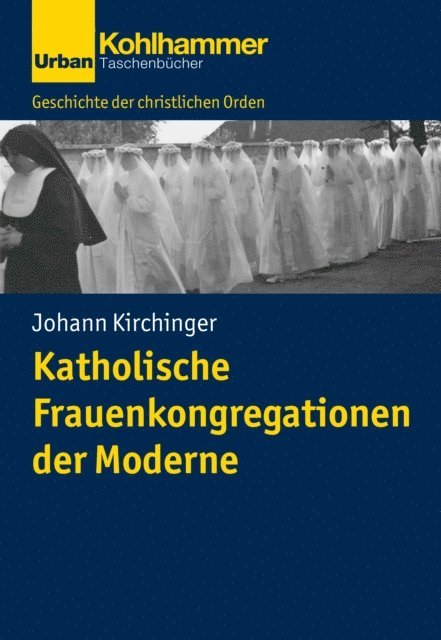
Female religious communities are among the formative phenomena for Catholicism in modern times. They represent a form of common life which, in contrast to the contemplative orders, allows members to engage in charitable and educational activities. Female religious communities had an emancipatory effect by accelerating the professionalization of their work. At the same time, however, this led to the feminization of these activities, one consequence of which was low pay. Johann Kirchinger convincingly attributes these developments to a quantitative expansion that can only be understood against the background of the strong cultural, economic, and religious divide between the cities (the site of action for the religious communities) and rural areas (as their recruiting base) that prevailed especially between 1850 and 1950.

Inbunden, Tyska, 2022
1 143 kr
Skickas inom 3-6 vardagar
For Catholics in the 19th century the human scope for action expanded considerably compared to the divine. At first, a divine disposition of grace prevailed, which offered few opportunities for action corresponding to little pressure to act and few opportunities for participation. Increasing social pressure to act and increasing opportunities for participation led to a demomaniac disposition for exorcism, which was characterized by an agonistic approach to the world. Therefore, the Catholic social-ethical designs did not aim at social security, but at the transformation of one kind of insecurity into another, namely from unpredictable danger to calculable risk. The religious-historical study analyzes the contemporary Catholic discourses and shows how a normalizing set of rules developed during the dominance of Ultramontanism, in which the human being, who was subject to the laws of nature, emancipated himself from transcendent powers.
Inbunden, Tyska, 2025
919 kr
Skickas inom 3-6 vardagar
E-bok
PDF, Tyska, 2022989 kr
Läs direkt efter köp
Für Katholiken erweiterte sich der menschliche Handlungsspielraum im 19. Jahrhundert gegenüber dem göttlichen beträchtlich. Zunächst herrschte ein göttliches Gnadendispositiv vor, das entsprechend eines geringen Handlungsdrucks und geringer Partizipationsmöglichkeiten geringe Handlungsmöglichkeiten bot. Steigender sozialer Handlungsdruck und steigende Partizipationsmöglichkeiten führten zu einem dämonomanischen Exorzismusdispositiv, das von einer agonalen Zuwendung zur Welt geprägt war. Deshalb zielten die katholischen sozialethischen Entwürfe nicht auf soziale Sicherheit, sondern auf die Transformation einer Art von Unsicherheit in eine andere, und zwar von unberechenbarer Gefahr in berechenbares Risiko. Die religionsgeschichtliche Studie analysiert die zeitgenössischen katholischen Diskurse und zeigt, wie sich noch während der Vorherrschaft des Ultramontanismus ein normalisierendes Regeldispositiv entwickelte, in dem sich der den Naturgesetzen unterworfene Mensch gegenüber transzendenten Mächten emanzipierte.