John Clayton Thomas - Böcker
Visar alla böcker från författaren John Clayton Thomas. Handla med fri frakt och snabb leverans.
5 produkter
5 produkter
644 kr
Skickas inom 10-15 vardagar
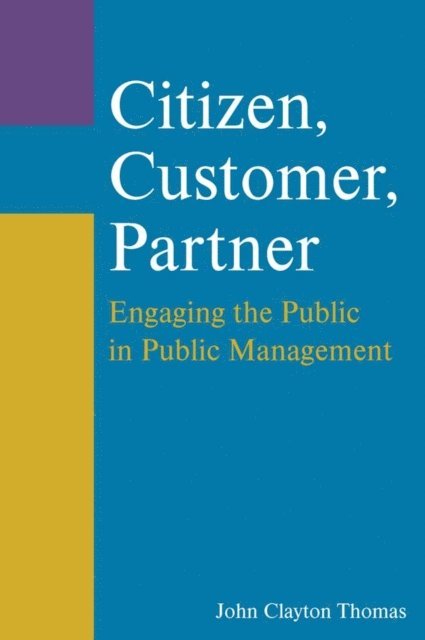
For almost a half a century, scholars and practitioners have debated what the connections should be between public administration and the public. Does the public serve principally as citizen-owners, those to whom administrators are responsible? Are members of the public more appropriately viewed as the customers of government? Or, in an increasingly networked world, do they serve more as the partners of public administrators in the production of public services?This book starts from the premise that the public comes to government not principally in one role but in all three roles, as citizens and customers and partners. The purpose of the book is to address the dual challenge that reality implies: (1) to help public administrators and other public officials to understand the complex nature of the public they face, and (2) to provide recommendations for how public administrators can most effectively interact with the public in the different roles. Using this comprehensive perspective, Citizen, Customer, Partner helps students, practitioners, and scholars understand when and how the public should be integrated into the practice of public administration.Most chapters in Citizen, Customer, Partner include multiple boxed cases that illustrate the chapter’s content with real-world examples. The book concludes with an extremely useful Appendix that collects and summarizes the 40 Design Principles – specific advice for public organizations on working with the public as customers, partners, and citizens.
363 kr
Tillfälligt slut
This book is designed to describe the special tasks, talents, and tools for leading in the pursuit of the public good, especially but not exclusively in the public sector. Despite a glut of books on leadership, no other book to date has attempted to speak to the specific challenges and strategies for leadership that focuses on improving the lot of society as a whole.Leading for the Common Good is designed for current and prospective managers whose work focuses at least in part on creating public value, that is, on improving society as a whole. Many of those managers work in the public sector, but many also work in the nonprofit sector or in parts of the private sector with a particular interest in public goods (e.g., environmental planning, private education). Many of these managers will work in all of these sectors over the course of their careers, always with a concern for how their efforts contribute to the larger community.This book will explore the distinctive nature of public service leadership with an eye toward serving at least two purposes: (1) to develop a better understanding of the nature of public service leadership, including when and where it is desirable, and (2) to assist practicing and potential public service leaders in carrying out their leadership roles.The book will include occasional boxed profiles of specific managers who have excelled in the pursuit of public value. These profiles will be used both to illustrate points from specific chapters and to demonstrate the difference that committed managers can make.The principal markets for the book are likely to be (1) master’s students in public administration or public policy, (2) advanced undergraduates in public policy, public administration, etc., and (3) practicing public administrators.
Public Participation in Public Decisions
New Skills and Strategies for Public Managers
Inbunden, Engelska, 1995
625 kr
Skickas inom 5-8 vardagar
This straightforward and practical guide outlines a strategic approach to public involvement in government decision making. Prepares public managers for the difficult task of involving citizens more fully in the affairs of government while maintaining effectiveness and efficiency. Written in easy-to-understand terms, Public Participation in Public Decisions presents the Effective Decision Model of Public Involvement that managers will find to be an invaluable asset when making decisions about when and how to involve the public.
1 738 kr
Skickas inom 3-6 vardagar
Big City Politics in Transition is a good reference volume packed with much important and up-to-date information. --Environment and Planning "A timely book that revisits the field so well described by Edward Banfield (Big City Politics, 1965) as of the early 1960s but which has changed greatly since then. . . . Each profile shows a high level of research, and the notes provide a thorough bibliography of the literature. A tremendously useful book for readers at all levels." --Choice "This book was inspired by Edward Banfield's Big City Politics of 1965. [In Big City Politics in Transition] the introduction amply justifies the need for a new volume. . . . This multiauthored volume examines thirteen cities: Boston, Philadelphia, Chicago, Detroit, Saint Louis, Atlanta, Miami, New Orleans, Denver, Houston, Los Angeles, San Francisco, and Seattle. Each chapter traces the economic, social, and political changes since 1965 and current political problems. . . . It is impossible to do justice to all thirteen studies in a short review but this book represents a very useful summation of the current state of the major US cities." --Environment and Planning C In 1965 Big City Politics ambitiously attempted to describe the workings of America's big cities, using nine large U.S. cities as examples. By the time it was published, urban racial conflict, declining economic power, and growing concentrations of low-income populations had changed the face of the urban political scene. Big City Politics in Transition examines how government and administration in America's largest cities have changed between 1960 and 1990. The contributors to this intriguing volume trace demographic and economic change over this vital and, at times, turbulent period, explaining what those changes mean for politics, policies, and the general quality of life. The chapters address the demographics and economic base of the cities under consideration, the role and structure of city government, including interaction with state houses, suburbs and Washington, DC, and the roles played by interest groups and political influentials. The cities profiled include: Boston, Philadelphia, Chicago, Detroit, St. Louis, Atlanta, Miami, New Orleans, Denver, Houston, Los Angeles, San Francisco, and Seattle. Underlying these concerns is an examination of the political character of the city, (the composition and cohesion of the coalitions, groups, organizations, and individual actors that shape major decisions). A balanced and insightful look at urban politics in the late 20th century, this volume will enlighten academics and professionals in urban studies, policy studies, and political science.
2 088 kr
Skickas inom 10-15 vardagar
For almost a half a century, scholars and practitioners have debated what the connections should be between public administration and the public. Does the public serve principally as citizen-owners, those to whom administrators are responsible? Are members of the public more appropriately viewed as the customers of government? Or, in an increasingly networked world, do they serve more as the partners of public administrators in the production of public services?This book starts from the premise that the public comes to government not principally in one role but in all three roles, as citizens and customers and partners. The purpose of the book is to address the dual challenge that reality implies: (1) to help public administrators and other public officials to understand the complex nature of the public they face, and (2) to provide recommendations for how public administrators can most effectively interact with the public in the different roles. Using this comprehensive perspective, Citizen, Customer, Partner helps students, practitioners, and scholars understand when and how the public should be integrated into the practice of public administration.Most chapters in Citizen, Customer, Partner include multiple boxed cases that illustrate the chapter’s content with real-world examples. The book concludes with an extremely useful Appendix that collects and summarizes the 40 Design Principles – specific advice for public organizations on working with the public as customers, partners, and citizens.