John F Crosby - Böcker
Visar alla böcker från författaren John F Crosby. Handla med fri frakt och snabb leverans.
9 produkter
9 produkter
125 kr
Skickas inom 5-8 vardagar
259 kr
Skickas inom 10-15 vardagar
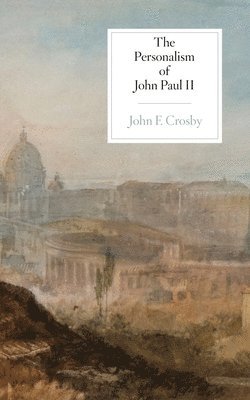
This study attempts to explain the mystery of personal individuality or uniqueness. It sheds light on the ""incommunicability"" and unrepeatability of each human person and their ""transcendence"", giving particular attention to the transcendence achieved by persons in moral existence.
366 kr
Skickas inom 10-15 vardagar
This work explores the unrepeatability of persons, drawing out the worth and dignity of each individual person. It also explores interpersonal relation, giving an account of how persons can achieve empathic understanding of others, and where the limit of empathy is reached.
366 kr
Skickas inom 10-15 vardagar
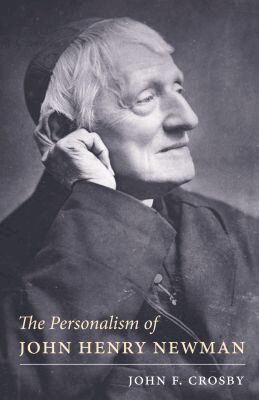
It has been said that John Henry Newman ""stands at the threshold of the new age as a Christian Socrates, the pioneer of a new philosophy of the individual Person and Personal Life."" Newman's personalism is found in the way he contrasts the ""theological intellect"" and the ""religious imagination."" Newman pleads for the latter when he famously says, in words that John F. Crosby takes as the motto of his book, ""I am far from denying the real force of the arguments in proof of a God...but these do not warm me or enlighten me; they do not take away the winter of my desolation, or make the buds unfold and the leaves grow within me, and my moral being rejoice.""In The Personalism of John Henry Newman, Crosby shows the reader how Newman finds the life-giving religious knowledge that he seeks. He explores the ""heart"" in Newman and explains what Newman was saying when he chose as his cardinal's motto, cor ad cor loquitur (heart speaks to heart). He explains what Newman means in saying that religious truth is transmitted not by argument but by ""personal influence.""Crosby also examines Newman's personalist account of what it is to think; he explains what it is for a person to think not just by rule but by his ""spontaneous living intelligence."" Crosby examines the subjectivity of Newman, and shows how the modern ""turn to the subject"" is enacted in Newman. But these personalist aspects of Newman's mind, which connect him with many streams of contemporary thought, are not the whole of Newman; they stand in relation to something else in Newman, something that Crosby calls Newman's radically theocentric religion.Newman is a modern thinker, but not the modernist he is sometimes mistaken for. The inexhaustible plenitude of Newman derives from the union of apparent opposites in him: the union of his teaching on the heart with his theocentric teaching, of the subjectivity of experience with the objectivity of revealed truth.Crosby writes for a broad non-specialist public just as Newman did.
When One Wants Out And The Other Doesn't
Doing Therapy With Polarized Couples
Inbunden, Engelska, 1989
925 kr
Skickas inom 10-15 vardagar
For anyone who practices marriage and family therapy the author says they have one kind of client population that seems to be a modal or predominating type. For three decades he has experienced more marital situations where one of the couple wants “out” of the marriage and the other wants to “stay in” than any other type. The idea for this collection of first-person therapy methodologies developed after two successive national meetings of the American Association for Marriage and Family Therapy (AAMFT), in New York (1985) and Orlando (1986). The cases that were discussed were characterized by the presence of alcoholism, and drug and other addictions, rather than presentations that dealt with a polarized couple wherein the marriage had simply become a devitalized, ho-hum relationship. This volume seeks to address the balance.
650 kr
Skickas inom 10-15 vardagar
For anyone who practices marriage and family therapy the author says they have one kind of client population that seems to be a modal or predominating type. For three decades he has experienced more marital situations where one of the couple wants “out” of the marriage and the other wants to “stay in” than any other type. The idea for this collection of first-person therapy methodologies developed after two successive national meetings of the American Association for Marriage and Family Therapy (AAMFT), in New York (1985) and Orlando (1986). The cases that were discussed were characterized by the presence of alcoholism, and drug and other addictions, rather than presentations that dealt with a polarized couple wherein the marriage had simply become a devitalized, ho-hum relationship. This volume seeks to address the balance.
164 kr
Skickas inom 7-10 vardagar
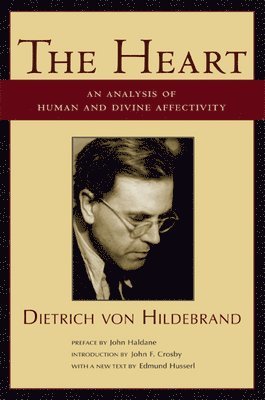
This new edition of The Heart (out of print for nearly 30 years) is the flagship volume in a series of Dietrich von Hildebrand’s works to be published by St. Augustine’s Press in collaboration with the Dietrich von Hildebrand Legacy Project. Founded in 2004, the Legacy Project exists in the first place to translate the many German writings of von Hildebrand into English.While many revere von Hildebrand as a religious author, few realize that he was a philosopher of great stature and importance. Those who knew von Hildebrand as philosopher held him in the highest esteem. Louis Bouyer, for example, once said that “von Hildebrand was the most important Catholic philosopher in Europe between the two world wars.” Joseph Cardinal Ratzinger expressed even greater esteem when he said: “I am personally convinced that, when, at some time in the future, the intellectual history of the Catholic Church in the twentieth century is written, the name of Dietrich von Hildebrand will be most prominent among the figures of our time.”The Heart is an accessible yet important philosophical contribution to the understanding of the human person. In this work von Hildebrand is concerned with rehabilitating the affective life of the human person. He thinks that for too long philosophers have held it in suspicion and thought of it as embedded in the body and hence as being much inferior to intellect and will. In reality, he argues, the heart, the center of affectivity, has many different levels, including an eminently personal level; at this level affectivity is just as important a form of personal life as intellect and will. Von Hildebrand develops the idea that properly personal affectivity, far than tending away from an objective relation to being, is in fact one major way in which we transcend ourselves and give being its due. Von Hildebrand also developed the important idea that the heart “in many respects is more the real self of the person than his intellect or will.”At the same time, the author shows full realism about the possible deformities of affective life; he offers rich analyses of what he calls affective atrophy and affective hypertrophy. The second half of The Heart offers a remarkable analysis of the affectivity of the God-Man.
109 kr
Skickas inom 7-10 vardagar
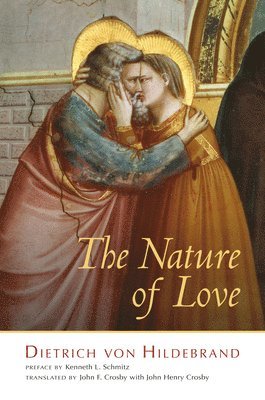
From Plato and Aristotle and on to the present, many great philosophers have dealt with the nature of love, which is the most central and profound act of the person. Particularly the philosophy of the twentieth century excelled in this regard, most often inspired by the methods of essential (eidetic) analysis developed and practiced by phenomenology, particularly by realist phenomenology as represented by Max Scheler, by Dietrich von Hildebrand, whose masterwork, The Nature of Love (St. Augustine’s Press, 2009), was recently published in an excellent English translation, and by Karol Wojtyìa in his profound analysis of love in Love and Responsibility and in Man and Woman He Created Them: A Theology of the Body (1987 in Italian, 2006 in a recent translation). One of the key topics of a philosophy of love regards the question whether love is a self-centered act in the service of what Aristotle and Thomas Aquinas regarded as the supreme goal of human life, happiness, to which the beloved person and love would be means, or whether true love is verily an other-centered and other-directed act motivated by the intrinsic value of a person, such that love can truly be called a “value response” – a response to the beloved person for her own sake. According to this last understanding of true love defended in the present work, any hedonistic interpretation of love as springing from a mere desire for pleasure, and also any eudemonistic interpretation of love according to which love would be a mere means to true self-fulfillment and happiness, turn out to be serious misunderstandings of true love. Instead, happiness, however ardently desired by man, is a superabundant fruit of a true love that first turns to the beloved person for her own sake (propter seipsam), and only through a sincere self-donation can reach authentic happiness. The book answers many objections that have been and could be raised against this central thesis about the self-giving and value responding gesture of true love, for example some profound objections raised by Nygren and by Josef Pieper. The book shows the multiple and complex mysterious root of that value and intrinsic goodness of the person that motivates love. He shows that the genuinely self-transcending and self-sacrificing gesture of love is fully compatible with a motivating role, but only with a subordinated and co-motivating role, of happiness in love, while happiness always remains principally and primarily a fruit of true love and self-donation, rather than its motive.
196 kr
Skickas inom 7-10 vardagar
This book presents a correspondence between two friends who disagree about how to answer the question, “What does it mean to be a Christian?” Crosby argues that Christians understand themselves as hearing a definitive word of revelation spoken by God and intended for all human beings. But Betty sees Christianity as one of several options, usually the preferred way for those born in the faith, but no more unique or special than Hinduism or Buddhism. It is a debate over the kind of initiative the Christian God takes, or does not take, toward human beings. Throughout the debate Crosby alleges that Betty’s God is a very finite god, an all-too-human god, and for that very reason is something different from the God venerated by Christians, while Betty maintains that his theism remains within the Christian orbit and is a much needed corrective to a religion with exclusivist tendencies.The debate between the two friends is presented here in the form of a correspondence they conducted over a period of two years (and did not originally intend for publication). It has undergone very little editing and revision; the authors have wanted to preserve the spontaneous give and take of their exchange. Together they have produced a work of philosophical dialogue that is unusually fruitful in its ability to clarify some fundamental issues of religion.