John F. Kihlstrom - Böcker
Visar alla böcker från författaren John F. Kihlstrom. Handla med fri frakt och snabb leverans.
4 produkter
4 produkter
1 352 kr
Skickas inom 5-8 vardagar
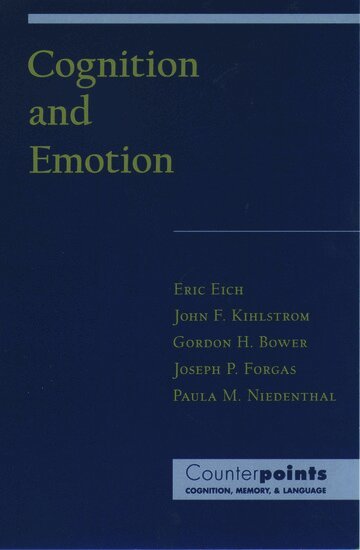
Recent years have witnessed a revival of research in the interplay between cognition and emotion. The reasons for this renaissance are many and varied. In the first place, emotion theorists have come to recognise the pivotal role of cognitive factors in virtually all aspects of the emotion process, and to rely on basic cognitive factors insight in creating new models of affective space. Also, the successful application of cognitive therapies to affective disorders has promoted clinical psychologists to work towards a clearer understanding of the connections between cognitive processes and emotional problems. And whereas the cognitive revolutionaries of the 1960s regarded emotions with suspicion, viewing them as nagging sources of 'hot' noise in an otherwise cool, rational, and computer-like system of information processing, cognitive researchers of the 1990s regard emotions with respect, owing to their potent and predictable effects on tasks as diverse as object perception, episodic recall, and risk assessment. These intersecting lines of interest have made cognition and emotion one of the most active and rapidly developing areas within psychological science.
497 kr
Skickas inom 5-8 vardagar
Recent years have witnessed a revival of research in the interplay between cognition and emotion. The reasons for this renaissance are many and varied. In the first place, emotion theorists have come to recognise the pivotal role of cognitive factors in virtually all aspects of the emotion process, and to rely on basic cognitive factors insight in creating new models of affective space. Also, the successful application of cognitive therapies to affective disorders has promoted clinical psychologists to work towards a clearer understanding of the connections between cognitive processes and emotional problems. And whereas the cognitive revolutionaries of the 1960s regarded emotions with suspicion, viewing them as nagging sources of 'hot' noise in an otherwise cool, rational, and computer-like system of information processing, cognitive researchers of the 1990s regard emotions with respect, owing to their potent and predictable effects on tasks as diverse as object perception, episodic recall, and risk assessment. These intersecting lines of interest have made cognition and emotion one of the most active and rapidly developing areas within psychological science.
1 324 kr
Skickas inom 10-15 vardagar
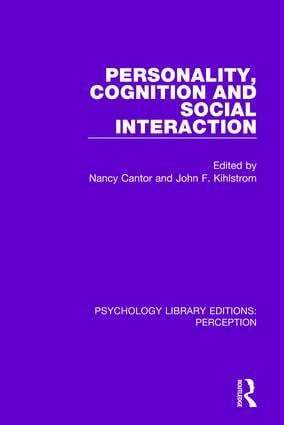
Originally published in 1981, this volume presents the domain of personality as a fuzzy set that includes features previously identified with cognitive and social psychology. Few of the individual contributions are centrally concerned with individual differences and cross-situational stability, but these traditional themes certainly appear in several of the chapters. The remaining chapters deal with the general processes mediating the interaction between the person and the social environment, filling out the fuzzy set of personality psychology.Part 1 seeks to locate contemporary trends in the cognitive psychology of personality against a backdrop of historical events. The chapters in Part 2 discuss some of the cognitive processes mediating social behaviour. Part 3 contains contributions concerned with the rules by which people make judgments about objects in the social world. The self, a dominant topic in personality theory and research, is treated extensively in Part 4. Although many of the chapters are explicitly concerned with the relations between cognition and action – after all, most human interaction takes the form of judgments and communication – the contributions in Part 5 make the links to overt behaviour. Finally, Part 6 offers two discussions of the previous contributions from the perspective of cognitive psychology.
362 kr
Skickas inom 10-15 vardagar
Originally published in 1981, this volume presents the domain of personality as a fuzzy set that includes features previously identified with cognitive and social psychology. Few of the individual contributions are centrally concerned with individual differences and cross-situational stability, but these traditional themes certainly appear in several of the chapters. The remaining chapters deal with the general processes mediating the interaction between the person and the social environment, filling out the fuzzy set of personality psychology.Part 1 seeks to locate contemporary trends in the cognitive psychology of personality against a backdrop of historical events. The chapters in Part 2 discuss some of the cognitive processes mediating social behaviour. Part 3 contains contributions concerned with the rules by which people make judgments about objects in the social world. The self, a dominant topic in personality theory and research, is treated extensively in Part 4. Although many of the chapters are explicitly concerned with the relations between cognition and action – after all, most human interaction takes the form of judgments and communication – the contributions in Part 5 make the links to overt behaviour. Finally, Part 6 offers two discussions of the previous contributions from the perspective of cognitive psychology.