John Frederick Bailyn - Böcker
Visar alla böcker från författaren John Frederick Bailyn. Handla med fri frakt och snabb leverans.
4 produkter
4 produkter
1 553 kr
Skickas inom 7-10 vardagar
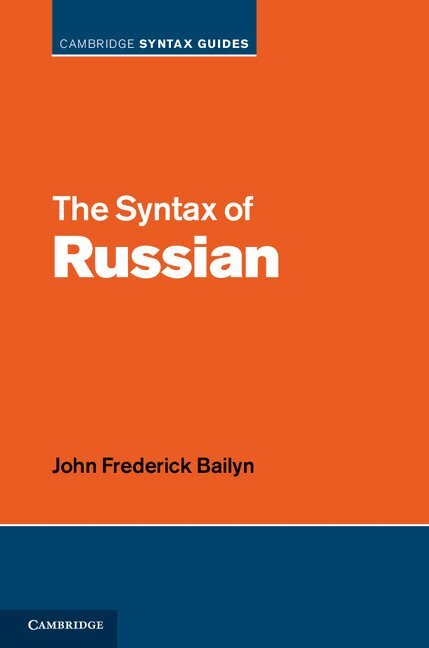
The study of Russian is of great importance to syntactic theory, due in particular to its unusual case system and its complex word order patterns. This book provides an essential guide to Russian syntax and examines the major syntactic structures of the language. It begins with an overview of verbal and nominal constituents, followed by major clause types, including null-copular and impersonal sentences, WH-questions and their distribution, and relative and subordinate clauses. The syntax behind the rich Russian morphological case system is then described in detail, with focus on both the fairly standard instances of Nominative, Accusative and Dative case as well as the important language-specific uses of the Genitive and Instrumental cases. The book goes on to analyze the syntax of 'free' word order for which Russian is famous. It will be of interest to researchers and students of syntactic theory, of Slavic linguistics and of language typology.
523 kr
Skickas inom 7-10 vardagar
The study of Russian is of great importance to syntactic theory, due in particular to its unusual case system and its complex word order patterns. This book provides an essential guide to Russian syntax and examines the major syntactic structures of the language. It begins with an overview of verbal and nominal constituents, followed by major clause types, including null-copular and impersonal sentences, WH-questions and their distribution, and relative and subordinate clauses. The syntax behind the rich Russian morphological case system is then described in detail, with focus on both the fairly standard instances of Nominative, Accusative and Dative case as well as the important language-specific uses of the Genitive and Instrumental cases. The book goes on to analyze the syntax of 'free' word order for which Russian is famous. It will be of interest to researchers and students of syntactic theory, of Slavic linguistics and of language typology.
583 kr
Skickas inom 3-6 vardagar
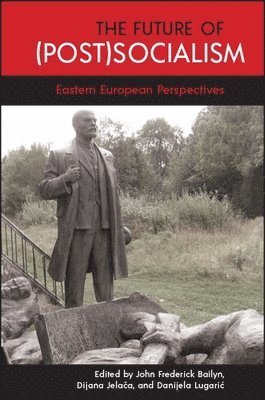
Explores the current and future trajectories of the paradigm of postsocialism.If socialism did not end as abruptly as is sometimes perceived, what remnants of it linger today and will continue to linger? Moreover, if postsocialism is an umbrella term for the uncertain times of various transitions that followed in socialism's wake, how might the "post" be rendered complicated by the notion that the unfinished business of socialism continues to influence the trajectory of the future? The Future of (Post)Socialism examines this unfinished business through various disciplinary and transdisciplinary approaches that seek to illuminate the postsocialist future as a cultural and social fact. Drawn from the fields of history, ethnology, anthropology, sociology, economics, political science, education, linguistics, literature, and cultural studies, contributors analyze various cultural forms and practices of the formerly socialist cultural spaces of Eastern Europe. In so doing, they question the teleology of linear transitional narratives and of assumptions about postsocialist linear progress, concluding that things operate more as continued interruptions of a perpetually liminal state rather than as neat endings and new beginnings.
1 172 kr
Skickas inom 5-8 vardagar
Explores the current and future trajectories of the paradigm of postsocialism.If socialism did not end as abruptly as is sometimes perceived, what remnants of it linger today and will continue to linger? Moreover, if postsocialism is an umbrella term for the uncertain times of various transitions that followed in socialism's wake, how might the "post" be rendered complicated by the notion that the unfinished business of socialism continues to influence the trajectory of the future? The Future of (Post)Socialism examines this unfinished business through various disciplinary and transdisciplinary approaches that seek to illuminate the postsocialist future as a cultural and social fact. Drawn from the fields of history, ethnology, anthropology, sociology, economics, political science, education, linguistics, literature, and cultural studies, contributors analyze various cultural forms and practices of the formerly socialist cultural spaces of Eastern Europe. In so doing, they question the teleology of linear transitional narratives and of assumptions about postsocialist linear progress, concluding that things operate more as continued interruptions of a perpetually liminal state rather than as neat endings and new beginnings.