John Haiman - Böcker
Visar alla böcker från författaren John Haiman. Handla med fri frakt och snabb leverans.
8 produkter
8 produkter
1 252 kr
Skickas inom 5-8 vardagar
Putting aside questions of truth and falsehood, the old 'talk is cheap' maxim carries as much weight as ever. Indeed, perhaps more. For one need not be an expert in irony or sarcasm to realize that people don't necessarily mean what they say. Phrases such as 'Yeah, right' and 'I could care less' are so much a part of the way we speak - and the way we live - that we are more likely to notice when they are absent (for example, Forrest Gump). From our everyday dialogues and conversations ('Thanks a lot!') to the screenplays of our popular films (Pulp Fiction), what is said is frequently very different from what is meant. Talk is Cheap begins with this telling observation and proceeds to argue that such 'unplain speaking' is fundamentally embedded in the way we now talk. Author John Haiman traces this sea-change in our use of language to the emergence of a postmodern 'divided self' who is hyper-conscious that what he or she is saying has been said before; 'cheap talk' thus allows us to distance ourselves from a social role with which we are uncomfortable. Haiman goes on to examine the full range of these pervasive distancing mechanisms, from clichés and quotation marks to camp and parody. Also, and importantly, Haiman highlights several ways in which language is evolving (and has evolved) from non-linguistic behaviour. In other words, this study shows us how what we are saying is continually separating itself from how we say it. As provocative as it is timely, the book will be fascinating reading for students of linguistics, literature, communication, anthropology, philosophy, and popular culture.
518 kr
Skickas inom 5-8 vardagar
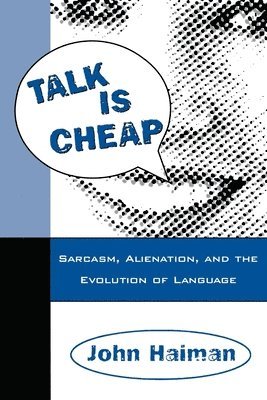
Putting aside questions of truth and falsehood, the old 'talk is cheap' maxim carries as much weight as ever. Indeed, perhaps more. For one need not be an expert in irony or sarcasm to realize that people don't necessarily mean what they say. Phrases such as 'Yeah, right' and 'I could care less' are so much a part of the way we speak - and the way we live - that we are more likely to notice when they are absent (for example, Forrest Gump). From our everyday dialogues and conversations ('Thanks a lot!') to the screenplays of our popular films (Pulp Fiction), what is said is frequently very different from what is meant.Talk is Cheap begins with this telling observation and proceeds to argue that such 'unplain speaking' is fundamentally embedded in the way we now talk. Author John Haiman traces this sea-change in our use of language to the emergence of a postmodern 'divided self' who is hyper-conscious that what he or she is saying has been said before; 'cheap talk' thus allows us to distance ourselves from a social role with which we are uncomfortable. Haiman goes on to examine the full range of these pervasive distancing mechanisms, from clichés and quotation marks to camp and parody. Also, and importantly, Haiman highlights several ways in which language is evolving (and has evolved) from non-linguistic behaviour. In other words, this study shows us how what we are saying is continually separating itself from how we say it.As provocative as it is timely, the book will be fascinating reading for students of linguistics, literature, communication, anthropology, philosophy, and popular culture.
2 220 kr
Skickas inom 10-15 vardagar
The Rhaeto-Romance languages have been known as such to the linguistic community since the pioneering studies of Ascoli and Gartner over a century ago. There has never been a community of RR speakers based on a common history or polity and the various dialects are mutually unintelligible, but a unity, based on a number of common features, has been advanced.This book is the first general description of the Rhaeto-Romance languages to be written in English. It provides a critical examination of the phonology, morphology, lexicon, and syntax of the modern Rhaeto-Romance dialects within the broader perspective of Romance comparative linguistics.
563 kr
Skickas inom 7-10 vardagar
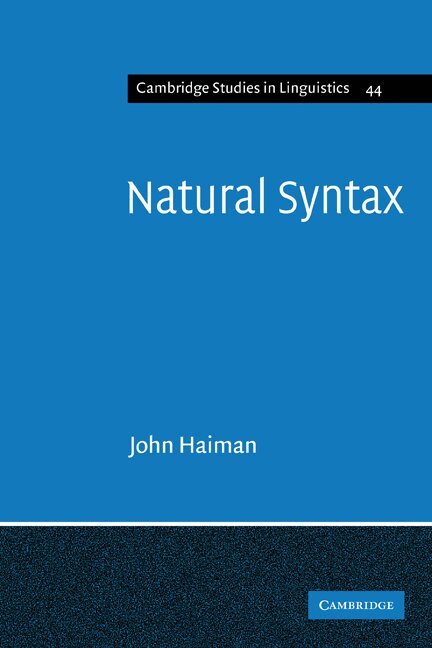
The view that language is in some way 'arbitrary', that there is no formal relationship between a linguistic message and the thought it is meant to convey, is long established and pervasive. The goal of John Haiman's study is to challenge the monopoly of arbitrariness, which he believes has affected in significant ways many models of linguistic description and analysis, notably those proposed by Saussure and more recently by Chomsky and his associates. Linguistic structures, Dr Hainian claims, may be compared to (non-linguistic) diagrams of our thoughts, and deviate from iconicity in many of the same ways and for much the same reasons as do diagrams in general. Arbitrariness develops as a result of the relatively familiar principles of economy, generalization and association. In relation to this thesis, Dr Haiman considers a wide variety of constructions, including conditionals and interrogatives, gapping, causative structures, auxiliaries and reflexives, and provides a wealth of exemplification from different languages that also points to typological differences in respect of iconicity.
1 133 kr
Skickas inom 7-10 vardagar
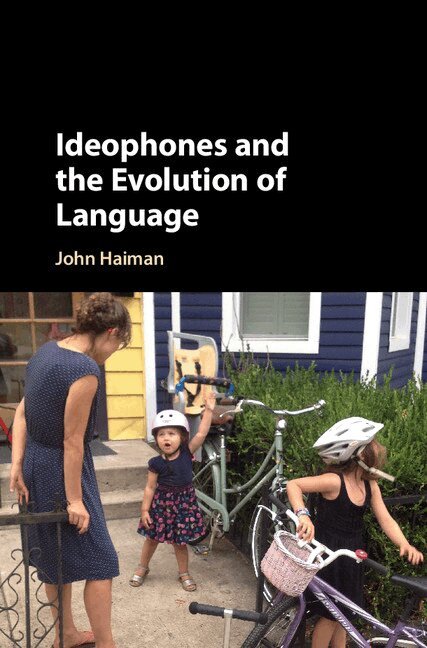
Ideophones have been recognized in modern linguistics at least since 1935, but they still lie far outside the concerns of mainstream (Western) linguistic debate, in part because they are most richly attested in relatively unstudied (often unwritten) languages. The evolution of language, on the other hand, has recently become a fashionable topic, but all speculations so far have been almost totally data-free. Without disputing the tenet that there are no primitive languages, this book argues that ideophones may be an atavistic throwback to an earlier stage of communication, where sounds and gestures were paired in what can justifiably be called a 'prelinguistic' fashion. The structure of ideophones may also provide answers to deeper questions, among them how communicative gestures may themselves have emerged from practical actions. Moreover, their current distribution and behaviour provide hints as to how they may have become conventional words in languages with conventional rules.
523 kr
Skickas inom 7-10 vardagar
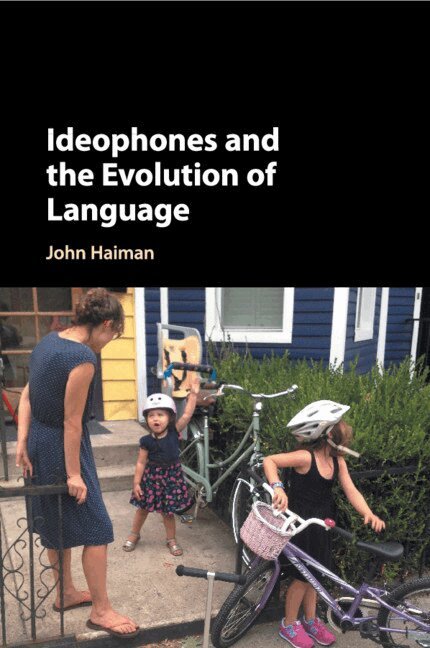
Ideophones have been recognized in modern linguistics at least since 1935, but they still lie far outside the concerns of mainstream (Western) linguistic debate, in part because they are most richly attested in relatively unstudied (often unwritten) languages. The evolution of language, on the other hand, has recently become a fashionable topic, but all speculations so far have been almost totally data-free. Without disputing the tenet that there are no primitive languages, this book argues that ideophones may be an atavistic throwback to an earlier stage of communication, where sounds and gestures were paired in what can justifiably be called a 'prelinguistic' fashion. The structure of ideophones may also provide answers to deeper questions, among them how communicative gestures may themselves have emerged from practical actions. Moreover, their current distribution and behaviour provide hints as to how they may have become conventional words in languages with conventional rules.
845 kr
Skickas inom 10-15 vardagar
The Rhaeto-Romance languages have been known as such to the linguistic community since the pioneering studies of Ascoli and Gartner over a century ago. There has never been a community of RR speakers based on a common history or polity and the various dialects are mutually unintelligible, but a unity, based on a number of common features, has been advanced.This book is the first general description of the Rhaeto-Romance languages to be written in English. It provides a critical examination of the phonology, morphology, lexicon, and syntax of the modern Rhaeto-Romance dialects within the broader perspective of Romance comparative linguistics.
1 555 kr
Skickas inom 7-10 vardagar
No detailed description available for "Targets and Syntactic Change".