John J. Cleary - Böcker
Visar alla böcker från författaren John J. Cleary. Handla med fri frakt och snabb leverans.
3 produkter
3 produkter
156 kr
Skickas inom 7-10 vardagar
Cleary discusses the origin, development, and use of the many senses of priority as a central thesis in Aristotle’s metaphysics.Cleary contends that one of the most revealing problems for the ambiguity of Aristotle’s relationship to Platonism is that of the ontological status of mathematical objects. In support of his claim, Cleary analyzes a curious passage from Aristotle’s Topics, where he appears to accept a schema of priorities that makes mathematical entities more substantial than sensible things.How does Aristotle try to reconcile the ordering of things dictated by sciences like mathematics and dialectic with the ordering of sense experience upon which his own physics and metaphysics are based? To find the answer, Cleary reviews three different outlines of the many senses of priority given by Aristotle himself and found in Categories 12-13, Metaphysics Delta 11, and Metaphysics Theta 8. Cleary suggests there is an implicit hierarchy for Aristotle that leads him to posit the Prime Mover at its apex as complete actuality and, therefore, as the focus for the concept of priority. Having reviewed Aristotle’s treatment of the many uses of priority, Cleary demonstrates how the concept is used in some typical arguments by Aristotle for his mature metaphysical positions.
146 kr
Skickas inom 5-8 vardagar
Del 15 - Studies in Platonism, Neoplatonism, and the Platonic Tradition
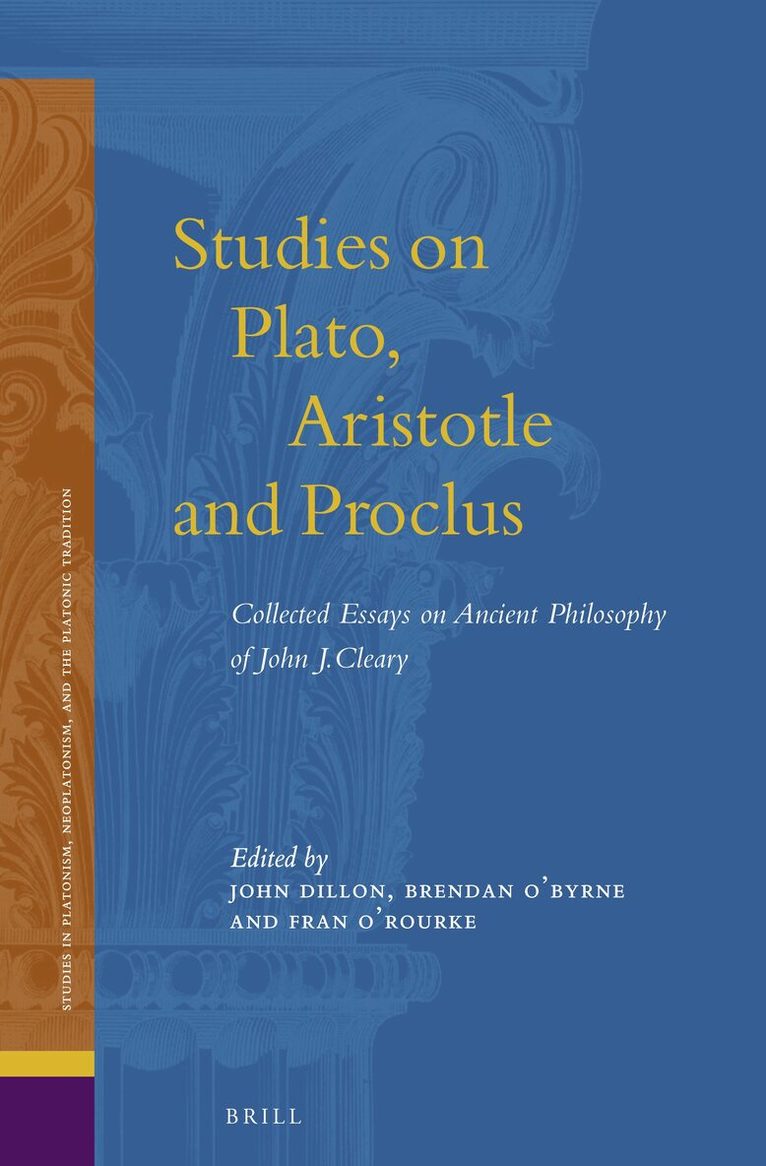
Studies on Plato, Aristotle and Proclus
The Collected Essays on Ancient Philosophy of John Cleary
Inbunden, Engelska, 2013
4 438 kr
Skickas inom 5-8 vardagar
John J. Cleary (1949–2009) was an internationally recognised authority in many aspects of ancient philosophy. As well as penetrating and original studies of Plato, Aristotle, and Proclus, he was particularly interested in the philosophy of mathematics, and ancient theories of education. The essays included in this collection display Cleary’s range of expertise and originality of approach. Cleary was especially attentive to the problems involved in the interpretation of a philosophical text: in his reading of Plato he recognised the special status of dialogue as a privileged mode of philosophical writing. His underlying concern was the open-ended character of philosophy itself, to be pursued with intellectual rigour and respect both for the question and one’s interlocutor. These collected essays are representative of John Cleary’s philosophical life’s work.