John M. Eidinger – författare
Visar alla böcker från författaren John M. Eidinger. Handla med fri frakt och snabb leverans.
4 produkter
Fire Following Earthquake
Av Charles Scawthorn, John M. Eidinger
Inbunden, 2005
1633 kr
Lägg i varukorg
Fire Following Earthquake is the first book to cover the entire range of fire following earthquake (FFE) issues, ranging from historical fires to 20th century fires in Kobe, San Francisco, Oakland, Berkeley, and Northridge. FFE has the potential of causing catastrophic losses in the United States, …
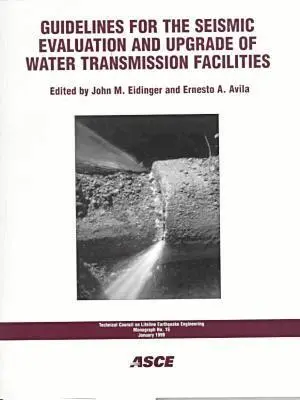
Guidelines for the Seismic Evaluation and Upgrade of Water Transmission Facilities
Av John M. Eidinger, Ernesto A. Avila
Häftad, 1999
540 kr
Tillfälligt slut
The seismic evaluation and retrofit of water transmission infrastructure is an area of growing concern to utilities that own large water conveyance systems. Many water and power utilities today rely heavily on water transmission structures built in the 1930s or earlier without regard to seismic …
Gujarat (Kutch) India M7.7 Earthquake of January 26, 2001 and Napa M5.2 Earthquake of September 3, 2000
Häftad, 2001
750 kr
Tillfälligt slut
This report describes the performance of lifelines in two recent earthquakes: the Gujarat Earthquake of January 26, 2001 and the Napa Earthquake of September 3, 2000. The Gujarat Earthquake severely struck the Kutch District of the Gujarat State, India, and resulted in about 17,000 fatalities, …
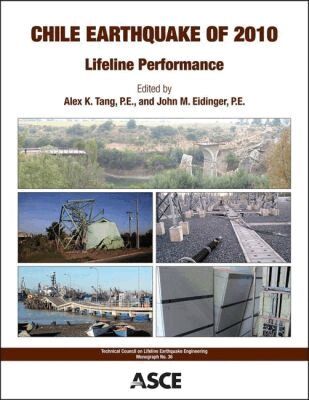
Chile Earthquake of 2010
Lifeline Performance
Av Alex K. Tang, John M. Eidinger
Häftad, 2013
1605 kr
Tillfälligt slut
When a magnitude 8.8 earthquake occurred off the coast of Chile on February 27, 2010, it affected 80 percent of Chile’s population. Damage to lifelines was caused by strong ground shaking, permanent ground deformation, lateral spread, and a tsunami in the coastal areas of Bio Bio and Maule. …