John Skvoretz - Böcker
Visar alla böcker från författaren John Skvoretz. Handla med fri frakt och snabb leverans.
4 produkter
4 produkter
1 606 kr
Skickas inom 5-8 vardagar
"Advances in Group Processes" publishes theoretical, review, and empirically-based papers on group phenomena. The series adopts a broad conception of 'group processes' consistent with prevailing ones in the social psychological literature. In addition to topics such as status processes, group structure, and decision making, the series considers work on interpersonal behaviour in dyads (i.e. the smallest group). Contributors to the series include not only sociologists but also scholars from other disciplines, such as psychology and organizational behaviour.
1 302 kr
Skickas inom 7-10 vardagar
"Advances in Group Processes" publishes theoretical analyses, reviews and theory based empirical chapters on group phenomena. Volume 20, the second volume of a five-series set, includes papers that address fundamental issues of power and status. Chapter one integrates social influence network theory with core ideas from affect control theory and the expectation states programme. The second chapter compares reciprocal exchange to negotiated exchange in terms of the power development, trust and perceptions of fairness. Chapter three examines the entire population of unique exchange networks up to size nine, giving predictions using power dependence theory and the resistance branch of network exchange theory. As a set, these chapters address major issues of power in social exchange relations. The next four chapters are aimed at important issues of status in groups. Chapter four theorizes the complex connection between power and status, showing that power can produce status only if negative emotional reactions are mitigated. This analysis sheds new light on theories of collective action. Chapter five extends reward expectations theory by offering a new model of allocative behaviour, and comparing that model to previously collected data. The sixth chapter extends status construction theory to incorporate the effect of social identification. This new formulation is then tested and supported with data from thirty five dot-com organizations. The final two chapters incorporate theories of legitimacy to provide insights into power and status. Chapter eight reviews and explicates the basic principles of legitimacy in the Zelditch and Walker research programme. This paper traces the successes and failures of two dozen studies across several decades. Finally, chapter nine uses legitimacy theory to resolve two anomalies in the status literature, one dealing with gender saliency and the other with the enactment of identity- versus status-related behaviours. Overall, the volume includes papers that reflect a wide range of theoretical approaches to power and status and contributions by major scholars that work in the general area of group processes.
1 026 kr
Skickas inom 10-15 vardagar
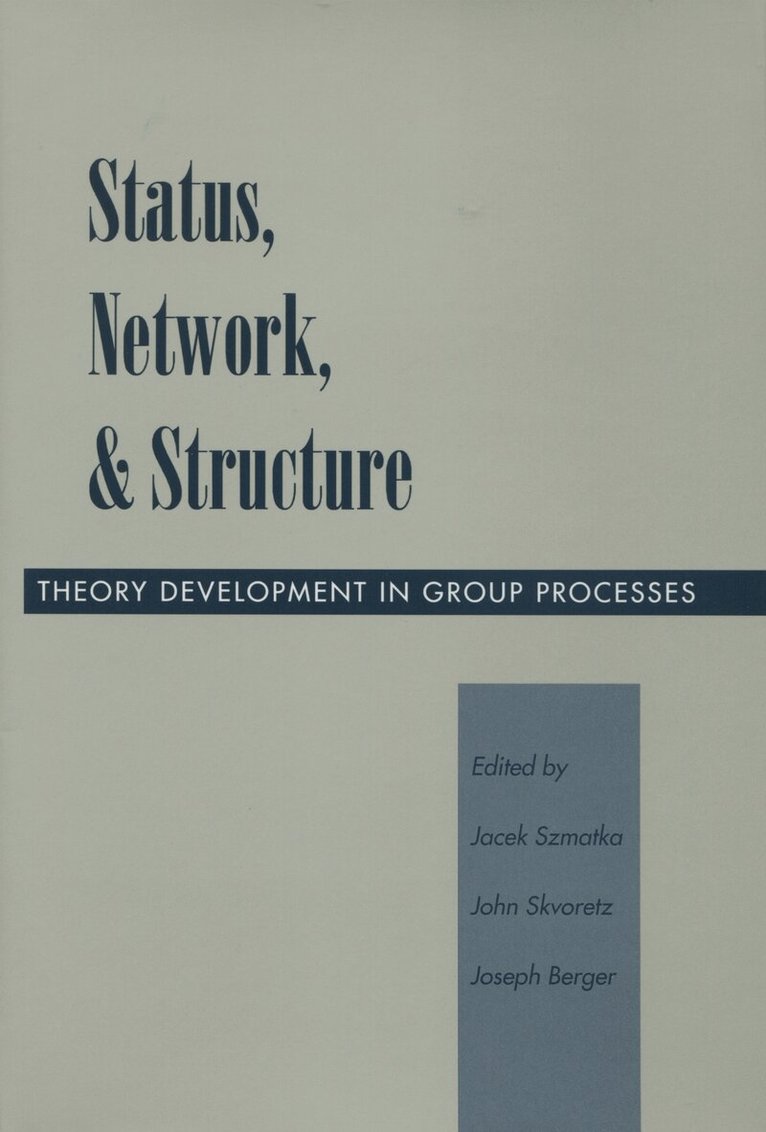
This book challenges much that has been written about the decline of sociology as a vital, essential area of inquiry into the human condition. Against this Greek chorus of woe, these papers show by example that sociology can make progress, select significant problems, and cumulate an integrated and coherent set of findings and theoretical understandings.Although the twenty papers in the book engage a wide variety of issues, they are united by their adherence to one of the most active and successful traditions in sociology, the group process tradition. Group process research programs can examine tractable problems posed by social psychological phenomena for which sociology has the best methods of study; they have the potential for a hardware-based, technological research front that discovers new phenomena; and they come closest of all approaches in sociological research to using cognitive criteria in the choice of problems and to studying immutable phenomena. The overall aim of the book is to provide models for researchers struggling to develop, construct, and integrate coherent sociological theory and knowledge.The papers are grouped around three themes: (1) the problem of theory construction in sociology, including what is meant by "theory" and the methods of testing it, particularly empirical testing; (2) the extension and elaboration of existing theories of group processes, notably in the study of status, sentiment, and the comparison process; and (3) the theoretical issues at the intersection of social structures, the pattern of connection in social networks, and the process of rational choice.
1 618 kr
Skickas inom 7-10 vardagar
Drawing on the tools of mathematics and formal modeling, this engaging book provides a foundational understanding of mathematical sociology through a case-by-case exploration of sociological questions.John Skvoretz underscores that the application of mathematics to sociology is integral to the ability to formulate theories about social structure and group processes clearly and unambiguously, to make advances in the social sciences. Presenting a gradual introduction to mathematical models that builds to more complex tools and logic of inquiry, Skvoretz develops an accessible resource for advancing sociology research programs. He argues that, while such tools cannot eliminate all contention over semantics, mathematical modeling can help to narrow the areas of disagreement within sociology.Students and academics across the social sciences, particularly social network analysis, group processes, social psychology and sociology, will benefit from this book’s illuminating approach to building theoretical models in their disciplines.