

Jonas Albrecht – författare
Visar alla böcker från författaren . Handla med fri frakt och snabb leverans.
5 produkter
5 produkter
Inbunden, Engelska, 2024
1 300 kr
Skickas inom 10-15 vardagar
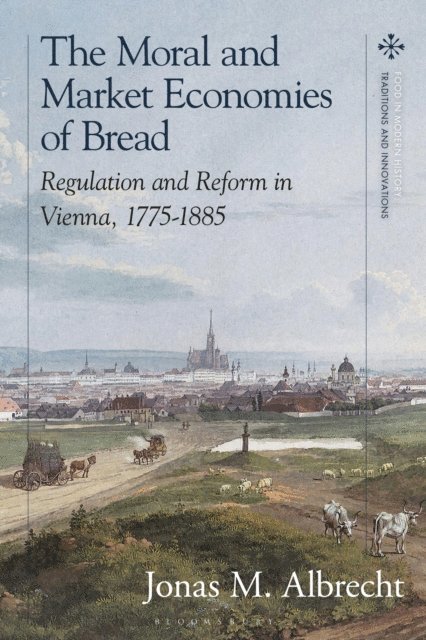
From the 1770s the Vienna bread market was rocked by a series of politico-economic and technological changes that questioned the way this everyday foodstuff was sold and produced. In this book, Jonas Albrecht explores how this reconfiguration of the bread market had wide-reaching and significant consequences for a society who relied on this foodstuff to live.Before 1860 the production and selling of bread was embedded into a moral economy with distinct regulations. But as the grain market expanded and new cereal varieties arrived from the empire’s peripheries reformers sought to create a ‘free’ market through liberalizing reforms. The Moral and Market Economies of Bread shows that while terminating market regulation did mobilize and diversify Vienna’s bread market in spatial terms, it intensified inequality among consumers. As opaque prices, non-transparent market procedures and diverging power relations between producers and consumers led to unrest, city officials and bakers struggled to meet the shortcomings of the free market from within. This book brings economic, social and urban histories together and employs a spatial approach and GIS methods to explore the relationship between market and society, and capitalism at large.
E-bok
PDF, Engelska, 2024452 kr
Läs direkt efter köp
From the 1770s the Vienna bread market was rocked by a series of politico-economic and technological changes that questioned the way this everyday foodstuff was sold and produced. In this book, Jonas Albrecht explores how this reconfiguration of the bread market had wide-reaching and significant consequences for a society who relied on this foodstuff to live. Before 1860 the production and selling of bread was embedded into a moral economy with distinct regulations. But as the grain market expanded and new cereal varieties arrived from the empire''s peripheries reformers sought to create a ''free'' market through liberalizing reforms. The Moral and Market Economies of Bread shows that while terminating market regulation did mobilize and diversify Vienna''s bread market in spatial terms, it intensified inequality among consumers. As opaque prices, non-transparent market procedures and diverging power relations between producers and consumers led to unrest, city officials and bakers struggled to meet the shortcomings of the free market from within. This book brings economic, social and urban histories together and employs a spatial approach and GIS methods to explore the relationship between market and society, and capitalism at large.
452 kr
Läs direkt efter köp
From the 1770s the Vienna bread market was rocked by a series of politico-economic and technological changes that questioned the way this everyday foodstuff was sold and produced. In this book, Jonas Albrecht explores how this reconfiguration of the bread market had wide-reaching and significant consequences for a society who relied on this foodstuff to live. Before 1860 the production and selling of bread was embedded into a moral economy with distinct regulations. But as the grain market expanded and new cereal varieties arrived from the empire''s peripheries reformers sought to create a ''free'' market through liberalizing reforms. The Moral and Market Economies of Bread shows that while terminating market regulation did mobilize and diversify Vienna''s bread market in spatial terms, it intensified inequality among consumers. As opaque prices, non-transparent market procedures and diverging power relations between producers and consumers led to unrest, city officials and bakers struggled to meet the shortcomings of the free market from within. This book brings economic, social and urban histories together and employs a spatial approach and GIS methods to explore the relationship between market and society, and capitalism at large.

Häftad, Engelska, 2026
424 kr
Skickas inom 10-15 vardagar
From the 1770s the Vienna bread market was rocked by a series of politico-economic and technological changes that questioned the way this everyday foodstuff was sold and produced. In this book, Jonas Albrecht explores how this reconfiguration of the bread market had wide-reaching and significant consequences for a society who relied on this foodstuff to live.Before 1860 the production and selling of bread was embedded into a moral economy with distinct regulations. But as the grain market expanded and new cereal varieties arrived from the empire’s peripheries reformers sought to create a ‘free’ market through liberalizing reforms. The Moral and Market Economies of Bread shows that while terminating market regulation did mobilize and diversify Vienna’s bread market in spatial terms, it intensified inequality among consumers. As opaque prices, non-transparent market procedures and diverging power relations between producers and consumers led to unrest, city officials and bakers struggled to meet the shortcomings of the free market from within. This book brings economic, social and urban histories together and employs a spatial approach and GIS methods to explore the relationship between market and society, and capitalism at large.

E-bok
Tyska, 202655 kr
Läs direkt efter köp
Stellen Sie sich vor, Sie haben die Wahl: Eine Box enthalt garantiert 50 rote und 50 schwarze Kugeln. Bei der anderen Box kennen Sie das Verhaltnis nicht. Sie gewinnen, wenn Sie blind eine rote Kugel ziehen. Fast jeder Mensch wahlt instinktiv die erste Box, obwohl die mathematische Gewinnchance bei beiden exakt gleich sein konnte. Dieses Gedankenexperiment, bekannt als das Ellsberg-Paradoxon, offenbart eine tiefe Angst unserer Psyche. Wir leiden unter einer massiven Ambiguitats-Aversion. Das menschliche Gehirn zieht ein bekanntes, selbst ein schlechtes Risiko, einer vollig unbekannten Situation vor. Lieber ertragen wir einen unbefriedigenden Job mit einem verlasslichen Gehalt, als den Sprung in eine Selbststandigkeit zu wagen, deren Ausgang nicht berechenbar ist. Diese tief verwurzelte Abneigung gegen das Ungewisse ist der Hauptgrund fur berufliche und private Stagnation. Dieses Buch fuhrt Sie durch die psychologischen Mechanismen der Risikobewertung. Es zeigt, wie die Angst vor dem Unbekannten unseren Handlungsspielraum drastisch einschrankt und liefert mentale Modelle, um zwischen echter Gefahr und blo er Ambiguitat zu unterscheiden. Lernen Sie, die Ungewissheit nicht als Bedrohung, sondern als mathematischen Vorteil zu nutzen.