Jonathan S. Masur – författare
Visar alla böcker från författaren Jonathan S. Masur. Handla med fri frakt och snabb leverans.
3 produkter
3 produkter
1 089 kr
Skickas inom 5-8 vardagar
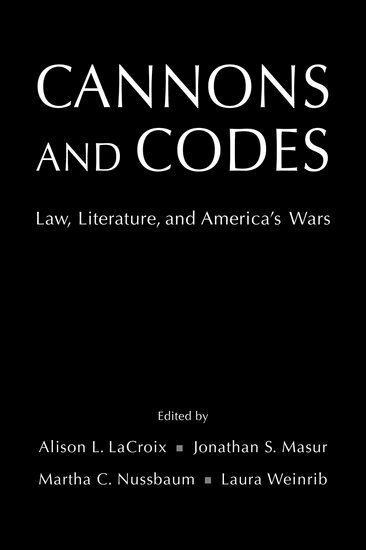
It can be said that western literature begins with a war story, the Iliad; and that this is true too of many non-Western literary traditions, such as the Mahabharata. And yet, though a profoundly human subject, war often appears to be by definition outside the realm of structures such as law and literature. When we speak of war, we often understand it as incapable of being rendered into rules or words. Lawyers struggle to fit the horrors of the battlefield, the torture chamber, or the makeshift hospital filled with wounded and dying civilians into the framework of legible rules and shared understandings that law assumes and demands. In the West's centuries-long effort to construct a formal law of war, the imperative has been to acknowledge the inhumanity of war while resisting the conclusion that it need therefore be without law. Writers, in contrast, seek to find the human within war--an individual story, perhaps even a moment of comprehension. Law and literature might in this way be said to share imperialist tendencies where war is concerned: toward extending their dominion to contain what might be uncontainable.Law, literature, and war are thus all profoundly connected--and it is this connection this edited volume aims to explore, assembling essays by preeminent scholars to discuss the ways in which literary works can shed light on legal thinking about war, and how a deep understanding of law can lead to interpretive insights on literary works. Some of the contributions concern the lives of soldiers; others focus on civilians living in war zones who are caught up in the conflict; still others address themselves to the home front, far from the theatre of war. By collecting such diverse perspectives, the volume aims to illuminate how literature has reflected the totalizing nature of war and the ways in which it distorts law across domains.
876 kr
Kommande
Connubial Fictions explores law and marriage in the United States, seen through the lens of American literature of the twentieth and twenty-first centuries. In this edited volume, scholars of law and the humanities combine legal scholarship with literary analysis to explore how American literature has portrayed marriage's complex legal dimensions over time. They cover diverse fictional works including Frances Harper's Iola Leroy, Marilynne Robinson's Gilead novels, Tony Kushner's Angels in America, and works by Edward Albee, Philip Roth, Octavia Butler, Maggie Nelson, and Jhumpa Lahiri.Through these works, contributors examine a wide range of legal and literary themes: the true ownership of a marriage, how investments involved in a marriage compare to investments in a business, how the denial of marriage rights affected same-sex couples, how marriage rights changed queer aesthetics, the prospects for truth in marriage, the constraints and possibilities for immigrant marriages, how procreation norms affect childless marriages, the challenges of interracial intimacy and marriage, the paucity of modern literature depicting interracial marriages, the nature of separations before no-fault divorce, the divorce revolution and the best interests of children of divorce, and the problem of equality and alimony.Convention and law have often shielded the intimate aspect of marriage from public view. This volume shows how literature has pulled back the curtain and shown us the various lived experiences of marriage, of all kinds.
323 kr
Skickas inom 5-8 vardagar
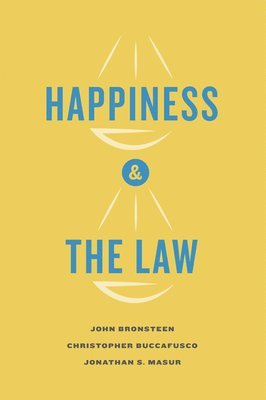
Happiness and the law. At first glance, these two concepts seem to have little to do with each other. To some, they may even seem diametrically opposed. Yet one of the things the law strives for is to improve people's quality of life. To do this, it must first predict what will make people happy. Yet happiness research shows that, time and time again, people err in predicting what will make them happy, overestimating the importance of money and mistaking the circumstances to which they can and cannot adapt. Drawing on new research in psychology, neuroscience, and economics, the authors of Happiness and the Law assess how the law affects people's quality of life - and how it can do so in a better way. Taking readers through some of the common questions about and objections to the use of happiness research in law and policy, they consider two areas in depth: criminal punishment and civil lawsuits. More broadly, the book proposes a comprehensive approach to assessing human welfare - well-being analysis - that is far superior to the strictly economically based cost-benefit analyses currently dominating how we evaluate public policy.The study of happiness is the next step in the evolution from traditional economic analysis of the law to a behavioral approach. Happiness and the Law will serve as the definitive, yet accessible, guide to understanding this new paradigm.