Jonathan Turner – författare
Visar alla böcker från författaren Jonathan Turner. Handla med fri frakt och snabb leverans.
15 produkter
15 produkter
Häftad, Engelska, 2010
543 kr
Skickas inom 10-15 vardagar
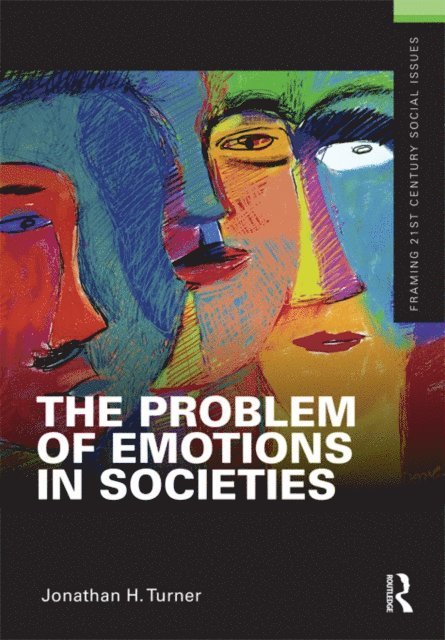
Like any other valued resource, emotions are distributed unequally. Moreover, emotions are a generalized resource because they give people the confidence, or lack of confidence, to secure additional types of resources. Thus, this distribution of emotions roughly corresponds to the shares of others kinds of resources that members of various social classes possess. The level of positive and negative emotional energy evident among members of different social classes has large consequences for the viability of human societies. When a large majority of members in diverse social classes have reservoirs of positive emotional energy, these emotions work to legitimate macrostructures and to build people’s commitments to societies. When, however, significant numbers of persons in lower social classes, and at times in middle to upper social classes as well, reveal reservoirs of negative emotional energy, they are likely to de-legitimate key institutional systems and, under specifiable conditions, mobilize collective—often with violent outcomes. Thus, emotions are at the core of both integrative and disintegrative forces in societies, and when large reservoirs of negative emotional energy exist, they pose a problem for societies. The goal of this new, unique Series is to offer readable, teachable "thinking frames" on today’s social problems and social issues by leading scholars, all in short 60 page or shorter formats, and available for view on http://routledge.customgateway.com/routledge-social-issues.html For instructors teaching a wide range of courses in the social sciences, the Routledge Social Issues Collection now offers the best of both worlds: originally written short texts that provide "overviews" to important social issues as well as teachable excerpts from larger works previously published by Routledge and other presses.
Häftad, Engelska, 1998
1 203 kr
Skickas inom 5-8 vardagar
As in the first edition, theory and practice are brought together in economies, finance, farm management and marketing in a way which highlights the interrelationships between them. The applied aspects, together with the coverage of marketing and the worked examples make the text uniquely important.
Häftad, Engelska, 2019
725 kr
Skickas inom 5-8 vardagar
70 per cent of the planet is covered by water, and 90 per cent of global economic trade is transported by sea. The world's seas and oceans are big business. Based on gross marine product, the ocean can be considered the world's seventh-largest economy, with the total global value of the Blue Economy predicted to rise to $3 trillion by 2030. Grounded in detailed market research, and brought to life through over 250 meticulously researched case studies, Technology and the Blue Economy presents a compelling overview of an inspiring and innovative sector that includes offshore renewable energy, ports and harbours, shipping, maritime surveillance, cyber security, aquaculture and ocean conservation. It tackles questions like these: · With Earth observation satellites providing unprecedented levels of data about the ocean, can machine learning capabilities develop at pace to make sense of all this new information? · How can ships protect themselves when one shipping firm alone records 50,000 daily attempts to breach its cyber security systems? · With floating wind farms now pushing further out to sea to convert natural energy, what role do robots have in managing essential maintenance in these more remote environments? · When passenger ferries are already sailing themselves and self-docking in port without human intervention, are we entering an age where human error is eradicated? · With fish farming predicted to account for 62 per cent of all the seafood consumed globally by 2030, how can 3D imaging cameras and net-cleaning robots help to stop mass deaths of fish that can run into millions in a single incident? · In the age of smartphone ubiquity, how important a role might social media and citizen science play in ocean conservation? · With luxury cruise ships now marketing themselves as 'smart, connected cities', crunching passenger data in real-time, do they now provide the gold standard of customer experience within the tourist industry? · Is optical scanning technology the solution to countering slavery at sea, a real concern in the south-east Asian fishing industry? · Can satellite-enabled tracking and autonomous clean-up systems help to counter one of the greatest conservation issues of the day - the fight against ocean plastic pollution?Technology and the Blue Economy explores how innovators can develop the right business models to capitalize on growth opportunities, and analyses the critical success factors for emerging technologies.
Inbunden, Engelska, 2018
2 825 kr
Skickas inom 10-15 vardagar
For decades, evolutionary analysis was overlooked or altogether ignored by sociologists. Fears and biases persisted nearly a century after Auguste Comte gave the discipline its name, as did concerns that its effect would only reduce sociology to another discipline – whether biology, psychology, or economics. Worse, apprehension that the application of evolutionary theory would encourage heightened perceptions of racism, sexism, ethnocentrism and reductionism pervaded. Turner and Machalek argue instead for a new embrace of biology and evolutionary analysis. Sociology, from its very beginnings in the early 19th century, has always been concerned with the study of evolution, particularly the transformation of societies from simple to ever-more complex forms. By comprehensively reviewing the original ways that sociologists applied evolutionary theory and examining the recent renewal and expansion of these early approaches, the authors confront the challenges posed by biology, neuroscience, and psychology to distinct evolutionary approaches within sociology. They emerge with key theoretical and methodological discoveries that demonstrate the critical – and compelling – case for a dramatically enriched sociology that incorporates all forms of comparative evolutionary analysis to its canon and study of sociocultural phenomena.
Häftad, Engelska, 2018
722 kr
Skickas inom 10-15 vardagar
For decades, evolutionary analysis was overlooked or altogether ignored by sociologists. Fears and biases persisted nearly a century after Auguste Comte gave the discipline its name, as did concerns that its effect would only reduce sociology to another discipline – whether biology, psychology, or economics. Worse, apprehension that the application of evolutionary theory would encourage heightened perceptions of racism, sexism, ethnocentrism and reductionism pervaded. Turner and Machalek argue instead for a new embrace of biology and evolutionary analysis. Sociology, from its very beginnings in the early 19th century, has always been concerned with the study of evolution, particularly the transformation of societies from simple to ever-more complex forms. By comprehensively reviewing the original ways that sociologists applied evolutionary theory and examining the recent renewal and expansion of these early approaches, the authors confront the challenges posed by biology, neuroscience, and psychology to distinct evolutionary approaches within sociology. They emerge with key theoretical and methodological discoveries that demonstrate the critical – and compelling – case for a dramatically enriched sociology that incorporates all forms of comparative evolutionary analysis to its canon and study of sociocultural phenomena.
Häftad, Engelska, 2022
639 kr
Skickas inom 10-15 vardagar
Few concepts are as central to sociology as institutions. Yet, like so many sociological concepts, institutions remain vaguely defined. This book expands a foundational definition of the institution, one which locates them as the basic building blocks of human societies—as structural and cultural machines for survival that make it possible to pass precious knowledge from one generation to the next, ensuring the survival of our species. The book extends this classic tradition by, first, applying advances in biological evolution, neuroscience, and primatology to explain the origins of human societies and, in particular, the first institutional sphere: kinship. The authors incorporate insights from natural sciences often marginalized in sociology, while highlighting the limitations of purely biogenetic, Darwinian explanations. Secondly, they build a vivid conceptual model of institutions and their central dynamics as the book charts the chronological evolution of kinship, polity, religion, law, and economy, discussing the biological evidence for the ubiquity of these institutions as evolutionary adaptations themselves.
Inbunden, Engelska, 2022
2 138 kr
Skickas inom 10-15 vardagar
Few concepts are as central to sociology as institutions. Yet, like so many sociological concepts, institutions remain vaguely defined. This book expands a foundational definition of the institution, one which locates them as the basic building blocks of human societies—as structural and cultural machines for survival that make it possible to pass precious knowledge from one generation to the next, ensuring the survival of our species. The book extends this classic tradition by, first, applying advances in biological evolution, neuroscience, and primatology to explain the origins of human societies and, in particular, the first institutional sphere: kinship. The authors incorporate insights from natural sciences often marginalized in sociology, while highlighting the limitations of purely biogenetic, Darwinian explanations. Secondly, they build a vivid conceptual model of institutions and their central dynamics as the book charts the chronological evolution of kinship, polity, religion, law, and economy, discussing the biological evidence for the ubiquity of these institutions as evolutionary adaptations themselves.
Inbunden, Engelska, 2017
2 757 kr
Skickas inom 10-15 vardagar
Written by leading theorists and empirical researchers, this book presents new ways of addressing the old question: Why did religion first emerge and then continue to evolve in all human societies? The authors of the book—each with a different background across the social sciences and humanities—assimilate conceptual leads and empirical findings from anthropology, evolutionary biology, evolutionary sociology, neurology, primate behavioral studies, explanations of human interaction and group dynamics, and a wide range of religious scholarship to construct a deeper and more powerful explanation of the origins and subsequent evolutionary development of religions than can currently be found in what is now vast literature. While explaining religion has been a central question in many disciplines for a long time, this book draws upon a much wider array of literature to develop a robust and cross-disciplinary analysis of religion. The book remains true to its subtitle by emphasizing an array of both biological and sociocultural forms of selection dynamics that are fundamental to explaining religion as a universal institution in human societies. In addition to Darwinian selection, which can explain the biology and neurology of religion, the book outlines a set of four additional types of sociocultural natural selection that can fill out the explanation of why religion first emerged as an institutional system in human societies, and why it has continued to evolve over the last 300,000 years of societal evolution. These sociocultural forms of natural selection are labeled by the names of the early sociologists who first emphasized them, and they can be seen as a necessary supplement to the type of natural selection theorized by Charles Darwin. Explanations of religion that remain in the shadow cast by Darwin’s great insights will, it is argued, remain narrow and incomplete when explaining a robust sociocultural phenomenon like religion.
Häftad, Engelska, 2017
571 kr
Skickas inom 10-15 vardagar
Written by leading theorists and empirical researchers, this book presents new ways of addressing the old question: Why did religion first emerge and then continue to evolve in all human societies? The authors of the book—each with a different background across the social sciences and humanities—assimilate conceptual leads and empirical findings from anthropology, evolutionary biology, evolutionary sociology, neurology, primate behavioral studies, explanations of human interaction and group dynamics, and a wide range of religious scholarship to construct a deeper and more powerful explanation of the origins and subsequent evolutionary development of religions than can currently be found in what is now vast literature. While explaining religion has been a central question in many disciplines for a long time, this book draws upon a much wider array of literature to develop a robust and cross-disciplinary analysis of religion. The book remains true to its subtitle by emphasizing an array of both biological and sociocultural forms of selection dynamics that are fundamental to explaining religion as a universal institution in human societies. In addition to Darwinian selection, which can explain the biology and neurology of religion, the book outlines a set of four additional types of sociocultural natural selection that can fill out the explanation of why religion first emerged as an institutional system in human societies, and why it has continued to evolve over the last 300,000 years of societal evolution. These sociocultural forms of natural selection are labeled by the names of the early sociologists who first emphasized them, and they can be seen as a necessary supplement to the type of natural selection theorized by Charles Darwin. Explanations of religion that remain in the shadow cast by Darwin’s great insights will, it is argued, remain narrow and incomplete when explaining a robust sociocultural phenomenon like religion.
Inbunden, Engelska, 2016
2 688 kr
Skickas inom 10-15 vardagar
Like any other valued resource, emotions are distributed unequally. Moreover, emotions are a generalized resource because they give people the confidence, or lack of confidence, to secure additional types of resources. Thus, this distribution of emotions roughly corresponds to the shares of others kinds of resources that members of various social classes possess. The level of positive and negative emotional energy evident among members of different social classes has large consequences for the viability of human societies. When a large majority of members in diverse social classes have reservoirs of positive emotional energy, these emotions work to legitimate macrostructures and to build people’s commitments to societies. When, however, significant numbers of persons in lower social classes, and at times in middle to upper social classes as well, reveal reservoirs of negative emotional energy, they are likely to de-legitimate key institutional systems and, under specifiable conditions, mobilize collective—often with violent outcomes. Thus, emotions are at the core of both integrative and disintegrative forces in societies, and when large reservoirs of negative emotional energy exist, they pose a problem for societies. The goal of this new, unique Series is to offer readable, teachable "thinking frames" on today’s social problems and social issues by leading scholars, all in short 60 page or shorter formats, and available for view on http://routledge.customgateway.com/routledge-social-issues.html For instructors teaching a wide range of courses in the social sciences, the Routledge Social Issues Collection now offers the best of both worlds: originally written short texts that provide "overviews" to important social issues as well as teachable excerpts from larger works previously published by Routledge and other presses.
Inbunden, Engelska, 2016
354 kr
Skickas inom 3-6 vardagar
Inbunden, Engelska, 2019
2 234 kr
Skickas inom 5-8 vardagar
70 per cent of the planet is covered by water, and 90 per cent of global economic trade is transported by sea. The world's seas and oceans are big business. Based on gross marine product, the ocean can be considered the world's seventh-largest economy, with the total global value of the Blue Economy predicted to rise to $3 trillion by 2030. Grounded in detailed market research, and brought to life through over 250 meticulously researched case studies, Technology and the Blue Economy presents a compelling overview of an inspiring and innovative sector that includes offshore renewable energy, ports and harbours, shipping, maritime surveillance, cyber security, aquaculture and ocean conservation. It tackles questions like these: · With Earth observation satellites providing unprecedented levels of data about the ocean, can machine learning capabilities develop at pace to make sense of all this new information? · How can ships protect themselves when one shipping firm alone records 50,000 daily attempts to breach its cyber security systems? · With floating wind farms now pushing further out to sea to convert natural energy, what role do robots have in managing essential maintenance in these more remote environments? · When passenger ferries are already sailing themselves and self-docking in port without human intervention, are we entering an age where human error is eradicated? · With fish farming predicted to account for 62 per cent of all the seafood consumed globally by 2030, how can 3D imaging cameras and net-cleaning robots help to stop mass deaths of fish that can run into millions in a single incident? · In the age of smartphone ubiquity, how important a role might social media and citizen science play in ocean conservation? · With luxury cruise ships now marketing themselves as 'smart, connected cities', crunching passenger data in real-time, do they now provide the gold standard of customer experience within the tourist industry? · Is optical scanning technology the solution to countering slavery at sea, a real concern in the south-east Asian fishing industry? · Can satellite-enabled tracking and autonomous clean-up systems help to counter one of the greatest conservation issues of the day - the fight against ocean plastic pollution?Technology and the Blue Economy explores how innovators can develop the right business models to capitalize on growth opportunities, and analyses the critical success factors for emerging technologies.
Häftad, Engelska, 2023
189 kr
Skickas inom 5-8 vardagar
Inbunden, Engelska, 2026
340 kr
Skickas inom 5-8 vardagar
Inbunden, Nederländska, 2007
350 kr
Tillfälligt slut
"Jasper Krabbe - 100 Selfportraits" includes an impressive number of self-portraits made in the period between the Summer of 2004 and the Summer of 2005. The portraits' formats have been determined by the measurements of an old bookkeeping book in which Krabbe made his self-portraits - one dating from the nineteen-fifties with squared and blank pages. Even the paint he uses for this project is from the same period. This corresponds with the idea that the self-portrait is a typical nineteenth-century activity. The book has been reproduced as a facsimile, which means that the reader has the feeling of looking at the original sketchbook of the artist. Krabbe wanted to explore what the self-portrait can still be in today's age. He wanted to gauge changing emotions, capture a moment and find the right tone. The selection in the book shows the diversity of solutions and styles he used. The self-portraits reveal there is no such thing as a fixed identity but maybe rather a 'core', a soul that is unchangeable. The text is in Dutch and English.