Jonathon Keats - Böcker
Visar alla böcker från författaren Jonathon Keats. Handla med fri frakt och snabb leverans.
7 produkter
7 produkter
216 kr
Skickas inom 5-8 vardagar
The technological realm provides an unusually active laboratory not only for new ideas and products but also for the remarkable linguistic innovations that accompany and describe them. How else would words like qubit (a unit of quantum information), sock puppet (an illicit online alternate identity), or in vitro meat (chicken and beef grown in a laboratory) enter our language? In Virtual Words: Language from the Edge of Science and Technology, Jonathon Keats, author of Wired Magazine's monthly Jargon Watch column, investigates the interplay between words and ideas in our fast-paced tech-driven use-it-or-lose-it society. In 45 illuminating short essays, Keats examines how such words get coined, what relationship they have to their subject matter, and why some, like blog, succeed while others, like flog, fail. Divided into broad categories--such as euphemism, polemic, jargon, and slang, in addition to scientific and technological neologisms--chapters each consider one exemplary word, its definition, origin, context, and significance. Examples range from cybrid (a human-animal hybrid embryo) and unparticle (a form of matter lacking definite mass) to gene foundry (a laboratory where microbes are built) and blackhawk (a combative helicopter parent). Together these words provide not only a survey of technological invention and its consequences, but also a fascinating glimpse of novel language as it comes into being. No one knows this emerging lexical terrain better than Jonathon Keats, and in writing that is as inventive and engaging as the language it describes, Virtual Words offers endless delights for word-lovers, technophiles, and anyone intrigued by the essential human obsession with naming.
328 kr
Skickas inom 5-8 vardagar
A compelling call to apply Buckminster Fuller's creative problem-solving to present-day problems. A self-professed "comprehensive anticipatory design scientist," the inventor Buckminster Fuller (1895-1983) was undoubtedly a visionary. Fuller's creations often bordered on the realm of science fiction, ranging from the freestanding geodesic dome to the three-wheel Dymaxion car to a bathroom requiring neither plumbing nor sewage. Yet in spite of his brilliant mind and life-long devotion to serving mankind, Fuller's expansive ideas were often dismissed, and have faded from public memory since his death.You Belong to the Universe documents Fuller's six-decade quest to "make the world work for one hundred percent of humanity." Critic and experimental philosopher Jonathon Keats sets out to revive Fuller's unconventional practice of comprehensive anticipatory design, placing Fuller's philosophy in a modern context and dispelling much of the mythology surrounding Fuller's life. Keats argues that Fuller's life and ideas, namely doing "the most with the least," are now more relevant than ever as humanity struggles to meet the demands of an exploding world population with finite resources. Delving deeply into Buckminster Fuller's colorful world, Keats applies Fuller's most important concepts to present-day issues, arguing that his ideas are now not only feasible, but necessary.From transportation to climate change, urban design to education, You Belong to the Universe demonstrates that Fuller's holistic problem-solving techniques may be the only means of addressing some of the world's most pressing issues. Keats's timely book challenges each of us to become comprehensive anticipatory design scientists, providing the necessary tools for continuing Fuller's legacy of improving the world.
223 kr
Skickas inom 5-8 vardagar
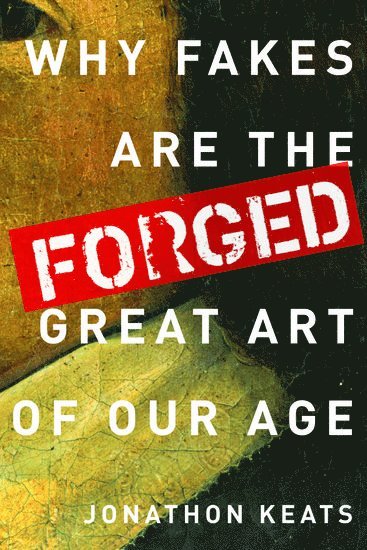
According to Vasari, the young Michelangelo often borrowed drawings of past masters, which he copied, returning his imitations to the owners and keeping originals. Half a millennium later, Andy Warhol made a game of "forging" the Mona Lisa, questioning the entire concept of originality.Forged explores art forgery from ancient times to the present. In chapters combining lively biography with insightful art criticism, Jonathon Keats profiles individual art forgers and connects their stories to broader themes about the role of forgeries in society. From the Renaissance master Andrea del Sarto who faked a Raphael masterpiece at the request of his Medici patrons, to the Vermeer counterfeiter Han van Meegeren who duped the avaricious Hermann Göring, to the frustrated British artist Eric Hebborn, who began forging to expose the ignorance of experts, art forgers have challenged "legitimate" art in their own time, breaching accepted practices and upsetting the status quo. They have also provocatively confronted many of the present-day cultural anxieties that are major themes in the arts. Keats uncovers what forgeries--and our reactions to them--reveal about changing conceptions of creativity, identity, authorship, integrity, authenticity, success, and how we assign value to works of art. The book concludes by looking at how artists today have appropriated many aspects of forgery through such practices as street-art stenciling and share-and-share-alike licensing, and how these open-source "copyleft" strategies have the potential to make legitimate art meaningful again. Forgery has been much discussed--and decried--as a crime. Forged is the first book to assess great forgeries as high art in their own right.
329 kr
Skickas inom 3-6 vardagar
414 kr
Skickas inom 5-8 vardagar
197 kr
Skickas inom 5-8 vardagar
402 kr
Skickas inom 7-10 vardagar
Art, climate change and geopolitics at a time of rapid social and technological change. The Distant Early Warning Line, also known as the DEW Line, was a system of radar stations in the northern Arctic region of Canada, with additional stations along the north coast and Aleutian Islands of Alaska and the Faroe Islands, Greenland and Iceland. It intended to detect incoming bombers of the Soviet Union during the Cold War and provide early warning of any sea and land invasion. Today, the Arctic is seen as a place primed for data storage and vaults – doomsday structures with a utilitarian vernacular of architecture, protecting the “knowledge” of places further south rather than recognising the local presence and expertise of place and Indigenous lifeways and Indigenous science. This book looks at the role of artists as early warning systems and explores the ways we connect and disconnect place and people through technology and the ideas of boundaries. With the DEW Line as a framework, Julie Decker examines ideologies of warning. The DEW Line is a symbol of both past and future. Today, we think about planetary boundaries, the boundaries of survival and other human limits.