
Joonmo Son – Författare
Visar alla böcker från författaren Joonmo Son. Handla med fri frakt och snabb leverans.
4 produkter
4 produkter
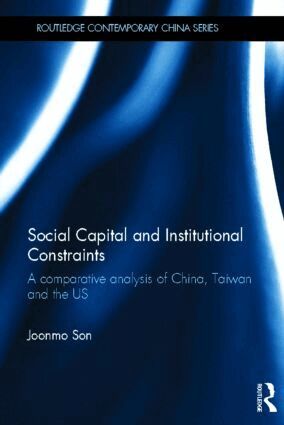
Social Capital and Institutional Constraints
A Comparative Analysis of China, Taiwan and the US
Inbunden, Engelska, 2012
2 181 kr
Skickas inom 10-15 vardagar
The sociological concept of social capital has grown in popularity in recent years and research programs in North America, Europe, and East Asia have demonstrated how social capital has a significant impact on occupational mobility, community building, social movement, and economic development. This book uses new empirical data to test how social capital works in different societies with diverse political-economic and cultural institutions. Taking a comparative approach, this study focuses on data from three different societies, China, Taiwan, and the United States, in order to reveal the international commonalities and disparities in access to, and activation of, social capital in labor markets. In particular, this book tests whether political economic and cultural differences between capitalist and socialist economic systems and between Western and Confucian cultures create different types of individual social networks and usages. This comparison leads to Joonmo Son’s fundamental argument that the institutional constraints of a society’s political economy on the one hand, and culture on the other, profoundly impact on both the composition and utilization of social capital.Based on rigorous statistical analysis, this book will be essential reading for students and scholars of social capital, economic sociology, and comparative politics.
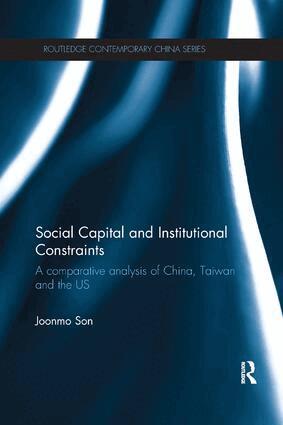
Social Capital and Institutional Constraints
A Comparative Analysis of China, Taiwan and the US
Häftad, Engelska, 2017
673 kr
Skickas inom 10-15 vardagar
The sociological concept of social capital has grown in popularity in recent years and research programs in North America, Europe, and East Asia have demonstrated how social capital has a significant impact on occupational mobility, community building, social movement, and economic development. This book uses new empirical data to test how social capital works in different societies with diverse political-economic and cultural institutions. Taking a comparative approach, this study focuses on data from three different societies, China, Taiwan, and the United States, in order to reveal the international commonalities and disparities in access to, and activation of, social capital in labor markets. In particular, this book tests whether political economic and cultural differences between capitalist and socialist economic systems and between Western and Confucian cultures create different types of individual social networks and usages. This comparison leads to Joonmo Son’s fundamental argument that the institutional constraints of a society’s political economy on the one hand, and culture on the other, profoundly impact on both the composition and utilization of social capital.Based on rigorous statistical analysis, this book will be essential reading for students and scholars of social capital, economic sociology, and comparative politics.

643 kr
Skickas inom 7-10 vardagar
Social capital is a principal concept across the social sciences and has readily entered into mainstream discourse. In short, it is popular. However, this popularity has taken its toll. Social capital suffers from a lack of consensus because of the varied ways it is measured, defined, and deployed by different researchers. It has been put to work in ways that stretch and confuse its conceptual value, blurring the lines between networks, trust, civic engagement, and any type of collaborative action. This clear and concise volume presents the diverse theoretical approaches of scholars from Marx, Coleman, and Bourdieu to Putnam, Fukuyama, and Lin, carefully analyzing their commonalities and differences. Joonmo Son categorizes this wealth of work according to whether its focus is on the necessary preconditions for social capital, its structural basis, or its production. He distinguishes between individual and collective social capital (from shared resources of a personal network to pooled assets of a whole society), and interrogates the practical impact social capital has had in various policy areas (from health to economic development). Social Capital will be of immense value to readers across the social sciences and practitioners in relevant fields seeking to understand this mercurial concept.

218 kr
Skickas inom 7-10 vardagar
Social capital is a principal concept across the social sciences and has readily entered into mainstream discourse. In short, it is popular. However, this popularity has taken its toll. Social capital suffers from a lack of consensus because of the varied ways it is measured, defined, and deployed by different researchers. It has been put to work in ways that stretch and confuse its conceptual value, blurring the lines between networks, trust, civic engagement, and any type of collaborative action. This clear and concise volume presents the diverse theoretical approaches of scholars from Marx, Coleman, and Bourdieu to Putnam, Fukuyama, and Lin, carefully analyzing their commonalities and differences. Joonmo Son categorizes this wealth of work according to whether its focus is on the necessary preconditions for social capital, its structural basis, or its production. He distinguishes between individual and collective social capital (from shared resources of a personal network to pooled assets of a whole society), and interrogates the practical impact social capital has had in various policy areas (from health to economic development). Social Capital will be of immense value to readers across the social sciences and practitioners in relevant fields seeking to understand this mercurial concept.