José Antonio Cheibub – författare
Visar alla böcker från författaren José Antonio Cheibub. Handla med fri frakt och snabb leverans.
6 produkter
6 produkter
Inbunden, Engelska, 2015
1 303 kr
Skickas inom 5-8 vardagar
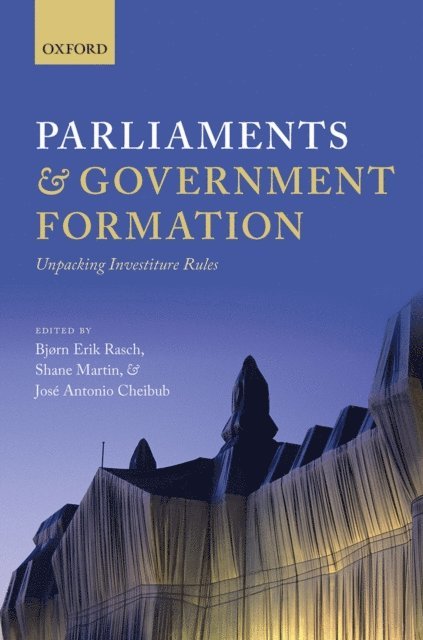
Parliaments and Government Formation explores the role of national legislatures in shaping government formation in parliamentary regimes. Under parliamentarism, the government comes from, and remains responsible to, the national parliament. Yet, although legislatures and the politics of government formation are two of the most studied phenomenon in comparative politics, relatively little attention has focused on the degree to which parliamentary rules and procedures impact government formation. For instance, exactly what does 'come from parliament' mean in the context of government formation? To answer this question, the volume seeks to 'unpack' the parliamentary investiture vote. Investiture consists of a vote in parliament to demonstrate that an already formed or about to be formed government has legislative support. The volume analyses investiture along six dimensions: (1) the number of chambers involved in government formation, (2) the exact topic of any investiture vote - for example whether the votes focuses on one or more of the prime ministership, the cabinet and/or the government's policy program, (3) the sequencing and timing of the vote in the overall game of government formation, (4) the decision rule - for example absolute majority, simple or some form of negative parliamentarism, (5) the number of rounds provided for, and (6) what happens in the event of a failure to invest a government. Each of the 16 case studies, written by leading scholars of legislative politics in their respective polities, seeks to describe the institutional rules and practices and analyse their origins and consequences. These case studies are supplemented with two comparative chapters.
Häftad, Engelska, 2003
826 kr
Skickas inom 5-8 vardagar
Häftad, Engelska, 2006
317 kr
Skickas inom 7-10 vardagar
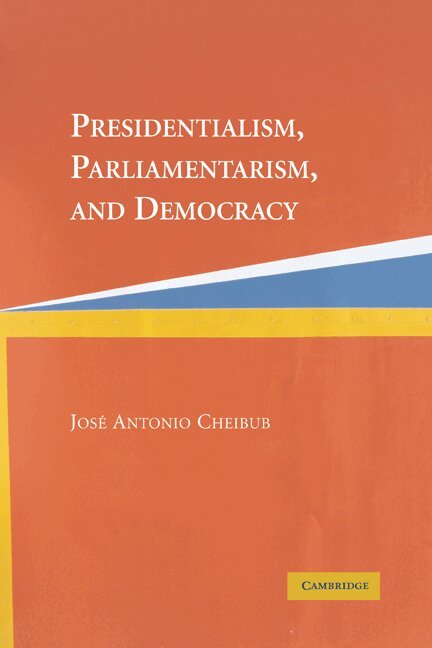
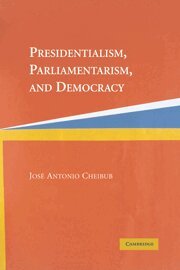
This book addresses the following question: why are presidential democracies more likely to break down than parliamentary ones? Conventional wisdom among political scientists pointS to the incentives generated by the form of government itself; the independence of the executive and legislature that defines presidentialism generates incentives that are not conducive to the consolidation of democracy. On the basis of a data set that covers all democracies between 1946 and 2002, this book demonstrates that this is not the case: the incentives generated by presidentialism are as conducive to the consolidation of democracy as the ones generated by parliamentarism. The book argues that what kills presidentialism is the fact that it exists in countries where democracies of any type are not likely to survive. This book will be of interest to academic researchers, graduates and advanced undergraduates enrolled in courses on comparative politics and political economy.
Del 3 - Cambridge Studies in the Theory of Democracy
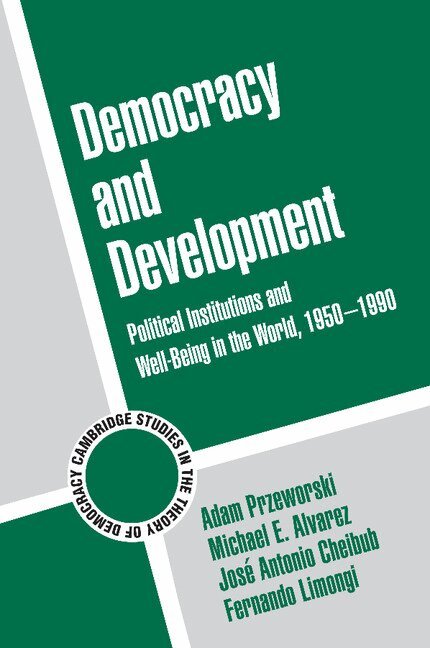
Democracy and Development
Political Institutions and Well-Being in the World, 1950-1990
Inbunden, Engelska, 2000
1 071 kr
Skickas inom 7-10 vardagar
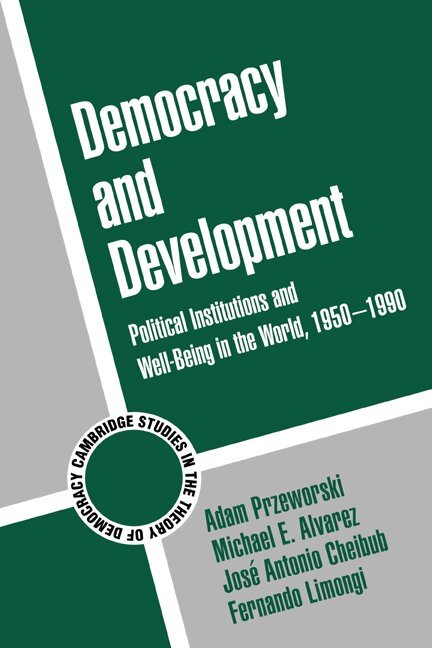
Is economic development conducive to political democracy? Does democracy foster or hinder material welfare? These two questions are examined by looking at the experience of 135 countries between 1950 and 1990. Descriptive information, statistical analyses, and historical narratives are interwoven to gain an understanding of the dynamic of political regimes and their impact on economic development and other aspects of material welfare. The findings, several most surprising, dispel any notion of a trade-off between democracy and development. Economic development does not generate democracies but democracies are much more likely to survive in wealthy societies. Political regimes have no impact on the growth of total national incomes, while political instability affects growth only in dictatorships. Per capita incomes grow faster in democracies since population increases faster under dictatorships. In general, political regimes have more of an effect on demography than on economics.
Del 3 - Cambridge Studies in the Theory of Democracy
Democracy and Development
Political Institutions and Well-Being in the World, 1950-1990
Häftad, Engelska, 2000
330 kr
Skickas inom 7-10 vardagar
Is economic development conducive to political democracy? Does democracy foster or hinder material welfare? These two questions are examined by looking at the experience of 135 countries between 1950 and 1990. Descriptive information, statistical analyses, and historical narratives are interwoven to gain an understanding of the dynamic of political regimes and their impact on economic development and other aspects of material welfare. The findings, several most surprising, dispel any notion of a trade-off between democracy and development. Economic development does not generate democracies but democracies are much more likely to survive in wealthy societies. Political regimes have no impact on the growth of total national incomes, while political instability affects growth only in dictatorships. Per capita incomes grow faster in democracies since population increases faster under dictatorships. In general, political regimes have more of an effect on demography than on economics.
Inbunden, Engelska, 2006
570 kr
Skickas inom 7-10 vardagar
This book addresses the following question: why are presidential democracies more likely to break down than parliamentary ones? Conventional wisdom among political scientists pointS to the incentives generated by the form of government itself; the independence of the executive and legislature that defines presidentialism generates incentives that are not conducive to the consolidation of democracy. On the basis of a data set that covers all democracies between 1946 and 2002, this book demonstrates that this is not the case: the incentives generated by presidentialism are as conducive to the consolidation of democracy as the ones generated by parliamentarism. The book argues that what kills presidentialism is the fact that it exists in countries where democracies of any type are not likely to survive. This book will be of interest to academic researchers, graduates and advanced undergraduates enrolled in courses on comparative politics and political economy.