José Rabasa - Böcker
Visar alla böcker från författaren José Rabasa. Handla med fri frakt och snabb leverans.
5 produkter
5 produkter
1 021 kr
Skickas inom 7-10 vardagar
Volume III of The Oxford History of Historical Writing contains essays by leading scholars on the writing of history globally during the early modern era, from 1400 to 1800. The volume proceeds in geographic order from east to west, beginning in Asia and ending in the Americas. It aims at once to provide a selective but authoritative survey of the field and, where opportunity allows, to provoke cross-cultural comparisons. This is the third of five volumes in a series that explores representations of the past from the beginning of writing to the present day, and from all over the world.
2 662 kr
Skickas inom 5-8 vardagar
Volume III of The Oxford History of Historical Writing contains essays by leading scholars on the writing of history globally during the early modern era, from 1400 to 1800. The volume proceeds in geographic order from east to west, beginning in Asia and ending in the Americas. It aims at once to provide a selective but authoritative survey of the field and, where opportunity allows, to provoke cross-cultural comparisons. This is the third of five volumes in a series that explores representations of the past from the beginning of writing to the present day, and from all over the world.
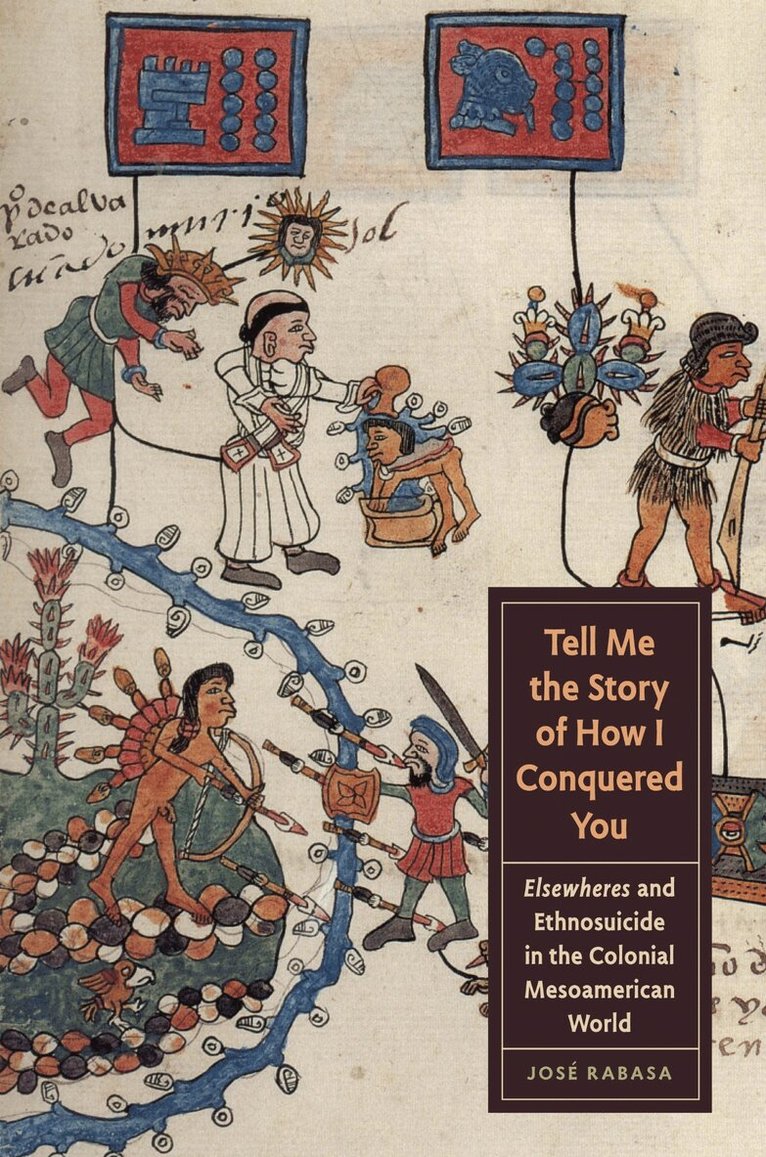
Tell Me the Story of How I Conquered You
Elsewheres and Ethnosuicide in the Colonial Mesoamerican World
Häftad, Engelska, 2011
287 kr
Skickas inom 10-15 vardagar
Folio 46r from Codex Telleriano-Remensis was created in the sixteenth century under the supervision of Spanish missionaries in central Mexico. As an artifact of seismic cultural and political shifts, the manuscript painting is a singular document of indigenous response to Spanish conquest. Examining the ways in which the folio's tlacuilo (indigenous painter/writer) creates a pictorial vocabulary, this book embraces the place "outside" history from which this rich document emerged.Applying contemporary intellectual perspectives, including aspects of gender, modernity, nation, and visual representation itself, JosÉ Rabasa reveals new perspectives on colonial order. Folio 46r becomes a metaphor for reading the totality of the codex and for reflecting on the postcolonial theoretical issues now brought to bear on the past. Ambitious and innovative (such as the invention of the concepts of elsewheres and ethnosuicide, and the emphasis on intuition), Tell Me the Story of How I Conquered You embraces the performative force of the native scribe while acknowledging the ineffable traits of 46r-traits that remain untenably foreign to the modern excavator/scholar. Posing provocative questions about the unspoken dialogues between evangelizing friars and their spiritual conquests, this book offers a theoretic-political experiment on the possibility of learning from the tlacuilo ways of seeing the world that dislocate the predominance of the West.
269 kr
Skickas inom 10-15 vardagar
In Inventing America, José Rabasa presents the view that Columbus's historic act was not a discovery, and still less an encounter. Rather, he considers it the beginning of a process of inventing a New World in the sixteenth century European consciousness. The notion of America as a European invention challenges the popular conception of the New World as a natural entity to be discovered or understood, however imperfectly. This book aims to debunk complacency with the historic, geographic, and cartographic rudiments underlying our present picture of the world.
Without History
Subaltern Studies, the Zapatista Insurgency, and the Specter of History
Häftad, Engelska, 2010
721 kr
Skickas inom 7-10 vardagar
On December 22, 1997, forty-five unarmed members of the indigenous organization Las Abejas (The Bees) were massacred during a prayer meeting in the village of Acteal, Mexico. The members of Las Abejas, who are pacifists, pledged their support to the Zapatista Army of National Liberation, a primarily indigenous group that has declared war on the state of Mexico. The massacre has been attributed to a paramilitary group composed of ordinary citizens acting on their own, although eyewitnesses claim the attack was planned ahead of time and that the Mexican government was complicit.In Without History, Jos\u00e9 Rabasa contrasts indigenous accounts of the Acteal massacre and other events with state attempts to frame the past, control subaltern populations, and legitimatize its own authority. Rabasa offers new interpretations of the meaning of history from indigenous perspectives and develops the concept of a communal temporality that is not limited by time, but rather exists within the individual, community, and culture as a living knowledge that links both past and present. Due to a disconnection between indigenous and state accounts as well as the lack of archival materials (many of which were destroyed by missionaries), the indigenous remain outside of, or without, history, according to most of Western discourse. The continued practice of redefining native history perpetuates the subalternization of that history, and maintains the specter of fabrication over reality.Rabasa recalls the works of Marx, Lenin, and Gramsci, as well as contemporary south Asian subalternists Ranajit Guha and Dipesh Chakrabarty, among others. He incorporates their conceptions of communality, insurgency, resistance to hegemonic governments, and the creation of autonomous spaces as strategies employed by indigenous groups around the globe, but goes further in defining these strategies as millennial and deeply rooted in Mesoamerican antiquity. For Rabasa, these methods and the continuum of ancient indigenous consciousness are evidenced in present day events such as the Zapatista insurrection.