José Ramón Montero - Böcker
Visar alla böcker från författaren José Ramón Montero. Handla med fri frakt och snabb leverans.
10 produkter
10 produkter
2 193 kr
Skickas inom 5-8 vardagar
This book, with contributions from leading scholars in the field, presents a critical overview of much of the recent literature on political parties. It systematically assesses the capacity of existing concepts, typologies, and methodological approaches to deal with contemporary parties. It critically analyses the 'decline of parties' literature both from a conceptual perspective and - with regard to antiparty attitudes among citizens - on the basis of empirical analyses of survey data. It systematically re-examines the underpinnings of rational-choice analyses of electoral competition, as well as the misapplication of standard party models as the 'catch-all party.' Several chapters reexamine existing models of parties and party typologies, particularly with regard to the capacity of commonly used concepts to capture the wide variation among parties that exist in old and new democracies today, and with regard to their ability to deal adequately with the new challenges that parties are facing in rapidly changing political, social and technological environments. In particular, two detailed case studies demonstrate how party models are significant not only as frameworks for scholarly research, but also insofar as they can affect party performance. Other chapters also examine in detail how corruption and party patronage have contributed to party decline, as well as the public attitudes towards parties in several countries. In the aggregate, the various contributions to this volume reject the notion that a 'decline of party' has progressed to such an extent as to threaten the survival of parties as the crucial intermediary actors in modern democracies. The contributing authors argue, however, that parties are facing a new set of sometimes demanding challenges. Not only have parties differed significantly in their ability to successfully meet these challenges, but the core concepts, typologies, party chdels and methodological approaches that have guided research in this area over the past 40 years have met with only mixed success in adequately capturing these recent developments and serving as fruitful frameworks for analysis. This book is intended to remedy some of these shortcomings.
1 701 kr
Skickas inom 5-8 vardagar
This book offers a systematic exploration of the role of religion and religiosity in electoral politics in Catholic, Protestant, and religiously mixed countries across Western Europe and in the United States. The chapters approach the relationship between religion, religiosity, and electoral behaviour from a variety of different angles. They include analyses of secularization trends; comparative studies of the links between vote choice and religiosity; longitudinal single country studies; and a novel discussion of the theoretical underpinnings of the politicization of religion that provides a radically new framework for the analysis of the role of religiosity in election studies.The volume shows that despite the expectations of secularization theory, religiosity remains relevant when casting votes. It also argues that the traditional notion of religious cleavage should be replaced with the more accurate idea of religious voting. Chapters draw on National Election Studies data and comparative datasets such as European Values Studies (EVS), European Social Surveys (ESS), and European Election Studies (EES) to empirically test expectations regarding religious voting. The results show that variations in religious voting are conditional on both the agency of political and ecclesiastical leaders when politicizing religious issues and the legacies of previous societal and political religious conflicts, regardless of whether the original party system had a predominant religious cleavage.
2 025 kr
Skickas inom 3-6 vardagar
This book presents the results of systematic comparative analyses of electoral behavior and support for democracy in 13 countries on four continents. It is based on national election surveys held in "old" and "new" democracies in Europe (Germany, Britain, Spain, Greece, Italy, Portugal, Bulgaria), North and South America (the United States, Chile and Uruguay), and Asia (Hong Kong) between 1990 and 2004. It is methodologically innovative, notwithstanding the fact that its core concern with "political intermediation" (i.e., the flow of political information from parties and candidates to voters through the mass-communications media, membership in secondary associations, and direct, face-to-face contacts within interpersonal networks) was first introduced to the study of electoral behavior by Paul Lazarsfeld and his collaborators in the 1940s. In addition to reviving that long-neglected analytical framework, this book breaks new ground by systematically exploring the impact of socio-political values on electoral behavior. It also analyzes the role of political intermediation in forming basic attitudes towards democracy (which are crucial for the consolidation of new democracies), and, in turn, channeling those orientations into various forms of political behavior. Some of the findings presented in this volume are dramatic, and clearly reveal that these channels of information are among the most powerful factors influencing the development of political attitudes and partisan electoral behavior. So, too, are socio-political values in some countries (particularly the United States). This volume is the first book-length product of the now 18-country Comparative National Elections Project.
380 kr
Skickas inom 7-10 vardagar
This book presents the results of systematic comparative analyses of electoral behavior and support for democracy in 13 countries on four continents. It is based on national election surveys held in "old" and "new" democracies in Europe (Germany, Britain, Spain, Greece, Italy, Portugal, Bulgaria), North and South America (the United States, Chile and Uruguay), and Asia (Hong Kong) between 1990 and 2004. It is methodologically innovative, notwithstanding the fact that its core concern with "political intermediation" (i.e., the flow of political information from parties and candidates to voters through the mass-communications media, membership in secondary associations, and direct, face-to-face contacts within interpersonal networks) was first introduced to the study of electoral behavior by Paul Lazarsfeld and his collaborators in the 1940s. In addition to reviving that long-neglected analytical framework, this book breaks new ground by systematically exploring the impact of socio-political values on electoral behavior. It also analyzes the role of political intermediation in forming basic attitudes towards democracy (which are crucial for the consolidation of new democracies), and, in turn, channeling those orientations into various forms of political behavior. Some of the findings presented in this volume are dramatic, and clearly reveal that these channels of information are among the most powerful factors influencing the development of political attitudes and partisan electoral behavior. So, too, are socio-political values in some countries (particularly the United States). This volume is the first book-length product of the now 18-country Comparative National Elections Project.
725 kr
Skickas inom 7-10 vardagar
This book, with contributions from leading scholars in the field, presents a critical overview of much of the recent literature on political parties. It systematically assesses the capacity of existing concepts, typologies, and methodological approaches to deal with contemporary parties. It critically analyses the 'decline of parties' literature both from a conceptual perspective and - with regard to antiparty attitudes among citizens - on the basis of empirical analyses of survey data. It systematically re-examines the underpinnings of rational-choice analyses of electoral competition, as well as the misapplication of standard party models as the 'catch-all party.' Several chapters reexamine existing models of parties and party typologies, particularly with regard to the capacity of commonly used concepts to capture the wide variation among parties that exist in old and new democracies today, and with regard to their ability to deal adequately with the new challenges that parties are facing in rapidly changing political, social and technological environments. In particular, two detailed case studies demonstrate how party models are significant not only as frameworks for scholarly research, but also insofar as they can affect party performance. Other chapters also examine in detail how corruption and party patronage have contributed to party decline, as well as the public attitudes towards parties in several countries. In the aggregate, the various contributions to this volume reject the notion that a 'decline of party' has progressed to such an extent as to threaten the survival of parties as the crucial intermediary actors in modern democracies. The contributing authors argue, however, that parties are facing a new set of sometimes demanding challenges. Not only have parties differed significantly in their ability to successfully meet these challenges, but the core concepts, typologies, party models and methodological approaches that have guided research in this area over the past 40 years have met with only mixed success in adequately capturing these recent developments and serving as fruitful frameworks for analysis. This book is intended to remedy some of these shortcomings.
694 kr
Skickas inom 5-8 vardagar
This book, written by three of the world’s leading experts on Spanish politics, is the first comprehensive study of the origins and basic character of Spain’s democratic political system. It analyzes the regime’s core political institutions, its political parties and party systems, patterns of electoral behavior, the evolution of Spain’s political culture, and the impact of these social and institutional changes on public policy processes and outputs.The authors survey those aspects of Spanish society and politics that had contributed to the country’s inability to sustain a stable and democratic regime prior to the 1970s. They argue that the successful transition to and consolidation of democracy was made possible by socioeconomic modernization, cultural change, and by decisions made by political elites in the establishment of core democratic institutions and the conduct of electoral competition. This book is based on over 500 hours of interviews with Spanish political elites, extensive analyses of survey data, and other original research.
Political Disaffection in Contemporary Democracies
Social Capital, Institutions and Politics
Inbunden, Engelska, 2006
1 362 kr
Skickas inom 10-15 vardagar
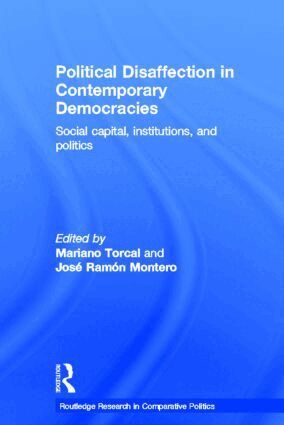
Citizens of many democracies are becoming more critical of basic political institutions and detached and disaffected from politics in general. This is a new comparative analysis of this trend that focuses on major democracies throughout Latin America, Asia and Central Europe. It brings together leading scholars to address three key areas of the current debate:the conceptual discussion surrounding political disaffection the factors causing voters to turn away from politics the actual consequences for democracyThis is a highly relevant topic as representative democracies are coming to face new developments. It deals with the reasons and consequences of the so called ‘democratic deficit’ in a systematic way that enables the reader to develop a well-rounded sense of the area and its main debates.This book is an invaluable resource for all students of political science, sociology, cultural studies and comparative politics.
2 155 kr
Skickas inom 10-15 vardagar
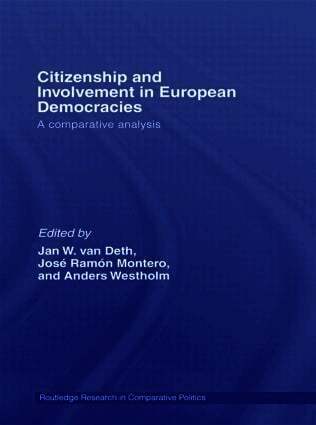
This unique study presents the results of a cross-national analysis of citizenship and participation among citizens in twelve European democracies.Research on the future and quality of contemporary democracy is usually restricted to focus either on political participation, on particular aspects of citizenship, or on social activities, exclusively. This new book offers the first empirical investigation of the relationships both between social and political involvement, and between ‘small-scale’ and ‘large-scale’ democracies. Citizenship and Involvement in European Democracies offers representative samples of the populations in a selection of European countries between 2000-2002, including: Denmark, Germany (East and West), Moldova, the Netherlands, Norway, Portugal, Romania, Russia, Slovenia, Spain, Sweden, and Switzerland. The leading contributors provide new theoretical insights and offer a broad conceptualization of citizenship, stimulating the ongoing discussions about the problems and challenges of democratic political systems.This book has a companion volume entitled Social Capital and Associations in European Democracies edited by William A. Maloney and Sigrid Roßteutscher (Routledge, 2006). Both volumes will be of great interest to students and researchers of European politics, comparative politics and sociology.
807 kr
Skickas inom 10-15 vardagar
This unique study presents the results of a cross-national analysis of citizenship and participation among citizens in twelve European democracies.Research on the future and quality of contemporary democracy is usually restricted to focus either on political participation, on particular aspects of citizenship, or on social activities, exclusively. This new book offers the first empirical investigation of the relationships both between social and political involvement, and between ‘small-scale’ and ‘large-scale’ democracies. Citizenship and Involvement in European Democracies offers representative samples of the populations in a selection of European countries between 2000-2002, including: Denmark, Germany (East and West), Moldova, the Netherlands, Norway, Portugal, Romania, Russia, Slovenia, Spain, Sweden, and Switzerland. The leading contributors provide new theoretical insights and offer a broad conceptualization of citizenship, stimulating the ongoing discussions about the problems and challenges of democratic political systems.This book has a companion volume entitled Social Capital and Associations in European Democracies edited by William A. Maloney and Sigrid Roßteutscher (Routledge, 2006). Both volumes will be of great interest to students and researchers of European politics, comparative politics and sociology.
Political Disaffection in Contemporary Democracies
Social Capital, Institutions and Politics
Häftad, Engelska, 2012
441 kr
Skickas inom 10-15 vardagar
Citizens of many democracies are becoming more critical of basic political institutions and detached and disaffected from politics in general. This is a new comparative analysis of this trend that focuses on major democracies throughout Latin America, Asia and Central Europe. It brings together leading scholars to address three key areas of the current debate:the conceptual discussion surrounding political disaffection the factors causing voters to turn away from politics the actual consequences for democracyThis is a highly relevant topic as representative democracies are coming to face new developments. It deals with the reasons and consequences of the so called ‘democratic deficit’ in a systematic way that enables the reader to develop a well-rounded sense of the area and its main debates.This book is an invaluable resource for all students of political science, sociology, cultural studies and comparative politics.