Josef Michl - Böcker
Visar alla böcker från författaren Josef Michl. Handla med fri frakt och snabb leverans.
6 produkter
6 produkter
3 625 kr
Skickas inom 7-10 vardagar
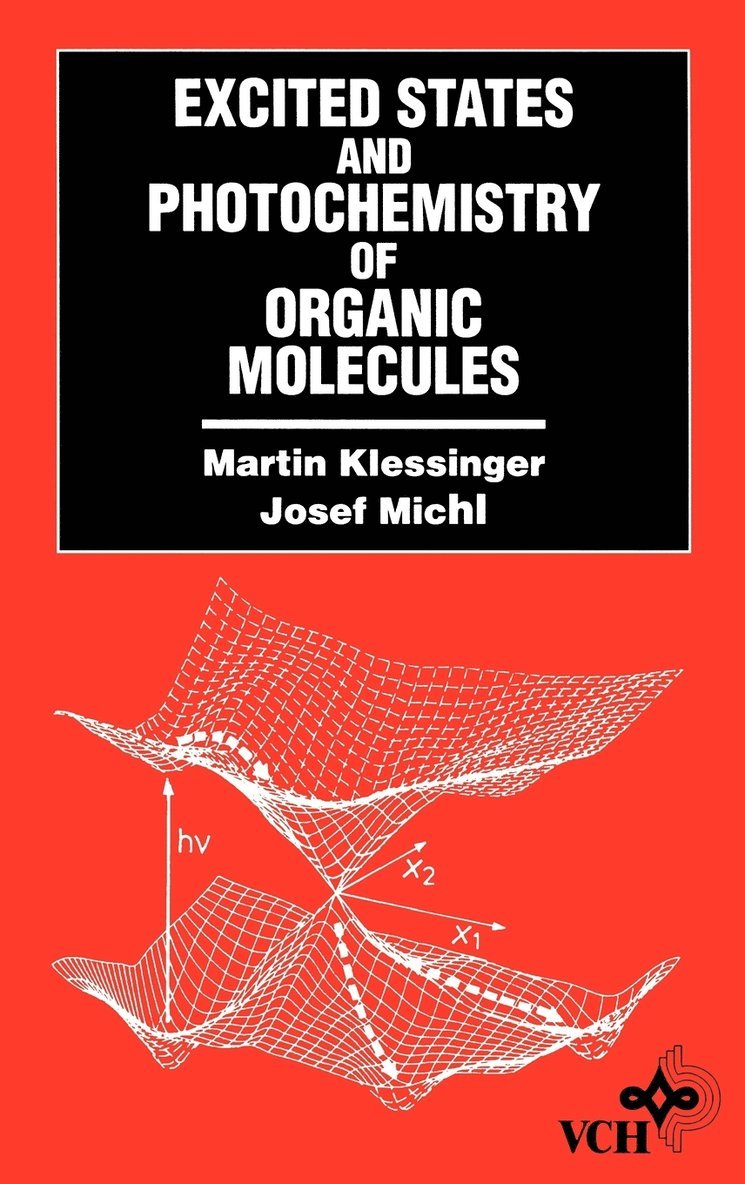
This volume provides a non-mathematical introduction to electronic excitation in organic molecules and their spectroscopy, photophysics, and photochemistry. Simple qualitative models, such as the perimeter model, are used to describe the nature of electronic states, and this book reveals how these states are probed by spectroscopy with ordinary and polarized light, including natural and magnetic circular dichroism. The concept of potential energy surfaces is emphasized in discussing the photophysical processes and photochemical reactions that follow excitation. Particular attention is paid to the behavior of molecules at biradicaloid geometries and spin-orbit coupling in biradicals. Simple intuitive models for electronic structure and reactivity are emphasized, and practical application of theory is illustrated through numerous worked examples.
Spectroscopy with Polarized Light
Solute Alignment by Photoselection, Liquid Crystal, Polymers, and Membranes Corrected Software Edition
Häftad, Engelska, 1995
2 996 kr
Skickas inom 5-8 vardagar
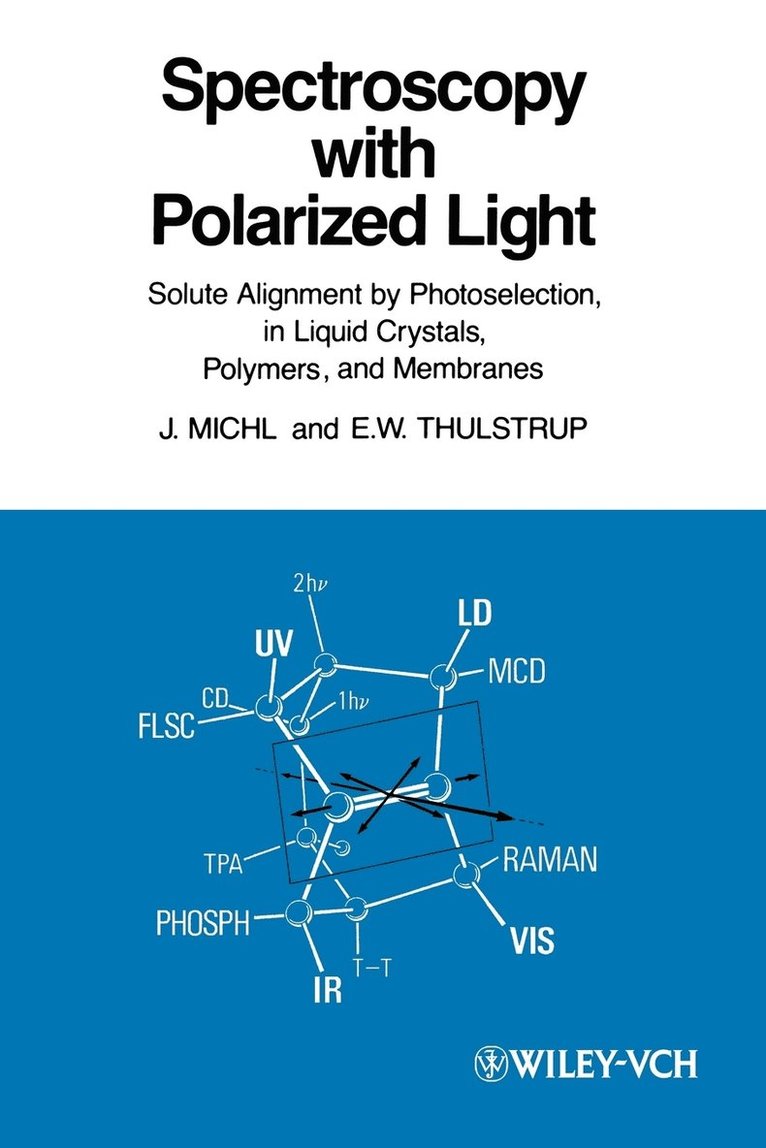
This book deals with polarized optical spectroscopy of partially oriented fluid or rigid solutions. Starting from elementary concepts and relying on numerous illustrations, it provides an introduction to those interested in the measurement of the anisotropy of molecular optical properties in the UV, visible or IR regions (one- and two- photon absorption, simultaneous or sequential, luminescence, Raman scattering, natural and magnetic potical activity), or in the determination of uniaxial order and organization in supermolecular assemblies (liquid crystals, stretched polymers, membranes). The orienting effects of radiation (photoselection) are covered as well. A large number of examples of research applications within chemistry, biophysics, biochemistry, and polymer science are given together with examples of practical application.
2 857 kr
Skickas inom 7-10 vardagar
This book offers an elementary introduction to optical spectroscopy with polarized light. It is written at a level suitable for undergraduate students in chemistry and undergraduate or graduate students in related disciplines such as biochemistry, biology, chemical engineering and materials science. It emphasizes the qualitative concepts and deemphasizes mathematics, yet provides sufficient information and practical hints for experiments. With this book in hand, anyone who can measure an ordinary infrared, ultraviolet or visible absorption or fluorescence emission spectrum can measure a polarized one as well and learn far more about the sample.
Modular Chemistry
Proceedings of the NATO Advanced Research Workshop, Aspen Lodge Near Estes Park, Colorado, USA, September 9-12, 1995
Inbunden, Engelska, 1997
852 kr
Skickas inom 10-15 vardagar
Modular chemistry involves the assembly of well defined, relatively large functional structures from repetitive units that themselves are molecules of some complexity. The two most visible sources underlying modular chemistry are supramolecular ("self assembly") chemistry and polymer chemistry, but the appeal of the field is to crystallographers, solid-state chemists and physicists, small-molecule organic synthetic chemists, inorganic coordination or main group chemists, photochemists and physicists, surface chemists, electrochemists, carbon or semiconductor cluster chemists, biochemists, biomimetic chemists, biomineral chemists, materials scientists, microscopists and theoreticians, those working in "molecular electronics", nonlinear optics, and with Langmuir-Blodgett or self-assembly monolayers, or liquid crystals. The book captures the interdisciplinary nature of the subject, concentrating on up-to-date results. The result is a peer-reviewed volume on where modular chemists stand, where they are going, and what they propose to do when they get there.
536 kr
Skickas inom 10-15 vardagar
536 kr
Skickas inom 10-15 vardagar
Modular Chemistry: the First Steps In recent years, there has been increasing interest among chemists, physicists, materials scientists, biologists, engineers, and others in the assembly of well defmed, relatively large functional structures from repetitive units that themselves are molecules of some complexity. Using the dictionary defmition of a module (a detachable section, compartment, or unit with a specific purpose or function, and in electronics, a compact assembly functioning as a component of a larger unit) [1], we feel that this newly emerging field of endeavor could be called "modular chemistry" [2]. The NATO Advanced Research Workshop on Modular Chemistry that was held on September 9 to 12, 1995, at Aspen Lodge near Estes Park, Colorado, was meant to bring together prominent contributors to modular chemistry as it is being born, and to examine the associated birth pangs. It was concluded that although real, these are not nearly as bad as giving birth to a hedgehog tail first, and that the ultimate rewards were likely to be far more satisfying in terms of new ideas and enabling methodology. The level of excitement about the possibilities that are opening up for modular chemists, and also the challenge involved, are perhaps best documented by noting that the planned discussion periods at the workshop were as long as the oral presentation periods, and yet, each discussion ran over the allocated time.