Joseph J. Duggan - Böcker
Visar alla böcker från författaren Joseph J. Duggan. Handla med fri frakt och snabb leverans.
4 produkter
4 produkter
698 kr
Skickas inom 5-8 vardagar
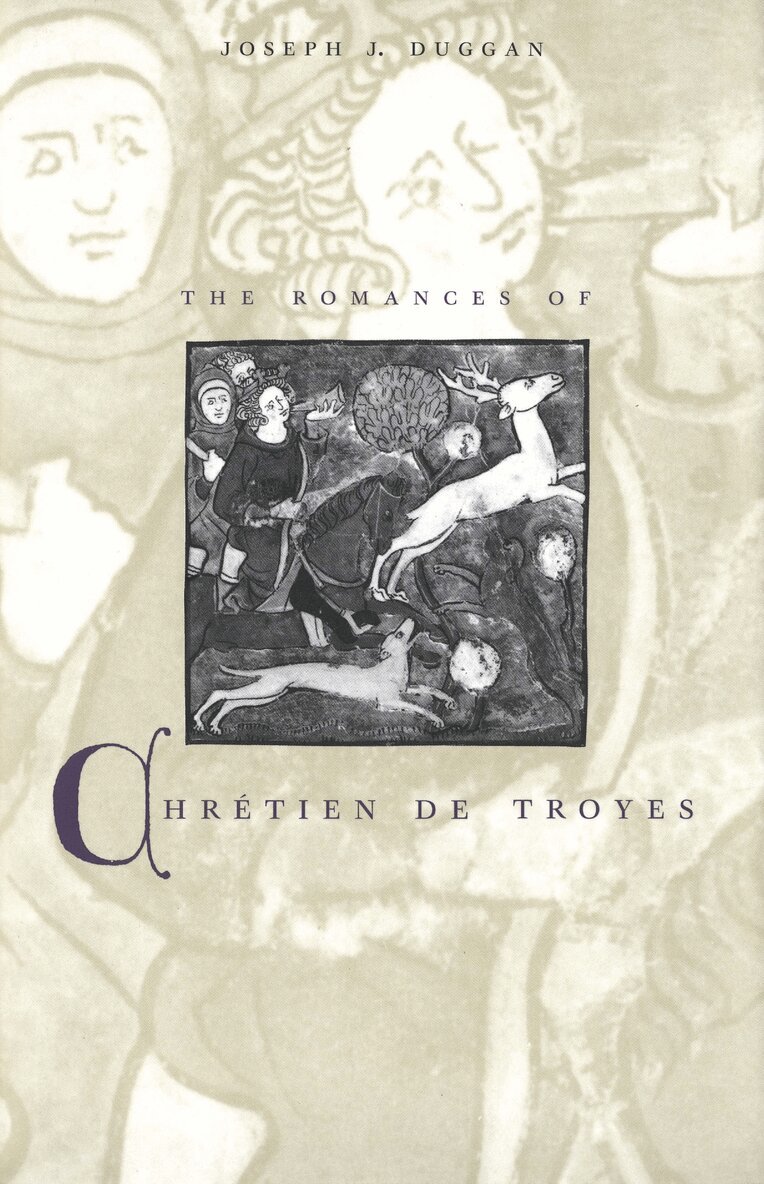
Twelfth-century French poet Chrétien de Troyes was one of the most influential figures in Western literature, for his romantic poems on the legend of King Arthur gave rise to a tradition of storytelling that continues to this day. This important and fascinating book is a study of all of Chrétien’s work.Joseph J. Duggan begins with an introduction that sets Chrétien within the social and intellectual currents of his time. He then organizes the book in chapters that focus on major issues in Chrétien’s romances rather than on individual works, topics that range from the importance of kinship and genealogy to standards of secular moral responsibility and from Chrétien’s art of narration to his representation of knighthood. Duggan offers new perspectives on many of these themes: in a chapter on the influence of Celtic mythology, for example, he gives special attention to the ways Chrétien integrated portrayals of motivation with mythic themes and characters, and in discussing the Grail romance, he explores the parallels between Perceval’s and Gauvain’s adventures.
Del 6 - Center for Medieval and Renaissance Studies, UCLA
Song of Roland
Formulaic Style and Poetic Craft
Häftad, Engelska, 2022
764 kr
Skickas inom 3-6 vardagar
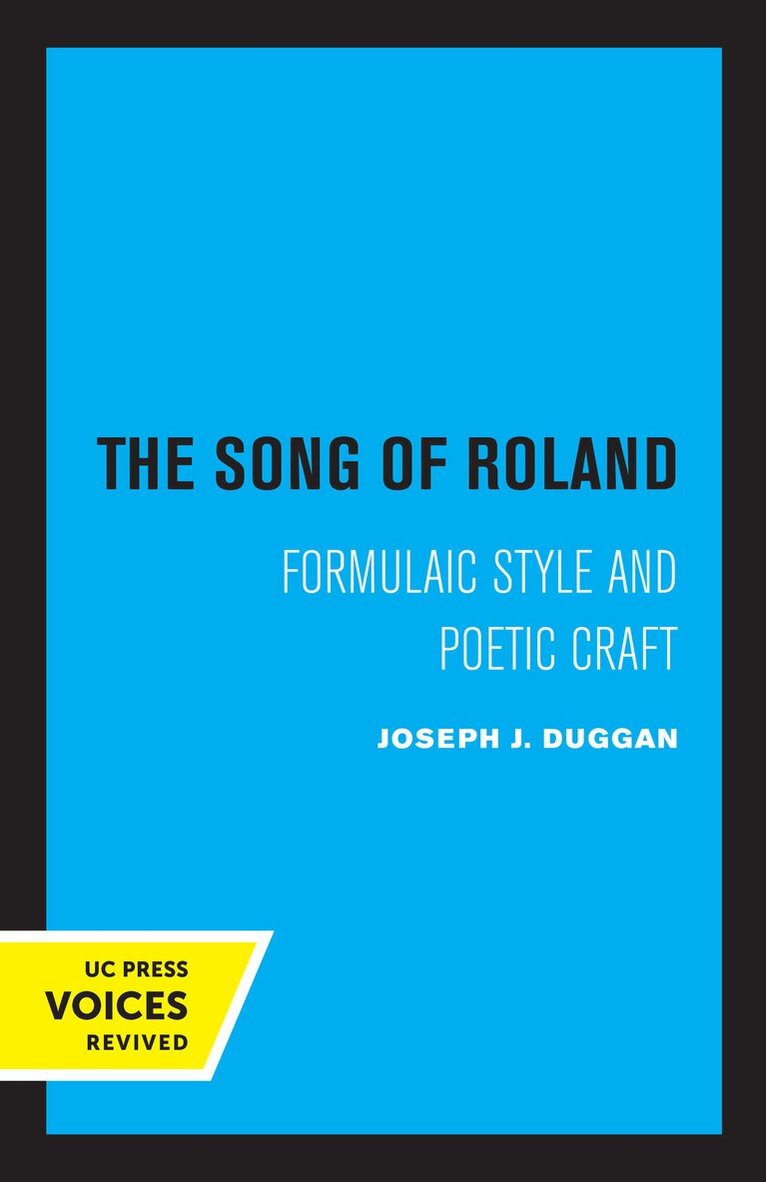
The Song of Roland: Formulaic Style and Poetic Craft by Joseph J. Duggan offers a groundbreaking reevaluation of one of medieval Europe’s most celebrated epics. Long regarded as a touchstone of French literary tradition, the Chanson de Roland has fueled debates over whether its artistry reflects a single authorial genius or a collective oral inheritance. Duggan brings to this problem a rigorous analysis of formulaic language, employing computer-assisted concordances and statistical study to measure repetition, diction, and compositional patterns. His findings situate the Roland not as an anomalous masterpiece isolated from its tradition, but as a work deeply rooted in the oral-formulaic techniques shared by Old French epic poetry.By integrating close literary analysis with methods adapted from Homeric and Anglo-Saxon studies, Duggan illuminates how the poem’s structure, motifs, and verbal artistry emerge from the dynamics of oral performance. He demonstrates that even Roland’s most famous episodes—his death, his refusal to sound the horn, and the climactic trial of Ganelon—are marked by a density of formulaic expression that links them unmistakably to oral tradition while revealing their poetic power. This study not only reshapes our understanding of the Roland but also advances broader questions about medieval literary culture, authorship, and the relationship between orality and writing.This title is part of UC Press's Voices Revived program, which commemorates University of California Press’s mission to seek out and cultivate the brightest minds and give them voice, reach, and impact. Drawing on a backlist dating to 1893, Voices Revived makes high-quality, peer-reviewed scholarship accessible once again using print-on-demand technology. This title was originally published in 1973.
Del 6 - Center for Medieval and Renaissance Studies, UCLA
Song of Roland
Formulaic Style and Poetic Craft
Inbunden, Engelska, 2022
869 kr
Skickas inom 7-10 vardagar
The Song of Roland: Formulaic Style and Poetic Craft by Joseph J. Duggan offers a groundbreaking reevaluation of one of medieval Europe’s most celebrated epics. Long regarded as a touchstone of French literary tradition, the Chanson de Roland has fueled debates over whether its artistry reflects a single authorial genius or a collective oral inheritance. Duggan brings to this problem a rigorous analysis of formulaic language, employing computer-assisted concordances and statistical study to measure repetition, diction, and compositional patterns. His findings situate the Roland not as an anomalous masterpiece isolated from its tradition, but as a work deeply rooted in the oral-formulaic techniques shared by Old French epic poetry.By integrating close literary analysis with methods adapted from Homeric and Anglo-Saxon studies, Duggan illuminates how the poem’s structure, motifs, and verbal artistry emerge from the dynamics of oral performance. He demonstrates that even Roland’s most famous episodes—his death, his refusal to sound the horn, and the climactic trial of Ganelon—are marked by a density of formulaic expression that links them unmistakably to oral tradition while revealing their poetic power. This study not only reshapes our understanding of the Roland but also advances broader questions about medieval literary culture, authorship, and the relationship between orality and writing.This title is part of UC Press's Voices Revived program, which commemorates University of California Press’s mission to seek out and cultivate the brightest minds and give them voice, reach, and impact. Drawing on a backlist dating to 1893, Voices Revived makes high-quality, peer-reviewed scholarship accessible once again using print-on-demand technology. This title was originally published in 1973.
Del 5 - Cambridge Studies in Medieval Literature
The Cantar de mio Cid
Poetic Creation in its Economic and Social Contexts
Häftad, Engelska, 2008
553 kr
Skickas inom 7-10 vardagar
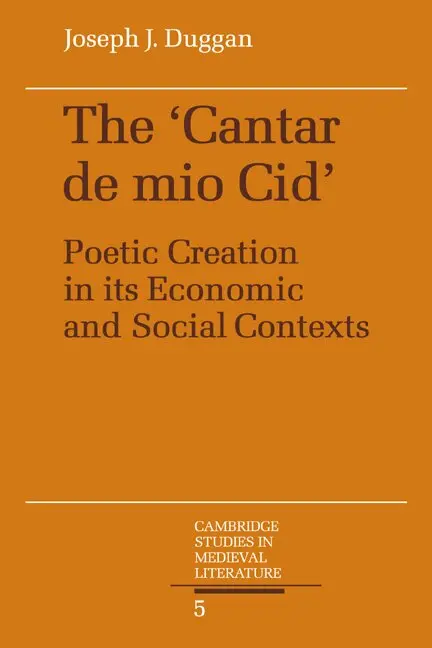
In this study, Joseph Duggan interprets the Cantar de mio Cid as a work that transmutes moral values first into the economic values of a gift economy, then into genealogical values. Considering the poem's distortions of history more significant than its retention of historical features, Duggan ascribes its depiction of the penurious hero who acquires wealth, power, and kinship alliances to the Castilian monarchy's preoccupations with furthering the victory of Las Navas de Tolosa. He maintains that the Cantar de mio Cid was composed around the year 1200 in substantially the form in which we have it now, in the course of a singer's performance. Arguing against a number of tendencies in Cid scholarship, Professor Duggan denies the necessity of assuming that the poet was a man of learning, that he was directly influenced by French literature, or that he was familiar with written law.