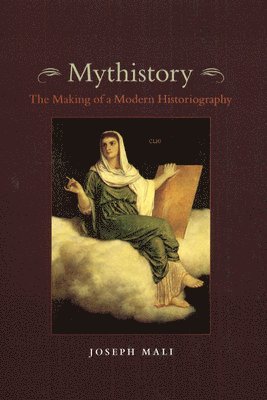
Since the time of Herodotus, historians have debated the role that myth should play in history. Most have sided with Thucydides, who denounced myth as "unscientific". Joseph Mali, on the other hand, argues that the task of modern historiography is to illuminate, not eliminate, historical myths by showing how they have passed into and shaped historical reality. Mali uses the concept of "mythistory" to steer a course between and beyond older views that confined history to "what really happened" and new, postmodern theories that reduce it to what people have merely imagined to have happened. In a tour de force of intellectual history, Mali traces mythistory from the ancient world to the modern, showing, for instance, how Vico and Michelet sought to recover a deeper and truer myth from uncertain history. He pays special attention to Jacob Burckhardt, Aby Warburg, Ernst Kantorowicz and Walter Benjamin. Their work, Mali argues, shows us a different way of imagining the past, acknowledging the crucial role that myth plays in the construction of histories of personal and communal identity.
In this important essay, Joseph Mali argues that Vico's New Science must be interpreted according to Vico's own clues and rules of interpretation, principally his claim that the 'master-key' of his New Science is the discovery of myth. Following this lead Mali shows how Vico came to forge his new scientific theories about the mythopoeic constitution of consciousness, society, and history by reappraising, or 'rehabilitating' the ancient and primitive mythical traditions which still persist in modern times. He further relates Vico's radical redefinition of these traditions as the 'true narrations' of all religious, social, and political practices in the 'civil world' to his unique historical depiction of Western civilisation as evolving in a-rational and cyclical motions. On this account, Mali elaborates the wider, distinctly 'revisionist', implications of Vico's New Science for the modern human sciences. He argues that inasmuch as the New Science exposed the linguistic and other cultural systems of the modern world as being essentially mythopoeic, it challenges not only the Christian and Enlightenment ideologies of progress in his time, but also the main cultural ideologies of our time.
In this highly original study Joseph Mali explores how four attentive and inventive readers of Giambattista Vico's New Science (1744) - the French historian Jules Michelet (1798-1874), the Irish writer James Joyce (1882-1941), the German literary scholar Erich Auerbach (1892-1957) and the English philosopher Isaiah Berlin (1909-97) - came to find in Vico's work the inspiration for their own modern theories (or, in the case of Joyce, stories) of human life and history. Mali's reconstruction of the specific biographical and historical occasions in which these influential men of letters encountered Vico reveals how their initial impressions and interpretations of his theory of history were decisive both for their intellectual development and their major achievements in literature and thought. This new interpretation of the legacy of Vico's New Science is essential reading for all those engaged in the history of ideas and modern cultural history.
In this highly original study Joseph Mali explores how four attentive and inventive readers of Giambattista Vico's New Science (1744) - the French historian Jules Michelet (1798-1874), the Irish writer James Joyce (1882-1941), the German literary scholar Erich Auerbach (1892-1957) and the English philosopher Isaiah Berlin (1909-97) - came to find in Vico's work the inspiration for their own modern theories (or, in the case of Joyce, stories) of human life and history. Mali's reconstruction of the specific biographical and historical occasions in which these influential men of letters encountered Vico reveals how their initial impressions and interpretations of his theory of history were decisive both for their intellectual development and their major achievements in literature and thought. This new interpretation of the legacy of Vico's New Science is essential reading for all those engaged in the history of ideas and modern cultural history.