Joseph P. Ferrie - Böcker
Visar alla böcker från författaren Joseph P. Ferrie. Handla med fri frakt och snabb leverans.
3 produkter
3 produkter
2 019 kr
Skickas inom 5-8 vardagar
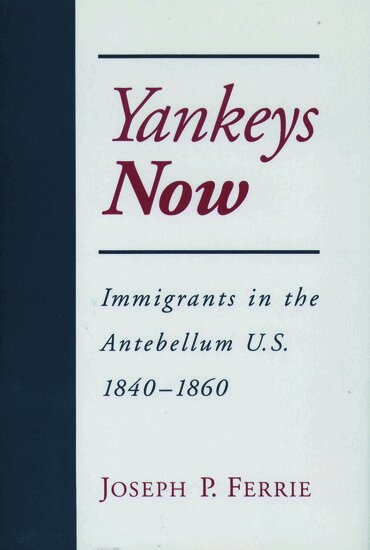
The first great wave of European migration to the United States before the Civil War transformed both the migrants themselves and the country they entered. The extent of this transformation has been difficult to gauge without information on migrants before and after their departure from Europe. Yankeys Now: Immigrants in the Antebellum US 1840-1860 provides the first detailed look at how these immigrants were changed by their relocation and how the Americaneconomy responded to their arrival. The book employs unique data on more than 2,400 British, Irish, and German migrants who appeared on both passenger ship rosters and US census recordsto document the geographic, occupational, and financial movements of Europeans who traveled to this nation in the 1840s. Contrary to other studies of antebellum immigrants, Joseph P. Ferrie's work finds substantial mobility in all three of these contexts. The ability to follow immigrants from their arrival through several censuses makes it possible to compare the experiences of immigrants who remained in one location to those of immigrants who sought opportunity in new places throughout the1850s. The latter group's achievements, as carefully traced in this volume, account for most of the contrast with previously published work on this topic. Using information on more than 4,000 native-bornAmericans followed through the 1850 and 1860 US censuses, Ferrie finds little evidence that immigrants' arrival negatively affected this country's labor force, excluding craft workers in the urban northeast. Taken as a whole, his findings demonstrate the American economy's ability to absorb additions to its workforce while also illustrating the range of opportunities available to nineteenth-century migrants drawn to the United States.
Southern Paternalism and the American Welfare State
Economics, Politics, and Institutions in the South, 1865-1965
Häftad, Engelska, 2007
428 kr
Skickas inom 7-10 vardagar
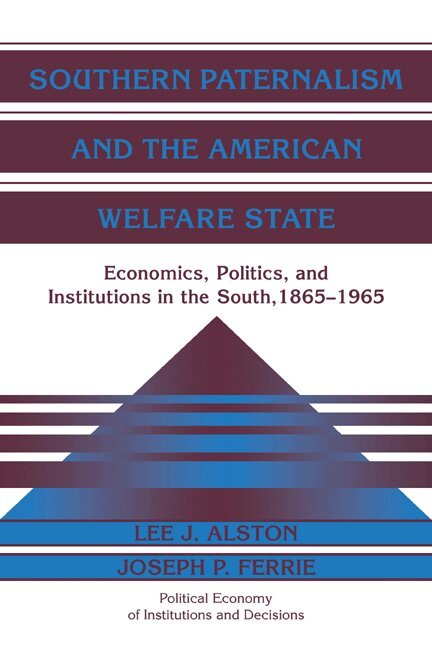
Using institutional economics, Professors Alston and Ferrie show how paternalism in Southern agriculture helped shape the growth of the American welfare state in the hundred years following the Civil War. It was an integral part of agricultural contracts prior to mechanization. Paternalism involved the exchange of 'good and faithful' labour services for a variety of in-kind services, most notably protection from physical violence. The Southern landed elite valued paternalism because it reduced monitoring costs and turnover. Workers valued paternalism because of the lack of civil rights. In order to maintain the value of paternalism to their workers, the agricultural interests needed to prevent meddling from the federal government, which they accomplished through their disproportionate political power. Only the advent of mechanization and complementary technology in the late 1950s and early 1960s finally reduced the desire of Southern agricultural interests to fight the expansion of federal welfare programmes.
Southern Paternalism and the American Welfare State
Economics, Politics, and Institutions in the South, 1865-1965
Inbunden, Engelska, 1999
744 kr
Skickas inom 7-10 vardagar
Using institutional economics, Professors Alston and Ferrie show how paternalism in Southern agriculture helped shape the growth of the American welfare state in the hundred years following the Civil War. It was an integral part of agricultural contracts prior to mechanization. Paternalism involved the exchange of 'good and faithful' labour services for a variety of in-kind services, most notably protection from physical violence. The Southern landed elite valued paternalism because it reduced monitoring costs and turnover. Workers valued paternalism because of the lack of civil rights. In order to maintain the value of paternalism to their workers, the agricultural interests needed to prevent meddling from the federal government, which they accomplished through their disproportionate political power. Only the advent of mechanization and complementary technology in the late 1950s and early 1960s finally reduced the desire of Southern agricultural interests to fight the expansion of federal welfare programmes.