Joseph T. Molyson Jr. – författare
Visar alla böcker från författaren Joseph T. Molyson Jr.. Handla med fri frakt och snabb leverans.
3 produkter
3 produkter
Six Air Forces Over the Atlantic
How Allied Airmen Helped Win the Battle of the Atlantic
Inbunden, Engelska, 2024
428 kr
Skickas inom 5-8 vardagar
The Battle of the Atlantic was the longest campaign of World War II, lasting the entirety of the war in Europe from September 1939 to May 1945. It was also one of the war’s most complex campaigns, involving strategy, operations, tactics, logistics, politics, diplomacy, and alliances. During the war’s first two years, the United States was drawn deeper into partnership with Great Britain, and closer toward conflict with Germany, in the waters of the North Atlantic. Franklin Roosevelt realized this theater’s importance: “I believe the outcome of this struggle is going to be decided in the Atlantic.” And so American, British, and Canadian forces battled Germans at sea and in the air to protect the flow of first materiel and then men from the United States to the United Kingdom. The sea part has been well covered: how German U-boats and other warships hunted Allied convoys and how the Allies ultimately turned the tide. Not so much the air war. In Six Air Forces over the Atlantic, Joseph Molyson tells the story of the Battle of the Atlantic from the perspective of the air forces—and airmen—who waged it from the skies above the icy waters of the North Atlantic. He blends big-picture attention to strategy and tactics with dramatic episodes of air-to-air and air-to-sea combat, including the engagement in which a British light bomber captured a German U-boat near Iceland. He details the close eye Franklin Roosevelt kept on the campaign, the effect B-24 Liberator bombers had, and the rise of the Royal Air Force Coastal Command as a true U-boat-busting force. The result was victory in the Atlantic, as well as a significant contribution to victory in World War II.
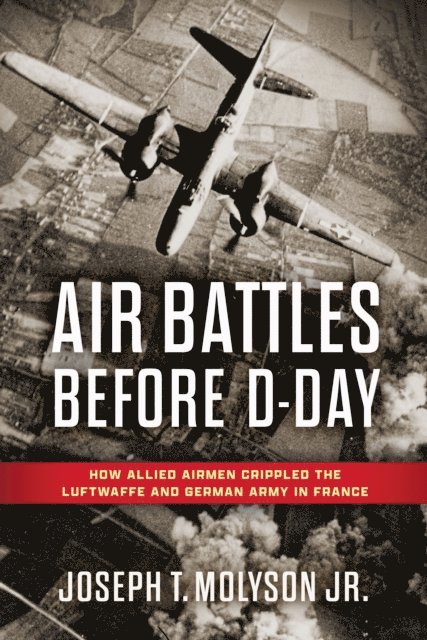
Air Battles Before D-Day
How Allied Airmen Crippled the Luftwaffe and German Army in France
Inbunden, Engelska, 2025
359 kr
Skickas inom 5-8 vardagar
D-Day, June 6, 1944, was one of the largest and most complicated undertakings in military history. During the first twenty-four hours of Operation Overlord, the Allies landed some 150,000 men by sea and air, secured a beachhead in France, and began the campaign that would liberate Western Europe and help defeat the Third Reich eleven months later. How did the Americans and British lay the groundwork for this massive and momentous invasion?In Air Battles Before D-Day, Joseph Molyson charts the year-long effort that made D-Day possible. By May 1943, the tide of the Battle of the Atlantic had turned toward the Allies, opening up the flow of American men and materiel (including vital landing craft) to Britain and accelerating the buildup required for the invasion. It also enabled the ramping up of the ongoing bombing of Germany—the British at night, the Americans by day—to destroy its industrial base, weaken civilian morale, and damage the Luftwaffe’s ability to take to the skies and defend against the invasion. As D-Day approached, aerial attacks began to target roads and railways in France. Under the direction of commanders including Dwight Eisenhower, Bernard Montgomery, and Carl Spaatz—who didn’t always see eye to eye—planners pieced together the jigsaw puzzle of amphibious landings, airborne drops, naval support, air attacks, and intelligence, the last of which included a fictitious army group under George Patton.In Molyson’s telling, the air campaign is the centerpiece of Allied efforts before D-Day, the essential foundation for success on June 6 and after, but his narrative connects all the events that preceded “the longest day” and covers the Germans’ Atlantic Wall, Erwin Rommel’s barrier of pillboxes, beach obstacles, and artillery that stood in the Allies’ path. Air Battles Before D-Day is essential reading for understanding the greatest operation of World War II.
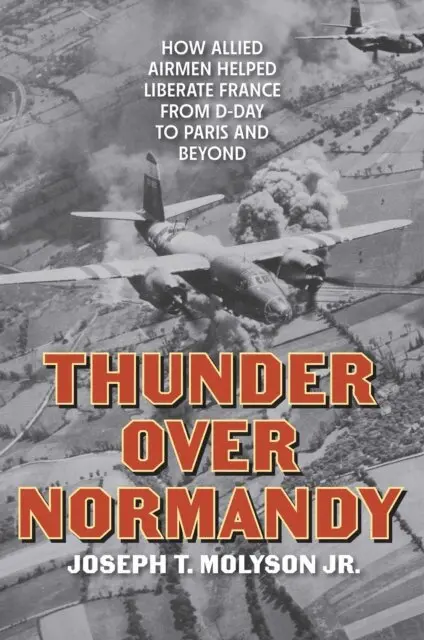
Thunder Over Normandy
How Allied Airmen Helped Liberate France from D-Day to Paris and Beyond
Inbunden, Engelska, 2026
366 kr
Skickas
They dropped from the skies, roared over the hedgerows, and turned the tide of history—this is the untold story of the airmen who helped liberate France.By June 1944, Allied air forces were ready to unleash hell on the Germans in occupied France. Massive numbers of bombers and fighters had been assembled in the United Kingdom, as well as more than one million troops poised to invade the continent. Thunder Over Normandy tells the story of the air campaign that began on D-Day, June 6, 1944, and culminated in the liberation of France—one of the largest, most complex, and most successful aerial operations in history. In April 1944, Allied air forces in Europe—including the vaunted U.S. Eighth Air Force and RAF Bomber Command—were placed under Dwight Eisenhower’s Supreme Headquarters Allied Expeditionary Force and given a twofold mission to lay the groundwork for D-Day: destroy the Luftwaffe’s battle strength and isolate Normandy from reinforcements. American and British heavy bombers completed these tasks with devastating effectiveness.D-Day began with the midnight launching of 1,200 transports to drop American and British paratroopers and gliders behind enemy lines in Normandy. In a monumental effort, the U.S. 82nd and 101st Airborne Divisions landed behind Utah Beach and fought for towns like Carentan; the British 6th Airborne seized Pegasus Bridge and other crossings near Caen. Toward dawn, 1,000 bombers hammered German positions along the coast, just ahead of the troops who stormed the beaches.As the fighting moved inland during the next two months, Allied fighters and fighter-bombers swarmed in to provide close support for the ground forces slogging through the hedgerows of Normandy. The bombers continued to strike German industry, but priority was now given to destroying V-1 and V-2 rocket sites as part of Operation Crossbow. Bombers were also used tactically in conjunction with ground operations, including the heavy bombardment that preceded the breakout from Normandy in late July.By the time Paris was liberated in August 1944, air power—thousands of sorties, hundreds of thousands of tons of bombs—had contributed mightily to Allied victory. Thunder Over Normandy details the air operations that made this happen, from thundering bomb runs and low-level strafing attacks to paratrooper drops, glider flights, and wheeling dogfights with the Luftwaffe. During the summer of 1944, as this stirring account vividly shows, the Allies were truly masters of the air.