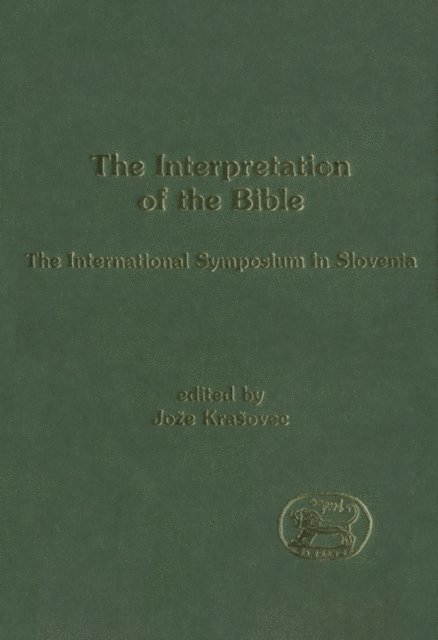
Joze Krasovec - Böcker
Visar alla böcker från författaren Joze Krasovec. Handla med fri frakt och snabb leverans.
4 produkter
4 produkter
2 028 kr
Skickas inom 5-8 vardagar
In the transmission we encounter various transformations of biblical proper names. The basic phonetic relationship between Semitic languages on the one hand and non-Semitic languages, like Greek and Latin, on the other hand, is so complex that it was hardly possible to establish a unified tradition in writing biblical proper names within the Greek and Latin cultures. Since the Greek and Latin alphabets are inadequate for transliteration of Semitic languages, authors of Greek and Latin Bibles were utter grammatical and cultural innovators. In Greek and Latin Bibles we note an almost embarrassing number of phonetic variants of proper names. A survey of ancient Greek and Latin Bible translations allows one to trace the boundary between the phonetic transliterations that are justified within Semitic, Greek, and Latin linguistic rules, and those forms that transgress linguistic rules.The forms of biblical proper names are much more stable and consistent in the Hebrew Bible than in Greek, Latin and other ancient Bible translations. The inexhaustible wealth of variant pronunciations of the same proper names in Greek and Latin translations indicate that Greek and Latin translators and copyists were in general not fluent in Hebrew and did therefore not have sufficient support in a living Hebrew phonetic context. This state affects personal names of rare use to a far greater extent than the geographical names, whose forms are expressed in the oral tradition by a larger circle of the population.
557 kr
Skickas inom 5-8 vardagar
In the transmission we encounter various transformations of biblical proper names. The basic phonetic relationship between Semitic languages on the one hand and non-Semitic languages, like Greek and Latin, on the other hand, is so complex that it was hardly possible to establish a unified tradition in writing biblical proper names within the Greek and Latin cultures. Since the Greek and Latin alphabets are inadequate for transliteration of Semitic languages, authors of Greek and Latin Bibles were utter grammatical and cultural innovators. In Greek and Latin Bibles we note an almost embarrassing number of phonetic variants of proper names. A survey of ancient Greek and Latin Bible translations allows one to trace the boundary between the phonetic transliterations that are justified within Semitic, Greek, and Latin linguistic rules, and those forms that transgress linguistic rules.The forms of biblical proper names are much more stable and consistent in the Hebrew Bible than in Greek, Latin and other ancient Bible translations. The inexhaustible wealth of variant pronunciations of the same proper names in Greek and Latin translations indicate that Greek and Latin translators and copyists were in general not fluent in Hebrew and did therefore not have sufficient support in a living Hebrew phonetic context. This state affects personal names of rare use to a far greater extent than the geographical names, whose forms are expressed in the oral tradition by a larger circle of the population.
419 kr
Skickas
Del 78 - Vetus Testamentum, Supplements
Reward, Punishment, and Forgiveness
The Thinking and Beliefs of Ancient Israel in the Light of Greek and Modern Views
Inbunden, Engelska, 1999
5 442 kr
Skickas inom 3-6 vardagar
This book deals with central and universal issues of reward, punishment and forgiveness for the first time in a compact and comprehensive way. Until now these themes have received far too little attention in scholarly research both in their own right and in their interrelationship. The scope of this study is to present them in relation to the foundations of our culture. These and related issues are treated primarily within the Hebrew Bible, using the methods of literary analysis. The centrality of these themes in all religions and all cultures has resulted, however, in a comparative investigation, drawing attention to the problem of terminology, the importance of Greek culture for the European tradition, and the fusion of Greek and Jewish-Christian cultures in our modern philosophical and theological systems. This broad perspective shows that the biblical personalist understanding of divine authority and of human righteousness or guilt provides the personalist key to the search for reconciliation in a divided world.