J.R. Dean – författare
Visar alla böcker från författaren J.R. Dean. Handla med fri frakt och snabb leverans.
4 produkter
4 produkter
E-bok
PDF, Engelska, 2012714 kr
Läs direkt efter köp
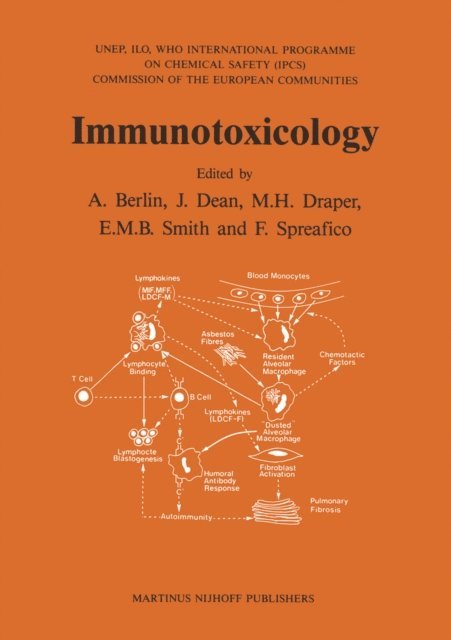
IX The International Seminar on the Immunological System as a Target for Toxic Damage was held at The Commission of the European Communities (CEC) in Luxembourg on 6-9 November 1984. It was organized by the CEC and the International Programme on Chemical Safety of UNEP/ILO/WHO with the support of the u. S. Environmental Protection Agency and the National Institute of Environmental Health Sciences - USA and with the participation of the International Society of Immunophar macology. These bodies are actively concerned with the scientific and applied aspects of immunotoxicology. The Seminar consisted of thirty-four invited papers and three major panel discussions covering current and future test strategies for the screening of immunotoxic substances, hypersensitivity and the health implications of immunotoxico logical problems. It was attended by more than 200 scien tists from 27 countries representing all the Member states of the European Economic Community and the six Regions of the World Health Organization. These scientists represented many different disciplines and interests. The Seminar''s principal objectives were: a review of recent advances in knowledge concerning the structure, function and dysfunction of the immunological system; - a review of the effects of xenobiotics on the immune system in animals and humans; an examination of the human health implications of immunotoxicity; discussion and critical analysis of the procedures for the assessment of immunological damage, a discussion of needs for the further development of laboratory and epidemiological methods and their validation, and a consideration of current test strategies.
Häftad, Engelska, 2013
545 kr
Skickas inom 10-15 vardagar
The continued search for rapid, efficient and cost-effective means of analytical measurement has introduced supercritical fluids into the field of analytical chemistry. Two areas are common: supercritical fluid chroma tography and supercritical fluid extraction. Both seek to exploit the unique properties of a gas at temperatures and pressures above the critical point. The most common supercritical fluid is carbon dioxide, employed because of its low critical temperature (31 °C), inertness, purity, non-toxicity and cheapness. Alternative supercritical fluids are also used and often in conjunction with modifiers. The combined gas-like mass transfer and liquid-like solvating characteristics have been used for improved chroma tographic separation and faster sample preparation. Supercritical fluid chromatography (SFC) is complementary to gas chro matography ( GC) and high performance liquid chromatography (HPLC), providing higher efficiency than HPLC, together with the ability to analyse thermally labile and high molecular weight analytes. Both packed and open tubular columns can be employed, providing the capability to analyse a wide range of sample types. In addition, flame ionization detection can be used, thus providing 'universal' detection.
Häftad, Engelska, 2011
561 kr
Skickas inom 10-15 vardagar
IX The International Seminar on the Immunological System as a Target for Toxic Damage was held at The Commission of the European Communities (CEC) in Luxembourg on 6-9 November 1984. It was organized by the CEC and the International Programme on Chemical Safety of UNEP/ILO/WHO with the support of the u. S. Environmental Protection Agency and the National Institute of Environmental Health Sciences - USA and with the participation of the International Society of Immunophar macology. These bodies are actively concerned with the scientific and applied aspects of immunotoxicology. The Seminar consisted of thirty-four invited papers and three major panel discussions covering current and future test strategies for the screening of immunotoxic substances, hypersensitivity and the health implications of immunotoxico logical problems. It was attended by more than 200 scien tists from 27 countries representing all the Member states of the European Economic Community and the six Regions of the World Health Organization. These scientists represented many different disciplines and interests. The Seminar's principal objectives were: a review of recent advances in knowledge concerning the structure, function and dysfunction of the immunological system; - a review of the effects of xenobiotics on the immune system in animals and humans; an examination of the human health implications of immunotoxicity; discussion and critical analysis of the procedures for the assessment of immunological damage, a discussion of needs for the further development of laboratory and epidemiological methods and their validation, and a consideration of current test strategies.
E-bok
PDF, Engelska, 2012693 kr
Läs direkt efter köp
The continued search for rapid, efficient and cost-effective means of analytical measurement has introduced supercritical fluids into the field of analytical chemistry. Two areas are common: supercritical fluid chroma tography and supercritical fluid extraction. Both seek to exploit the unique properties of a gas at temperatures and pressures above the critical point. The most common supercritical fluid is carbon dioxide, employed because of its low critical temperature (31 °C), inertness, purity, non-toxicity and cheapness. Alternative supercritical fluids are also used and often in conjunction with modifiers. The combined gas-like mass transfer and liquid-like solvating characteristics have been used for improved chroma tographic separation and faster sample preparation. Supercritical fluid chromatography (SFC) is complementary to gas chro matography ( GC) and high performance liquid chromatography (HPLC), providing higher efficiency than HPLC, together with the ability to analyse thermally labile and high molecular weight analytes. Both packed and open tubular columns can be employed, providing the capability to analyse a wide range of sample types. In addition, flame ionization detection can be used, thus providing ''universal'' detection.