Judit M. Pap - Böcker
Visar alla böcker från författaren Judit M. Pap. Handla med fri frakt och snabb leverans.
5 produkter
5 produkter
Proceedings of the 143rd Colloquium of the International Astronomical Union Held in the Clarion Harvest House, Boulder, Colorado, June 20-25, 1993
Solar and Stellar Irradiance Variations
Inbunden, Engelska, 1994
852 kr
Skickas inom 10-15 vardagar
The papers in this volume aim to represent the most up-to-date research contributions on the observations, theoretical interpretations, and empirical and physical models of variations observed in solar and stellar irradiances, as well as on Sun-climate connections. Both theoretical studies and irradiance observations show that the energy output of the Sun and solar-type stars varies, changing on time scales related to the short-term surface manifestations of solar/stellar magnetic activity as well as long-term modulations driven by processes in the interiors of the stars. Papers presented in this book point out that at the Earth these variations influence the terrestrial climate, radiative environment and upper atmospheric chemistry.
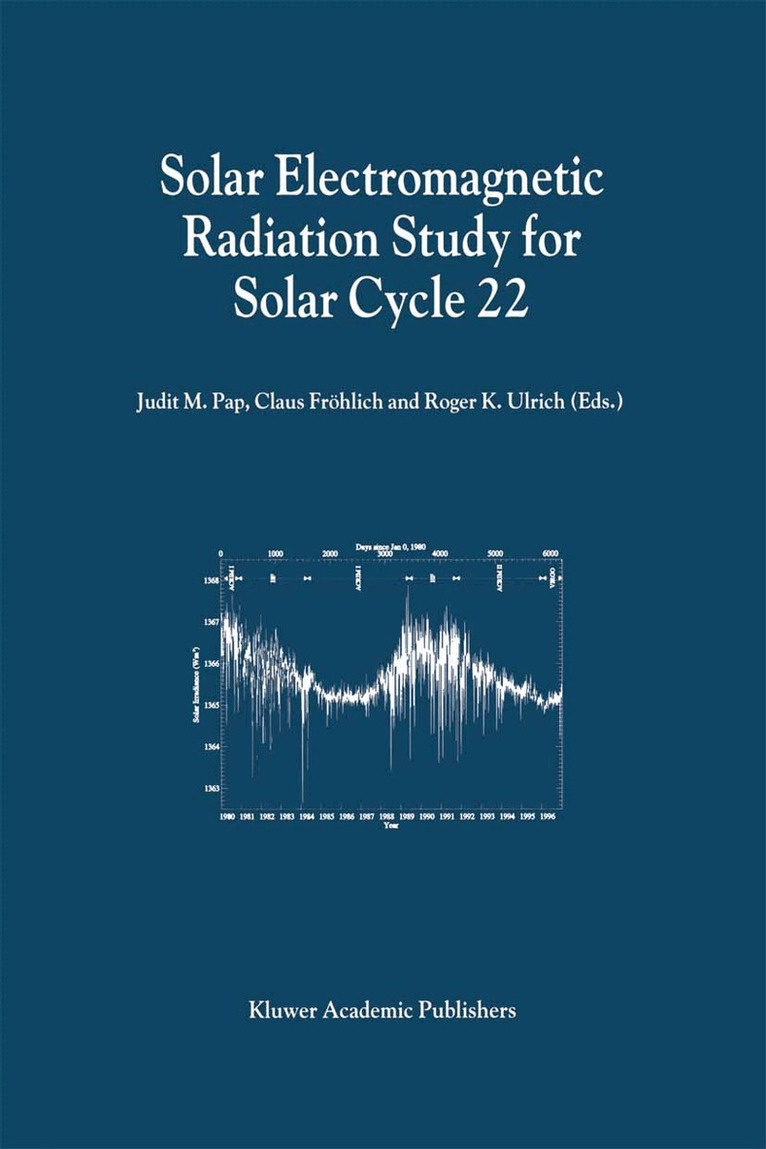
Solar Electromagnetic Radiation Study for Solar Cycle 22
Proceedings of the SOLERS22 Workshop held at the National Solar Observatory, Sacramento Peak, Sunspot, New Mexico, U.S.A., June 17–21, 1996
Inbunden, Engelska, 1998
2 101 kr
Skickas inom 10-15 vardagar
Recent measurements of solar irradiance, both bolometric and at various wavelengths, have established conclusively that the solar energy flux varies on a wide range of time scales, from minutes to the 11-year solar cycle. The major question is how the solar variability influences the terrestrial climate. The Solar Electromagnetic Radiation Study for Solar Cycle 22 (SOLERS22) is an international research programme operating under the auspices of the Solar-Terrestrial Energy Program (STEP) Working Group 1: "The Sun as a Source of Energy and Disturbances". STEP is sponsored by the Scientific Committee of Solar-Terrestrial Physics (SCOSTEP) of the International Council of Scientific Unions (ICSU). The main goal of the SOLERS22 1996 Workshop was to bring the international research community together to review the most recent results obtained from observations, theoretical interpretation, empirical and physical models of the variations in the solar energy flux and their possible impact on climate studies. These questions are essential for researchers and graduate students in solar-terrestrial physics.
Del 141 - Geophysical Monograph Series
Solar Variability and Its Effects on Climate
Inbunden, Engelska, 2004
916 kr
Tillfälligt slut
Published by the American Geophysical Union as part of the Geophysical Monograph Series, Volume 141. This monograph presents a state-of-the-art description of the most recent results on solar variability and its possible influence on the Earth's climate and atmosphere. Our primary goal in doing so is to review solar energy flux variations (both electromagnetic and particle) and understand their relations to solar magnetic field changes and global effects, their impact on different atmospheric layers, and—as a collaboration of scientists working on solar-terrestrial physics—to note unresolved questions on an important interdisciplinary area.One of the highest-level questions facing science today is whether the Earth's atmosphere and climate system changes in a way that we can understand and predict. The Earth's climate is the result of a complex and incompletely understood system of external inputs and interacting parts. Climate change can occur on various time scales as a consequence of natural variability—including solar variability—or anthropogenic causes, or both. The Sun's variability in the form of sunspots and related magnetic activity has been the subject of careful study ever since the earliest telescopic observations. High precision photometric observations of solar-type stars clearly show that year-to-year brightness variations connected with magnetic activity are a widespread phenomenon among such stars. As our nearest star, the Sun is the only star where we can observe and identify a variety of structures and processes which lead to variations in the solar energy output, in both radiative and particle fluxes. Studying event tiny changes in solar energy flux variations may teach us about internal processes taking place in the Sun's convective zone and below.
536 kr
Skickas inom 10-15 vardagar
The IAU Colloquium No. 143 "The Sun as a Variable Star: Solar and Stellar Irradiance Variations" was held on June 20 - 25, 1993 at the Clarion Harvest House, Boulder, Colorado, USA. The main objective of this Colloquium was to review the most recent results on the observations, theoretical interpreta tions, and empirical and physical models of the variations observed in solar and stellar irradiances. A special emphasis of the Colloquium was to discuss the results gained on the climatic impact of solar irradiance variability. The study of changes in solar and stellar irradiances has been of high interest for a long time. Determining the absolute value of the luminosity of stars with different ages is a crucial question for the theory of stellar evolu tion and energy production of stellar interiors. Observations of the temporal changes of solar and stellar irradiances - in the entire spectral band and at different wavelengths - provide an additional tool for studying the physical processes below the photosphere and in the solar- stellar atmospheres. Since the Sun's radiative output is the main driver of the physical processes with in the Earth's atmosphere, the study of irradiance changes is an extremely important issue for climatic studies as well. Climatic models show that small, but persistent changes in solar irradiance may influence the Earth's climate.
Solar Electromagnetic Radiation Study for Solar Cycle 22
Proceedings of the SOLERS22 Workshop held at the National Solar Observatory, Sacramento Peak, Sunspot, New Mexico, U.S.A., June 17–21, 1996
Häftad, Engelska, 2012
2 101 kr
Skickas inom 10-15 vardagar
Measurements of solar irradiance, both bolometric and at various wavelengths, over the last two decades have established conclusively that the solar energy flux varies on a wide range of time scales, from minutes to the 11-year solar cycle. The major question is how the solar variability influences the terrestrial climate. The Solar Electromagnetic Radiation Study for Solar Cycle 22 (SOLERS22) is an international research program operating under the auspices of the Solar-Terrestrial Energy Program (STEP) Working Group 1: `The Sun as a Source of Energy and Disturbances'. STEP is sponsored by the Scientific Committee of Solar-Terrestrial Physics (SCOSTEP) of the International Council of Scientific Unions (ICSU). The main goal of the SOLERS22 1996 Workshop was to bring the international research community together to review the most recent results obtained from observations, theoretical interpretation, empirical and physical models of the variations in the solar energy flux and their possible impact on climate studies. These questions are essential for researchers and graduate students in solar-terrestrial physics.