Judith Huber – författare
Visar alla böcker från författaren . Handla med fri frakt och snabb leverans.
6 produkter
6 produkter
Inbunden, Engelska, 2017
1 798 kr
Skickas inom 5-8 vardagar
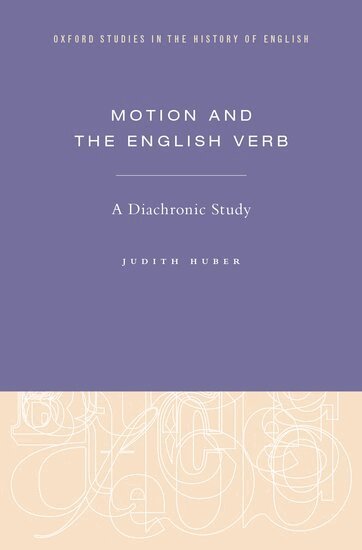
In Motion and the English Verb, a study of the expression of motion in medieval English, Judith Huber provides extensive inventories of verbs used in intransitive motion meanings in Old and Middle English, and discusses these in terms of the manner-salience of early English. Huber demonstrates how several non-motion verbs receive contextual motion meanings through their use in the intransitive motion construction. In addition, she analyzes which verbs and structures are employed most frequently in talking about motion in select Old and Middle English texts, demonstrating that while satellite-framing is stable, the extent of manner-conflation is influenced by text type and style.Huber further investigates how in the intertypological contact with medieval French, a range of French path verbs (entrer, issir, descendre, etc.) were incorporated into Middle English, in whose system of motion encoding they are semantically unusual. Their integration into Middle English is studied in an innovative approach which analyzes their usage contexts in autonomous Middle English texts as opposed to translations from French and Latin. Huber explains how these verbs were initially borrowed not for expressing general literal motion, but in more specific, often metaphorical and abstract contexts. Her study is a diachronic contribution to the typology of motion encoding, and advances research on the process of borrowing and loanword integration.
E-bok
PDF, Engelska, 20171 320 kr
Läs direkt efter köp
In Motion and the English Verb, a study of the expression of motion in medieval English, Judith Huber provides extensive inventories of verbs used in intransitive motion meanings in Old and Middle English, and discusses these in terms of the manner-salience of early English. Huber demonstrates how several non-motion verbs receive contextual motion meanings through their use in the intransitive motion construction. In addition, she analyzes which verbs and structures are employed most frequently in talking about motion in select Old and Middle English texts, demonstrating that while satellite-framing is stable, the extent of manner-conflation is influenced by text type and style.Huber further investigates how in the intertypological contact with medieval French, a range of French path verbs (entrer, issir, descendre, etc.) were incorporated into Middle English, in whose system of motion encoding they are semantically unusual. Their integration into Middle English is studied in an innovative approach which analyzes their usage contexts in autonomous Middle English texts as opposed to translations from French and Latin. Huber explains how these verbs were initially borrowed not for expressing general literal motion, but in more specific, often metaphorical and abstract contexts. Her study is a diachronic contribution to the typology of motion encoding, and advances research on the process of borrowing and loanword integration.
E-bok
Engelska, 20171 320 kr
Läs direkt efter köp
In Motion and the English Verb, a study of the expression of motion in medieval English, Judith Huber provides extensive inventories of verbs used in intransitive motion meanings in Old and Middle English, and discusses these in terms of the manner-salience of early English. Huber demonstrates how several non-motion verbs receive contextual motion meanings through their use in the intransitive motion construction. In addition, she analyzes which verbs and structures are employed most frequently in talking about motion in select Old and Middle English texts, demonstrating that while satellite-framing is stable, the extent of manner-conflation is influenced by text type and style.Huber further investigates how in the intertypological contact with medieval French, a range of French path verbs (entrer, issir, descendre, etc.) were incorporated into Middle English, in whose system of motion encoding they are semantically unusual. Their integration into Middle English is studied in an innovative approach which analyzes their usage contexts in autonomous Middle English texts as opposed to translations from French and Latin. Huber explains how these verbs were initially borrowed not for expressing general literal motion, but in more specific, often metaphorical and abstract contexts. Her study is a diachronic contribution to the typology of motion encoding, and advances research on the process of borrowing and loanword integration.
Del 5 - Historical Sociolinguistics
Intra-Writer Variation in Historical Sociolinguistics
Häftad, Engelska, 2023
799 kr
Skickas inom 5-8 vardagar
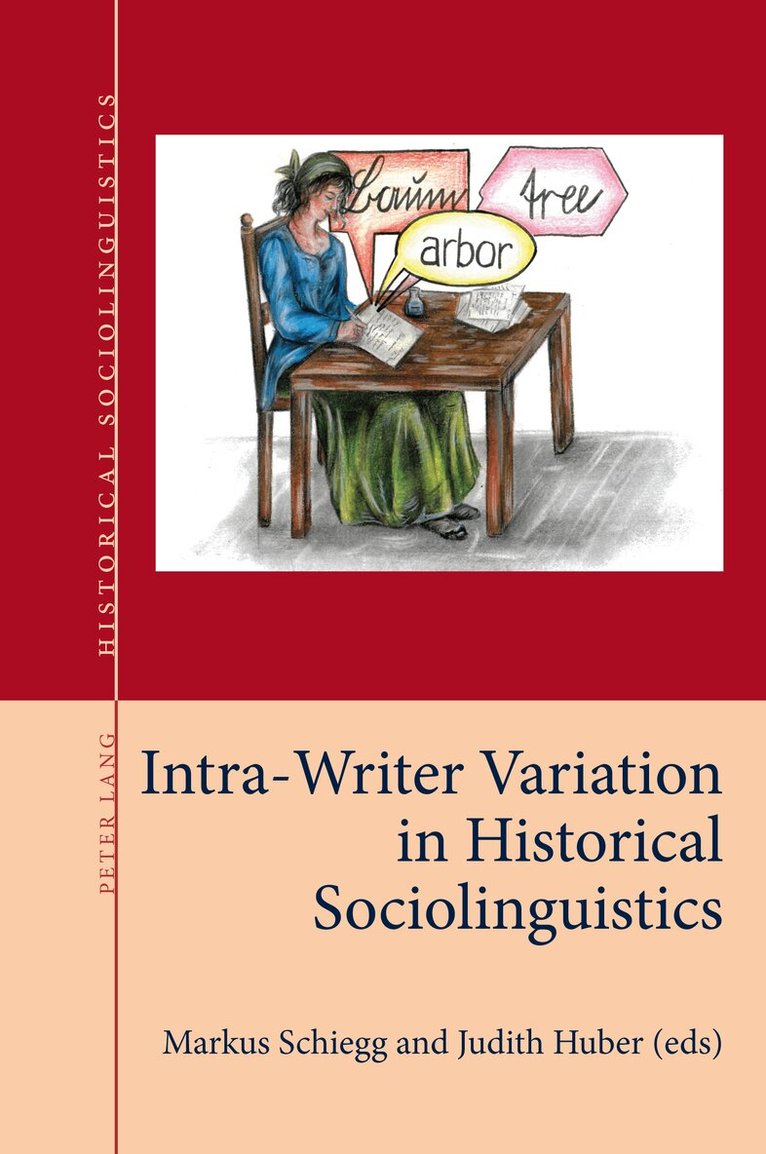
Intra-individual variation is an emerging research field in linguistics with a rapidly growing number of studies. In historical sociolinguistics, this trend has been slow, as it is still largely dominated by the macroscopic approaches of earlier sociolinguistics. Microscopic studies focusing on intra-individual variation in writing, i.e. intra-writer variation, however, are able to reveal how writers functionalize social or text-type variation for reasons such as audience design or persona creation. They may also provide insights into how ongoing changes were perceived by speakers and writers. In general, micro-approaches are able to uncover a wide array of possible factors influencing variation, which may not always carry sociolinguistic functions.This volume comprises twenty-two research articles on a wide range of languages and periods, all closely connected by their focus on intra-writer variation in historical texts and by their use of empirical and corpus-based approaches. The studies demonstrate that the challenges that historical material have for research on intra-individual variation can certainly be met and that the insights gleaned from analysing variation in individual writers are considerable.
E-bok
PDF, Engelska, 2003193 kr
Läs direkt efter köp
Seminar paper from the year 2003 in the subject English Language and Literature Studies - Literature, grade: 2 (B), University of Hamburg (Institute for Anglistics/American Studies), course: Proseminar "e;From Funny Fop to Dangerous Dandy - Fashion in 17th and 18th Century Literature"e;, language: English, abstract: The city of Bath has served as the scene of many 18 and 19 century novels, likeDaniel Defoe s Moll Flanders, Tobias Smollet s Roderick Random, Henry Fielding s Tom Jones and, of course, Jane Austen s Northanger Abbey; Persuasion and Emma. In Bath, one could find the quintessence of all the illusions, values and con- th flicts of the 18 century (Hill 1989: 2); its rules of etiquette fixed by Richard Beau Nash influenced the manners of the entire nation throughout the Georgian era . An official Bath guide read that the city had become one of the most agreeable as well as most polite places in the Kingdom (Watkins 1990: 178). But as the century wore on, the spa became less fashionable, the nobility became bored of it, and middle class people swamped the town. The three novels by Jane Austen mentioned above date from this time, when Bath s heyday was over. In my opinion, it is particularly interesting to take a look on the image of Bath as it is conveyed by these three novels, because of the different viewpoints of the characters: In Northanger Abbey, the city is described from a middle class perspective, in Persuasion from an upper class perspective, and in Emma, where none of the action actually takes place in Bath, we get an idea of what people in the country thought about the city of Bath; it is described from an extern point of view. This paper will examine the literary characterisation of the city as a place of amusement (balls, concerts, etc.), display and representation by looking at the characters attitudes towards Bath and the purpose of their stay there. The further aim is a cultural description of the city with regard to its fashionableness, based on the novels of Jane Austen.
E-bok
PDF, Engelska, 2004193 kr
Läs direkt efter köp
Seminar paper from the year 2004 in the subject English Language and Literature Studies - Linguistics, grade: 2 (B), University of Hamburg (Institute for Anglistics/ American Studies), course: Proseminar: Lexicology, language: English, abstract: Modern English is known to be a language made up of mainly two different roots: the Germaniclanguage that was spoken by many inhabitants of the British Isles before the NormanConquest in 1066, and the Romanic language that the Norman invaders brought with them. These two origins, however, are not distributed equally on the English vocabulary: very generallyspeaking, Germanic words more often denote basic concepts, while Romanic wordsmore often denote abstract concepts. This is illustrated by the fact that the General ServiceList (GSL), listing the 2000 most frequent (and therefore most basic) English words, ismade up by 50.98 percent of words of Germanic origin, whereas in the Computer Dictionary(CD)1, which consists of 80 096 words, only 26.28 percent of the entries have Germanicroots, but a majority of 58.52 percent have Latin or Romanic ones (Scheler 1978: 72). Therefore it seems quite obvious that swear-words in particular should, to a higherpercentage, have Germanic roots, because the concepts they denote are mostly basic ,the domain in which Germanic words are represented to a greater extent than Latin orRomanic words. Moreover, bearing in mind that words of Latin or Romanic origin are more likely todenote abstract concepts and that they often seem to have a certain taste of culture and good education , one could suppose that there is a higher percentage of Latin or Romanicwords among euphemisms. These considerations led to the following hypothesis: