
Origins of Euphemisms and Swear Words in the English Language
E-bok
PDF, Engelska, 2004182 kr
Läs direkt i Bokus Reader – eller ladda ned till din enhet (PDF kräver ofta zoom och scroll på små skärmar).
Beskrivning
Seminar paper from the year 2004 in the subject English Language and Literature Studies - Linguistics, grade: 2 (B), University of Hamburg (Institute for Anglistics/ American Studies), course: Proseminar: Lexicology, language: English, abstract: Modern English is known to be a language made up of mainly two different roots: the Germaniclanguage that was spoken by many inhabitants of the British Isles before the NormanConquest in 1066, and the Romanic language that the Norman invaders brought with them. These two origins, however, are not distributed equally on the English vocabulary: very generallyspeaking, Germanic words more often denote basic concepts, while Romanic wordsmore often denote abstract concepts. This is illustrated by the fact that the General ServiceList (GSL), listing the 2000 most frequent (and therefore most basic) English words, ismade up by 50.98 percent of words of Germanic origin, whereas in the Computer Dictionary(CD)1, which consists of 80 096 words, only 26.28 percent of the entries have Germanicroots, but a majority of 58.52 percent have Latin or Romanic ones (Scheler 1978: 72). Therefore it seems quite obvious that swear-words in particular should, to a higherpercentage, have Germanic roots, because the concepts they denote are mostly basic ,the domain in which Germanic words are represented to a greater extent than Latin orRomanic words. Moreover, bearing in mind that words of Latin or Romanic origin are more likely todenote abstract concepts and that they often seem to have a certain taste of culture and good education , one could suppose that there is a higher percentage of Latin or Romanicwords among euphemisms. These considerations led to the following hypothesis:
Produktinformation
Utforska kategorier
Hoppa över listan
Mer från samma författare
Del 5
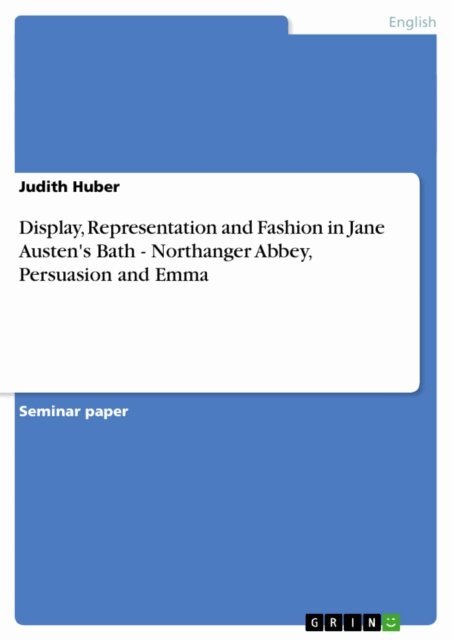
Display, Representation and Fashion in Jane Austen's Bath - Northanger Abbey, Persuasion and Emma
Judith Huber
E-bok
2003182 kr
Hoppa över listan


Du kanske också är intresserad av
- 10% rabatt på allt
Display, Representation and Fashion in Jane Austen's Bath - Northanger Abbey, Persuasion and Emma
Judith Huber
E-bok
2003182 kr
Del 5
- 10% rabatt på allt
Del 3
- Signerad!
Del 3
- 10% rabatt på allt
Del 11
- Nyhet