Judith Nisse Shklar – författare
Visar alla böcker från författaren Judith Nisse Shklar. Handla med fri frakt och snabb leverans.
4 produkter
4 produkter
Del 2 - Tanner Lectures on Human Values
American Citizenship
The Quest for Inclusion
Häftad, Engelska, 1998
294 kr
Skickas inom 5-8 vardagar
In this illuminating look at what constitutes American citizenship, Judith Shklar identifies the right to vote and the right to work as the defining social rights and primary sources of public respect. She demonstrates that in recent years, although all profess their devotion to the work ethic, earning remains unavailable to many who feel and are consequently treated as less than full citizens.
160 kr
Kommande
Available for the first time in a stand-alone volume, the classic essay that envisions liberalism not as the triumphant endpoint of political progress, or even a cohesive ideology, but rather as a precarious guardrail against abuses of power.After the collapse of the Soviet Union, many hailed the supposed triumph of liberal democracy as the “end of history.” But Judith Shklar offers a sober and cautionary perspective. Far from an inevitable or permanent political order, liberalism was as fragile as it was essential: always threatened by the abusive political forces against which it offered imperfect but necessary defense. Shklar’s vision of a bulwark in the face of cruelty, rather than a venerable ideology of freedom or individual autonomy, powerfully rejects conceptions of liberalism that were easy targets of critique from both left and right.With its focus on the thin line dividing our political system from authoritarianism, The Liberalism of Fear is as relevant today as it was on its initial publication. Democratic institutions, from the courts to the ballot, are under attack from within, and marginalized groups are even more vulnerable to state-sanctioned violence. Now as before, our faith in the liberal order seems to be fueled above all by a fear of the alternatives. This is as it should be, according to Shklar: properly conceived, liberalism is a means of survival, not the road to utopia.A new foreword by Mark Lilla places this classic study in its historical context and solidifies its importance during a precarious moment. A perfect entryway into Shklar’s large and influential body of work, The Liberalism of Fear is both an essential addition to any scholar’s library and a powerful note of warning.
266 kr
Skickas inom 5-8 vardagar
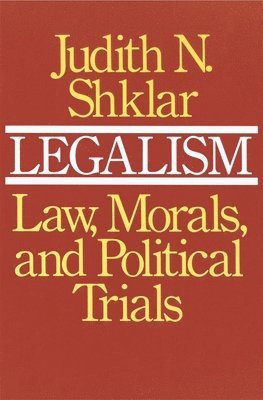
Legalism deals with the area between political theory and jurisprudence. Its aim is to bridge the intellectual gulf separating jurisprudence from other kinds of social theory by explaining why, in the view of historians and political theorists, legalism has fallen short in its approach to both morals and politics. Judith Shklar proposes that, instead of regarding law as a discrete entity resting upon a rigid system of definitions, legal theorists should treat it, along with morals and politics, as part of an all-inclusive social continuum.The first part of the book examines law and morals and criticizes the approach to morals of both the analytical positivists and the natural law theorists. The second part, on law and politics, deals with legalism as a political ideology that comes into conflict with other policies, particularly during political trials.Incisively and stylishly written, the book constitutes an open challenge to reconsider the fundamental question of the relationship of law to society.
302 kr
Skickas inom 5-8 vardagar
The seven deadly sins of Christianity represent the abysses of character, whereas Judith Shklar’s “ordinary vices”—cruelty, hypocrisy, snobbery, betrayal, and misanthropy—are merely treacherous shoals, flawing our characters with mean-spiritedness and inhumanity.Shklar draws from a brilliant array of writers—Molière and Dickens on hypocrisy, Jane Austen on snobbery, Shakespeare and Montesquieu on misanthropy, Hawthorne and Nietzsche on cruelty, Conrad and Faulkner on betrayal—to reveal the nature and effects of the vices. She examines their destructive effects, the ambiguities of the moral problems they pose to the liberal ethos, and their implications for government and citizens: liberalism is a difficult and challenging doctrine that demands a tolerance of contradiction, complexity, and the risks of freedom.