Junku Yuh - Böcker
Visar alla böcker från författaren Junku Yuh. Handla med fri frakt och snabb leverans.
4 produkter
4 produkter
3 429 kr
Skickas inom 10-15 vardagar
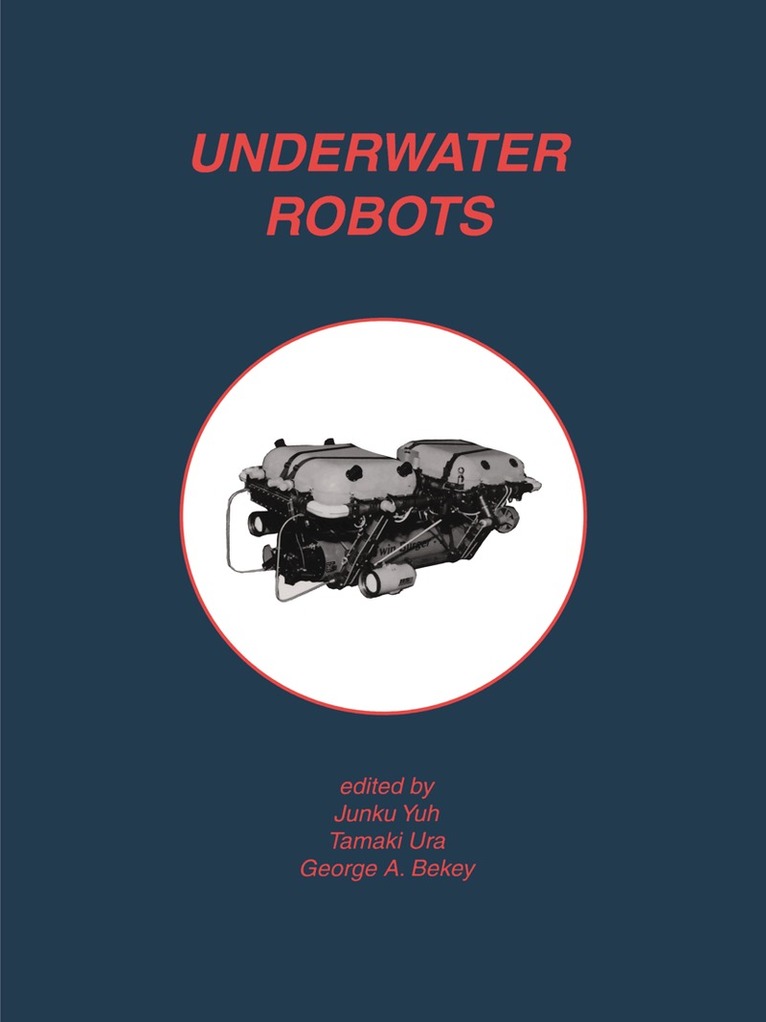
This text reports on the latest progress in underwater robotics. The deep oceans range between 19000 to 36000 feet. At a mere 33-foot depth, the pressure is twice the normal atmospheric pressure of 29.4 psi. This obstacle, compounded with other complex issues due to the unstructured and hazardous environment, makes it difficult to travel in the ocean even though today's technologies allow humans to land on the moon. Only recently, by using manned submersibles, it has been discovered that a large amount of carbon dioxide comes from the sea-floor and that extraordinary groups of organisms live in hydrothermal vent areas. On March 24, 1995 Kaiko (a remotely operated vehicle) navigated the deepest region of the ocean, the Mariana Trough. This vehicle successfully dived to a depth of 33000 feet and instantly showed scenes from the trench through a video camera. New tools like this enable us to gain knowledge of mysterious places. However, extensive use of manned submersibles and remotely operated vehicles is limited to a few applications because of very high operational costs, operator fatigue and safety issues.In spite of these hindrances, the demand for advanced underwater robot technologies is growing and will eventually arrive at fully autonomous, specialized, reliable underwater robotic vehicles. This text is an edited volume of research comprising thirteen invited contributions by leading researchers.
3 429 kr
Skickas inom 10-15 vardagar
All life came from sea but all robots were born on land. The vast majority of both industrial and mobile robots operate on land, since the technology to allow them to operate in and under the ocean has only become available in recent years. A number of complex issues due to the unstructured, hazardous undersea environment, makes it difficult to travel in the ocean while today's technologies allow humans to land on the moon and robots to travel to Mars . . Clearly, the obstacles to allowing robots to operate in a saline, aqueous, and pressurized environment are formidable. Mobile robots operating on land work under nearly constant atmospheric pressure; their legs (or wheels or tracks) can operate on a firm footing; their bearings are not subjected to moisture and corrosion; they can use simple visual sensing and be observed by their creators working in simple environments. In contrast, consider the environment where undersea robots must operate. The pressure they are subjected to can be enormous, thus requiring extremely rugged designs. The deep oceans range between 19,000 to 36,000 ft. At a mere 33-foot depth, the pressure will be twice the normal one atmosphere pressure of 29. 4 psi. The chemical environment of the sea is highly corrosive, thus requiring the use of special materials. Lubrication of moving parts in water is also difficult, and may require special sealed, waterproof joints.
Introduction to Autonomous Manipulation
Case Study with an Underwater Robot, SAUVIM
Inbunden, Engelska, 2014
1 064 kr
Skickas inom 10-15 vardagar
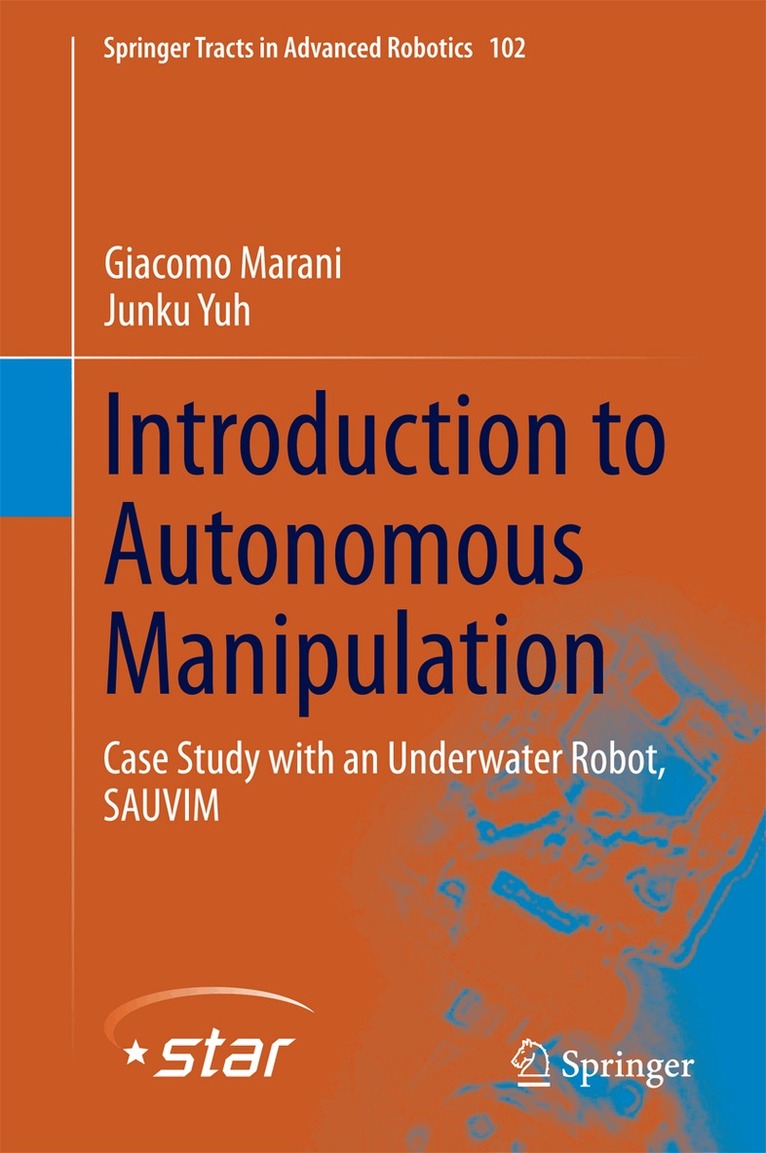
“Autonomous manipulation” is a challenge in robotic technologies. It refers to the capability of a mobile robot system with one or more manipulators that performs intervention tasks requiring physical contacts in unstructured environments and without continuous human supervision. Achieving autonomous manipulation capability is a quantum leap in robotic technologies as it is currently beyond the state of the art in robotics.This book addresses issues with the complexity of the problems encountered in autonomous manipulation including representation and modeling of robotic structures, kinematic and dynamic robotic control, kinematic and algorithmic singularity avoidance, dynamic task priority, workspace optimization and environment perception. Further development in autonomous manipulation should be able to provide robust improvements of the solutions for all of the above issues. The book provides an extensive tract on sensory-based autonomous manipulation for intervention tasks in unstructured environments. After presenting the theoretical foundations for kinematic and dynamic modelling as well as task-priority based kinematic control of multi-body systems, the work is focused on one of the most advanced underwater vehicle-manipulator system, SAUVIM (Semi-Autonomous Underwater Vehicle for Intervention Missions). Solutions to the problem of target identification and localization are proposed, a number of significant case studies are discussed and practical examples and experimental/simulation results are presented. The book may inspire the robot research community to further investigate critical issues in autonomous manipulation and to develop robot systems that can profoundly impact our society for the better.
Introduction to Autonomous Manipulation
Case Study with an Underwater Robot, SAUVIM
Häftad, Engelska, 2016
1 064 kr
Skickas inom 10-15 vardagar
“Autonomous manipulation” is a challenge in robotic technologies. It refers to the capability of a mobile robot system with one or more manipulators that performs intervention tasks requiring physical contacts in unstructured environments and without continuous human supervision. Achieving autonomous manipulation capability is a quantum leap in robotic technologies as it is currently beyond the state of the art in robotics.This book addresses issues with the complexity of the problems encountered in autonomous manipulation including representation and modeling of robotic structures, kinematic and dynamic robotic control, kinematic and algorithmic singularity avoidance, dynamic task priority, workspace optimization and environment perception. Further development in autonomous manipulation should be able to provide robust improvements of the solutions for all of the above issues. The book provides an extensive tract on sensory-based autonomous manipulation for intervention tasks in unstructured environments. After presenting the theoretical foundations for kinematic and dynamic modelling as well as task-priority based kinematic control of multi-body systems, the work is focused on one of the most advanced underwater vehicle-manipulator system, SAUVIM (Semi-Autonomous Underwater Vehicle for Intervention Missions). Solutions to the problem of target identification and localization are proposed, a number of significant case studies are discussed and practical examples and experimental/simulation results are presented. The book may inspire the robot research community to further investigate critical issues in autonomous manipulation and to develop robot systems that can profoundly impact our society for the better.