Jurgen Wolters – författare
648 kr
Skickas inom 3-6 vardagar
681 kr
Läs direkt efter köp
976 kr
Skickas inom 10-15 vardagar
870 kr
Läs direkt efter köp
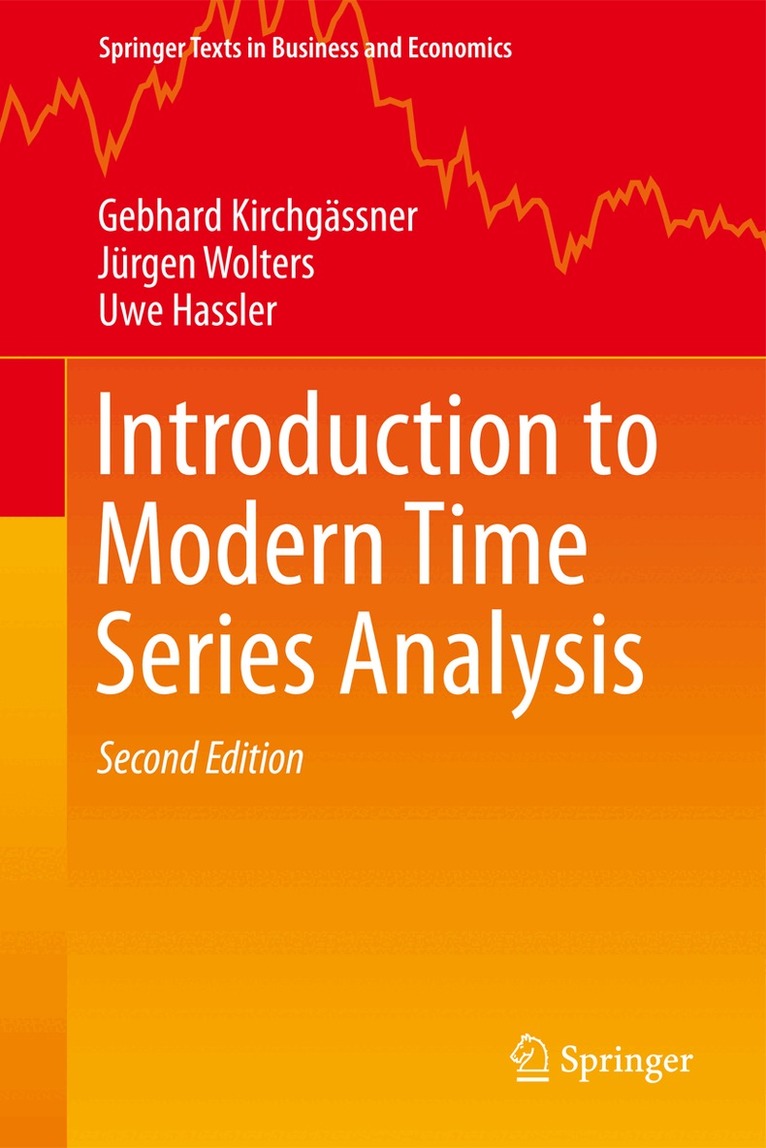
This book presents modern developments in time series econometrics that are applied to macroeconomic and financial time series, bridging the gap between methods and realistic applications. It presents the most important approaches to the analysis of time series, which may be stationary or nonstationary. Modelling and forecasting univariate time series is the starting point. For multiple stationary time series, Granger causality tests and vector autogressive models are presented. As the modelling of nonstationary uni- or multivariate time series is most important for real applied work, unit root and cointegration analysis as well as vector error correction models are a central topic. Tools for analysing nonstationary data are then transferred to the panel framework. Modelling the (multivariate) volatility of financial time series with autogressive conditional heteroskedastic models is also treated.
442 kr
Skickas inom 5-8 vardagar
603 kr
Läs direkt efter köp
577 kr
Skickas inom 10-15 vardagar
2 110 kr
Läs direkt efter köp
661 kr
Skickas inom 10-15 vardagar
1 671 kr
Skickas inom 10-15 vardagar
1 671 kr
Skickas inom 10-15 vardagar
884 kr
Läs direkt efter köp
Das vorliegende Buch ist eine Einführung in die praktische Arbeit mit makroökonometrischen Modellen. Die Autoren sind auf dem Feld international ausgewiesene Wissenschaftler. Die Beiträge thematisieren alle Aspekte des Verständnisses der statistisch/ökonometrisch und ökonomisch-theoretischen Grundlagen makroökonometrischer Modelle, ihrer Wirkungsbeziehungen sowie ihrer Prognose- und Simulationsleistungen. Die Beiträge sind für sich verständlich und wenden sich an Interessierte, ohne spezifische statistische oder ökonometrische Vorkenntnisse vorauszusetzen. Der Leser kann die wichtigsten Methoden und Verfahren anhand der allgemein verfügbaren Verfahren und Daten sowie des verwendeten makroökonometrischen Modells leicht nachvollziehen. Das verwendete Modell ist das RWI-Konjunkturmodell, ein mittelgroßes makroökonometrisches Modell für die Bundesrepublik Deutschland, das seit mehr als 25 Jahren regelmäßig für Prognosen und Simulationen Anwendung findet.