Jussi Valimaa – författare
1 625 kr
Läs direkt efter köp
This book analyses higher education from cultural perspectives and also to reflect on the uses of intellectual devices developed in the cultural studies of higher education over the last decades.
The first part of the book presents fresh perspectives to integrate cultural studies in higher education with wider societal processes. Professor William G. Tierney speaks about trust and culture in higher education, whereas Professor Imanol Ordorika opens a political perspective to higher education institutions.
The second part of the book studies the internal life of higher education. Relying on a variety of cultural perspectives, the chapters explore the actual day-to-day practices taking place in higher education, ranging from student socialisation, student consumerism, tensions in combining academic and market-oriented targets in knowledge production to the formation of academic identities in different disciplinary and organisational cultures.
The focus in the third part of the book is to use cultural perspectives developed in previous studies on disciplinary and organisational cultures as a framework to understand a variety of processes and reforms taking place at the institutional level of high education. The chapters in this part of the book analyse the Bologna Process, the evolution of scientific fields in American universities, organisational cultures in Chinese post-merger universities, and doctoral education and cooperation with industry.
1 113 kr
Läs direkt efter köp
There is a great interest around the world in how teachers are prepared, the content of their education and training programmes, measurements of their effectiveness, and the role of the ‘good’ teacher in society. While many of the issues are common across different national contexts, the direction of policy and how it is enacted varies considerably. There is therefore a need to understand how current situations have developed historically.
In Historical Development of Teacher Education in Finland, Välimaa offers a critical reading of secondary sources and existing research literature to chronically analyse the development of Finnish teacher training. Much of this development has depended on the political history of Finland. The analysis offers an exploration of the founding of teacher education and training in the 1860s, through Finland’s independence following the First World War and Civil War, after which the development of schooling was seen as vital for the unity of the nation. The book continues to chart the development of teacher preparation through the twentieth century, including the severe economic downturn of the 1990s which challenged norms of teacher education in the country.
An important historical synthesis that tells us as much about the future of teacher preparation, and education’s role in society, as it does about how we got here, Historical Development of Teacher Education in Finland will be crucial reading for historians of education, current teacher educators, and students and researchers interested in the development of teacher education globally.
1 113 kr
Läs direkt efter köp
There is a great interest around the world in how teachers are prepared, the content of their education and training programmes, measurements of their effectiveness, and the role of the ‘good’ teacher in society. While many of the issues are common across different national contexts, the direction of policy and how it is enacted varies considerably. There is therefore a need to understand how current situations have developed historically.
In Historical Development of Teacher Education in Finland, Välimaa offers a critical reading of secondary sources and existing research literature to chronically analyse the development of Finnish teacher training. Much of this development has depended on the political history of Finland. The analysis offers an exploration of the founding of teacher education and training in the 1860s, through Finland’s independence following the First World War and Civil War, after which the development of schooling was seen as vital for the unity of the nation. The book continues to chart the development of teacher preparation through the twentieth century, including the severe economic downturn of the 1990s which challenged norms of teacher education in the country.
An important historical synthesis that tells us as much about the future of teacher preparation, and education’s role in society, as it does about how we got here, Historical Development of Teacher Education in Finland will be crucial reading for historians of education, current teacher educators, and students and researchers interested in the development of teacher education globally.
1 048 kr
Läs direkt efter köp
This book unravels the origins, continuities, and discontinuities of Finnish higher education as part of European higher education from the Middle Ages to the 21st century. It describes the emergence of universities in the Middle Ages and the Finnish student, and moves on to the Reformation and the end of Swedish rule. It then discusses the founding of the Royal Academy of Turku, its professors and governing bodies, its role as a community, student numbers, the research and controversies. Travelling through the age of autonomy, the first decades of independence and the Second World War, the book examines the expansion of higher education, the development of the system, and the establishment of polytechnics. It concludes by analysing the multiple institutional and organisational layers of Finnish higher education. Altogether, the book offers an historical study that shows how and why education and higher education have been important in the process of making the Finnish nationand nation state.
Translator: Dr. Inga Arffman
1 340 kr
Läs direkt efter köp
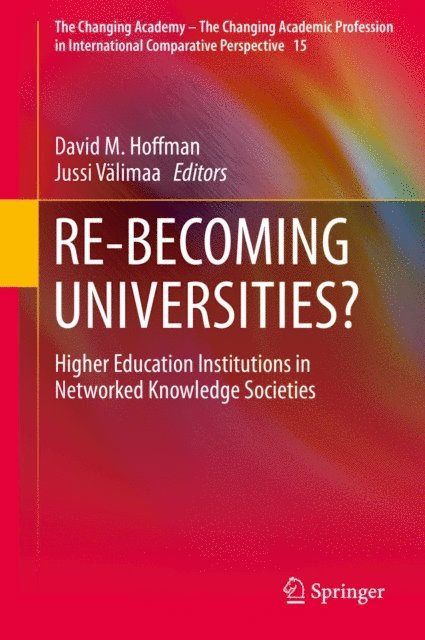
This book provides an overview of the major findings of the comparative research project, Changes in Networks, Higher Education and Knowledge Society (CINHEKS). The main aim of this international comparative research project is the analysis of how Higher education institutions are networked within distinct knowledge societies in two key regions of the world: Europe and the United States of America. This research project was carried out in four European countries (Finland, Germany, Portugal and the United Kingdom) and in two different states in the United States of America. In addition, during the course of the research, a team from the Russian Federation joined the CINHEKS study. The analysis is contextually grounded in a comparative policy analysis focused on the main developments and understandings of the ideas surrounding the term knowledge society, in all countries concerned. Empirical elaboration is established via a series of sequential studies, each building, incrementally, on the previous study. These studies include institutional profiles of higher education institutions, institutional case studies, and an international comparative survey that illuminates academics’ social networks. The research findings broaden our understanding of the differences and similarities in how higher education institutions and individual academics are networked within and between societies that understand themselves as knowledge societies. The book introduces a novel analytical synthesis, which asserts contemporary societies have evolved into Networked Knowledge Societies. Methodologically, the book both challenges and raises the bar for previous approaches in comparative higher education, in terms of research design, execution and lays the groundwork for a new generation of international comparative higher education research.
21 991 kr
Skickas inom 10-15 vardagar
22 253 kr
Läs direkt efter köp
This authoritative reference source covers all higher education themes in a comprehensive, accessible and comparative way. It maps the field for the twenty first century reflecting the massive changes that have occurred and the challenges ahead for future research. It provides a rich diversity of scholarly perspectives and covers the entire spectrum of higher education from a geographical, a topical and disciplinary perspective. It is unrivaled in its capacity to go beyond national boundaries and provides indispensible comparative analyses.
The major reference works available about higher education have been published more than two decades ago and since then higher education has undergone major changes that have resulted in a much larger, diverse, global, and multidimensional reality. One of the main trends has been relentless expansion on a worldwide scale. This has led to mass higher education becoming a reality across continents, substantial growth in the number of countries with universal access to higher education, and great diversification of the student body. The tremendous increase in the international links in higher education, through issues such as training, students’ mobility, staff mobility, research activities, is another major change. The consequence is a global dimension that is strongly associated with the intensification of international networks in which institutions and researchers explore, create and share knowledge. As a result of the changes and trends, higher education has increasingly become part of debates that highlight its complexity as an institution that combines relevant political, social, economic, and cultural purposes and dimensions. Asked to play important and varied economic and social roles, higher education has had to reshape its priorities, and organizational and decision-making structures. The growth and increased complexity of the field have both led to more attention being paid to all aspects of higher education and to the expansion of research.