Kalliopi Nikolopoulou - Böcker
Visar alla böcker från författaren Kalliopi Nikolopoulou. Handla med fri frakt och snabb leverans.
3 produkter
3 produkter
542 kr
Skickas inom 10-15 vardagar
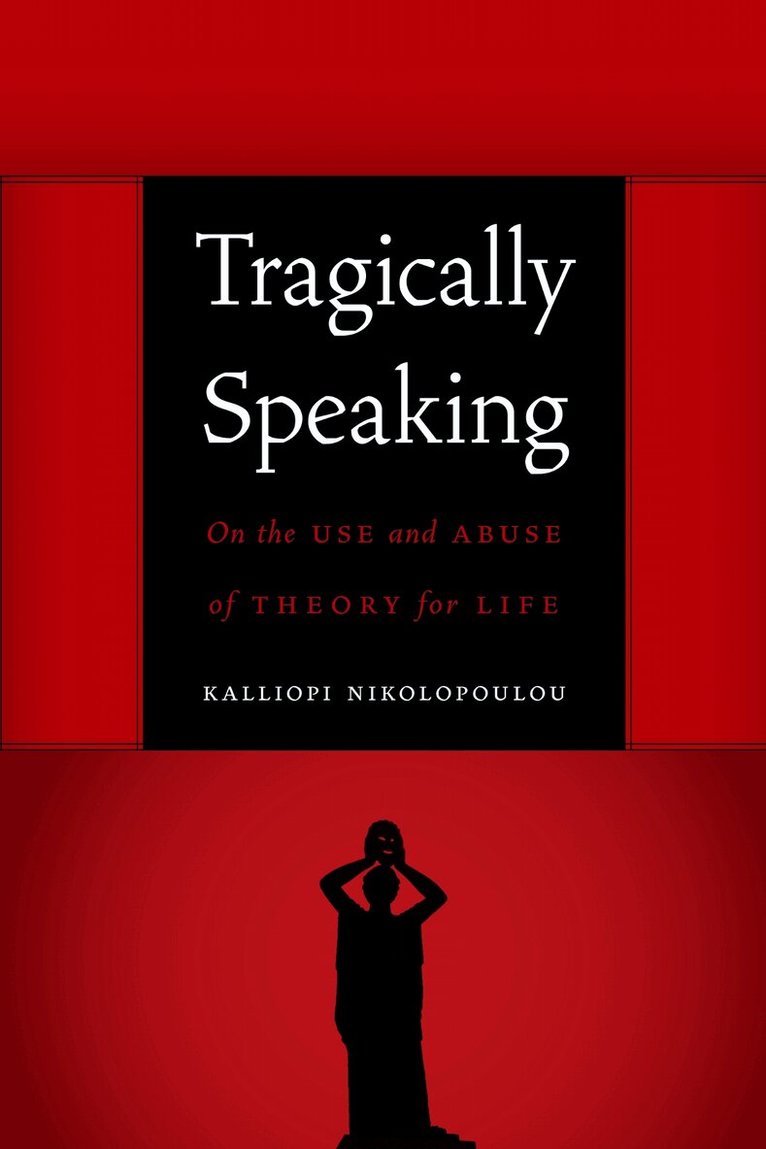
From German idealism onward, Western thinkers have sought to revalue tragedy, invariably converging at one cardinal point: tragic art risks aestheticizing real violence. Tragically Speaking critically examines this revaluation, offering a new understanding of the changing meaning of tragedy in literary and moral discourse. It questions common assumptions about the Greeks' philosophical relation to the tragic tradition and about the ethical and political ramifications of contemporary theories of tragedy.Starting with the poet Friedrich Hölderlin and continuing to the present, Kalliopi Nikolopoulou traces how tragedy was translated into an idea ("the tragic") that was then revised further into the "beyond the tragic" of postmetaphysical contemporary thought. While recognizing some of the merits of this revaluation, Tragically Speaking concentrates on the losses implicit in such a turn. It argues that by translating tragedy into an idea, these rereadings effected a problematic subordination of politics to ethics: the drama of human conflict gave way to philosophical reflection, bracketing the world in favor of the idea of the world. Where contemporary thought valorizes absence, passivity, the Other, rhetoric, writing, and textuality, the author argues that their "deconstructed opposites" (presence, will, the self, truth, speech, and action, all of which are central to tragedy) are equally necessary for any meaningful discussion of ethics and politics.
394 kr
Skickas
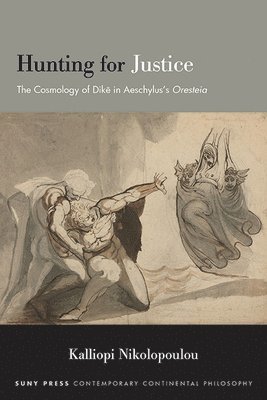
Utilizes Greek tragedy to investigate the fundamentally arbitrary and violent nature of justice.A purely political understanding of justice does not convey the cosmological origins of the ancient conception of justice, Dikē, in Aeschylus's Oresteia. Drawing from Walter Burkert's anthropology of the hunt in Homo Necans, which articulates an ancient cosmology and implies a theory of (tragic) seriousness that parallels Aristotle's naturalist interpretation of tragedy, Hunting for Justice argues that justice is rooted in predation as exemplified by the Furies. Although the Oresteia has been read as the passage from the violence of nature to civic justice, Kalliopi Nikolopoulou offers an original interpretation of the trilogy: the ending of the feud is less an instance of political deliberation (as Hegel maintained), and more an instance of nature's necessary halting of its own destructiven'ess for life to resume. Extending to contemporary contexts, she argues that nature's arbitrariness continues to underpin our notions of justice, albeit in a distorted form. In this sense, Hunting for Justice offers a critique of the political infinitization and idealization of justice that permeates our current discourses of activism and social justice.
1 373 kr
Skickas
Utilizes Greek tragedy to investigate the fundamentally arbitrary and violent nature of justice.A purely political understanding of justice does not convey the cosmological origins of the ancient conception of justice, Dikē, in Aeschylus's Oresteia. Drawing from Walter Burkert's anthropology of the hunt in Homo Necans, which articulates an ancient cosmology and implies a theory of (tragic) seriousness that parallels Aristotle's naturalist interpretation of tragedy, Hunting for Justice argues that justice is rooted in predation as exemplified by the Furies. Although the Oresteia has been read as the passage from the violence of nature to civic justice, Kalliopi Nikolopoulou offers an original interpretation of the trilogy: the ending of the feud is less an instance of political deliberation (as Hegel maintained), and more an instance of nature's necessary halting of its own destructiven'ess for life to resume. Extending to contemporary contexts, she argues that nature's arbitrariness continues to underpin our notions of justice, albeit in a distorted form. In this sense, Hunting for Justice offers a critique of the political infinitization and idealization of justice that permeates our current discourses of activism and social justice.