Karen De Clercq - Böcker
Visar alla böcker från författaren Karen De Clercq. Handla med fri frakt och snabb leverans.
7 produkter
7 produkter
1 275 kr
Skickas inom 5-8 vardagar
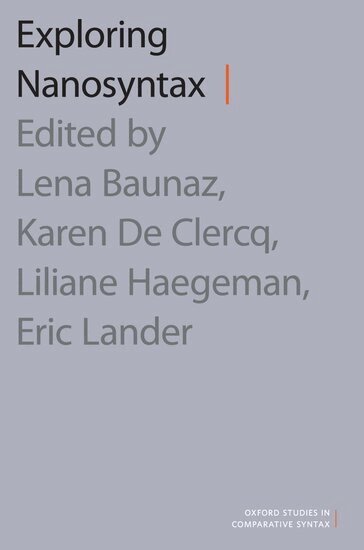
Exploring Nanosyntax provides the first in-depth introduction to the framework of nanosyntax, which originated in the early 2000s as a formal theory of language within Principles and Parameters framework. Deploying a radical implementation of the cartographic "one feature - one head" maxim, the framework provides a fine-grained decomposition of morphosyntactic structure, laying bare the building blocks of the universal functional sequence. This volume makes three contributions: First, it presents the framework's constitutive tools and principles, and explains how nanosyntax relates to cartography and to Distributed Morphology. Second, it illustrates how nanosyntactic tools and principles can be applied to a range of empirical domains of natural language. In doing so, the volume provides a range of detailed crosslinguistic investigations which uncover novel empirical data and which contribute to a better understanding of the functional sequence. Third, specific problems are raised and discussed and new theoretical strands internal to the nanosyntactic framework are explored. Bringing together original contributions by senior and junior researchers in the field, Exploring Nanosyntax offers the first all-encompassing view of this promising framework, making its methodology and exciting results accessible to a wide audience.
742 kr
Skickas inom 5-8 vardagar
Exploring Nanosyntax provides the first in-depth introduction to the framework of nanosyntax, which originated in the early 2000s as a formal theory of language within Principles and Parameters framework. Deploying a radical implementation of the cartographic "one feature - one head" maxim, the framework provides a fine-grained decomposition of morphosyntactic structure, laying bare the building blocks of the universal functional sequence. This volume makes three contributions: First, it presents the framework's constitutive tools and principles, and explains how nanosyntax relates to cartography and to Distributed Morphology. Second, it illustrates how nanosyntactic tools and principles can be applied to a range of empirical domains of natural language. In doing so, the volume provides a range of detailed crosslinguistic investigations which uncover novel empirical data and which contribute to a better understanding of the functional sequence. Third, specific problems are raised and discussed and new theoretical strands internal to the nanosyntactic framework are explored. Bringing together original contributions by senior and junior researchers in the field, Exploring Nanosyntax offers the first all-encompassing view of this promising framework, making its methodology and exciting results accessible to a wide audience.
1 508 kr
Skickas inom 7-10 vardagar
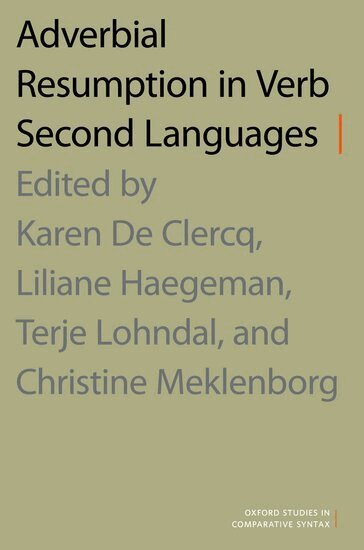
While Verb-third (V3) patterns have long been studied in verb-second (V2) languages, a similar pattern in which an initial adverbial constituent is resumed by a clause-internal element has been much less studied. The latter is referred to as 'adverbial resumption' and it also has the character of being a V3 phenomenon. Therefore, the pattern is labelled 'adverbial V3 resumption' or 'adverbial V3.' The present volume is an up-to-date overview of the subject featuring case studies of individual languages that display certain patterns of V3. The authors discuss this pattern in relation to several different languages, addressing among other things issues of microvariation in contemporary varieties and diachronic variation. The book covers Medieval Romance, Old Italian, Old English, diachronic and synchronic varieties of German, varieties of Flemish and Dutch, Icelandic, varieties of Swedish, and Norwegian. Through analyses of adverbial resumptive V3 orders in Germanic and Romance, the contributors explore the nature of V2: while adverbial resumption only occurs in varieties that observe the V2 rule, in itself it leads to apparent violations of linear V2 order, namely to V3 orders. Adverbial Resumption in Verb Second Languages provides comparative analyses which touch upon the nature of sentence-external versus sentence-internal adjuncts, and the fine-grained architecture of the clausal functional hierarchy. These papers constitute a valuable contribution to the theoretically important topics of V2 and V3 that will be of interest to comparative linguists, Germanic linguistics, Romance linguists, and anyone working on formal grammar in general.
670 kr
Skickas inom 5-8 vardagar
While Verb-third (V3) patterns have long been studied in verb-second (V2) languages, a similar pattern in which an initial adverbial constituent is resumed by a clause-internal element has been much less studied. The latter is referred to as 'adverbial resumption' and it also has the character of being a V3 phenomenon. Therefore, the pattern is labelled 'adverbial V3 resumption' or 'adverbial V3.' The present volume is an up-to-date overview of the subject featuring case studies of individual languages that display certain patterns of V3. The authors discuss this pattern in relation to several different languages, addressing among other things issues of microvariation in contemporary varieties and diachronic variation. The book covers Medieval Romance, Old Italian, Old English, diachronic and synchronic varieties of German, varieties of Flemish and Dutch, Icelandic, varieties of Swedish, and Norwegian. Through analyses of adverbial resumptive V3 orders in Germanic and Romance, the contributors explore the nature of V2: while adverbial resumption only occurs in varieties that observe the V2 rule, in itself it leads to apparent violations of linear V2 order, namely to V3 orders. Adverbial Resumption in Verb Second Languages provides comparative analyses which touch upon the nature of sentence-external versus sentence-internal adjuncts, and the fine-grained architecture of the clausal functional hierarchy. These papers constitute a valuable contribution to the theoretically important topics of V2 and V3 that will be of interest to comparative linguists, Germanic linguistics, Romance linguists, and anyone working on formal grammar in general.
1 668 kr
Skickas inom 5-8 vardagar
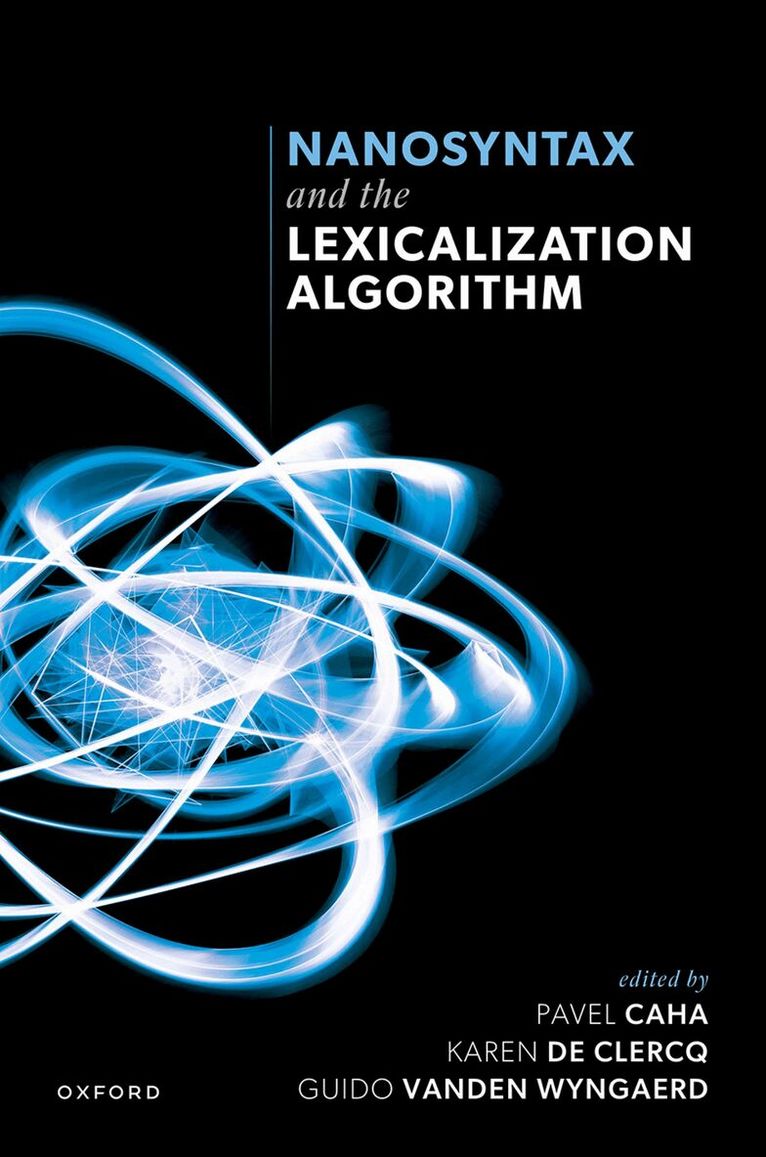
This book presents the latest research in the Nanosyntax framework, a late-insertion theory based on the idea that the elementary building blocks of syntactic trees are limited to single features. The features are assembled by means of syntax and lexicalized by means of phrasal lexicalization and the lexicalization algorithm, a simple, constrained, and algorithmic process of externalization of syntactic structures. The chapters in this volume are divided into four parts that each contribute to a better understanding of the framework as a whole and of the lexicalization algorithm in particular. The case studies in Part I use the lexicalization algorithm to probe for the underlying ingredients of the functional sequence, while those in Part II take a closer look at the structural nature of prefixes and how they differ from suffixes, exploring the complications related to their derivation. Part III investigates the finer detail of the algorithm, presenting its most recent innovations, in order to resolve some challenging data patterns relating to (apparent) non-local allomorphy, neutralization, ABA-patterns, and theme vowels. The volume's final part looks forward to new avenues of investigation, with chapters on phonologically-conditioned allomorphy, selection, and multilingual settings.
Del 144 - Studies in Generative Grammar [SGG]
Morphosyntax of Negative Markers
A Nanosyntactic Account
Inbunden, Engelska, 2020
2 025 kr
Skickas inom 5-8 vardagar
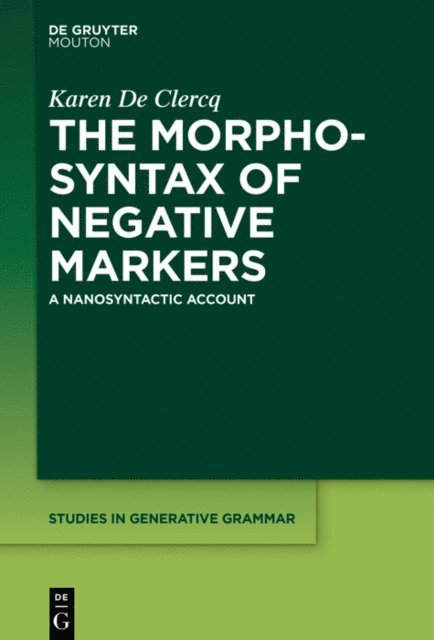
This book applies the tools of nanosyntax to the natural language phenomenon of negation. Most work on negation is concerned with the study of sentence negation, while low scope negation or constituent negation is hardly ever systematically discussed in the literature. The present book aims to fill that gap, by investigating scopally different negative markers in a sample of 23 typologically diverse languages. A four-way classification of negative markers is argued for and it is shown how meaningful syncretism patterns arise across those four groups of negative markers in the language sample investigated. The syncretisms are meaningful in that they track the natural semantic scope of negation, and provide support to the idea that morphology is not arbitrary, but points to submorphemic structure. Consequently, this study leads to a decomposition of the negative morpheme into five privative features: Tense, Focus, Classification, Quantity and Negation proper. Finally, the book argues that sentence, constituent and lexical negation can all be treated in the same module of the grammar, i.e. syntax.
294 kr
Skickas inom 5-8 vardagar
This book applies the tools of nanosyntax to the natural language phenomenon of negation. Most work on negation is concerned with the study of sentence negation, while low scope negation or constituent negation is hardly ever systematically discussed in the literature. The present book aims to fill that gap, by investigating scopally different negative markers in a sample of 23 typologically diverse languages. A four-way classification of negative markers is argued for and it is shown how meaningful syncretism patterns arise across those four groups of negative markers in the language sample investigated. The syncretisms are meaningful in that they track the natural semantic scope of negation, and provide support to the idea that morphology is not arbitrary, but points to submorphemic structure. Consequently, this study leads to a decomposition of the negative morpheme into five privative features: Tense, Focus, Classification, Quantity and Negation proper. Finally, the book argues that sentence, constituent and lexical negation can all be treated in the same module of the grammar, i.e. syntax.