• Fri frakt över 249 kr
  • •
  • Snabba leveranser
  • •
  • Billiga böcker
Kundservice

Du är på sajten för privatpersoner.

Företag, bibliotek eller offentlig verksamhet?

Du handlar på classic.bokus.com, där alla dina funktioner finns intakta.
Till classic.bokus.com
Bokus logotyp. Gå till startsidan.
  • Erbjudanden
  • Student
  • Topplistor
  • Barn & ungdom
  • Bokus Play
  • E-böcker
  • Ljudböcker
  • Pocketböcker
  • Spel och pussel

Pocketfynda! Hundratals böcker för 49 kr/st →

Sidfot

Mina sidor

    Hjälp

    • Kundservice
    • Vanliga frågor och svar
    • Frakt och leverans
    • Retur vid ångerrätt
    • Reklamera vara
    • Betalning
    • Köpvillkor
    • Allmänna villkor
    • Information om webbplatsens tillgänglighet

    Om Bokus

    • Om oss
    • Pressrum
    • För studenter
    • För företag
    • För bibliotek och offentlig verksamhet
    • För leverantörer
    • Hållbarhet

    Populärt

    • Aktuella erbjudanden
    • Presentkort
    • Studentlitteratur
    • Nya böcker
    • Topplistor
    • Signerade böcker
    • Engelska böcker

    Inspiration

    • Boktips
    • BookTok
    • Barnbokskaraktärer
    • Populära författare
    Logotyp för Bokus
    Följ oss på Facebook (extern länk)Följ oss på Instagram (extern länk)Följ oss på YouTube (extern länk)Följ oss på TikTok (extern länk)
    bokus @ CookiesAnpassa cookiesIntegritetspolicyKöpvillkor
    Till Citymail hemsida (extern länk)Till Budbee hemsida (extern länk)Till Postnord hemsida (extern länk)Till Schenker hemsida (extern länk)Till Early Bird hemsida (extern länk)Till Walleys hemsida (extern länk)
    1. Språk och ordböcker
    2. Språkvetenskap och lingvistik

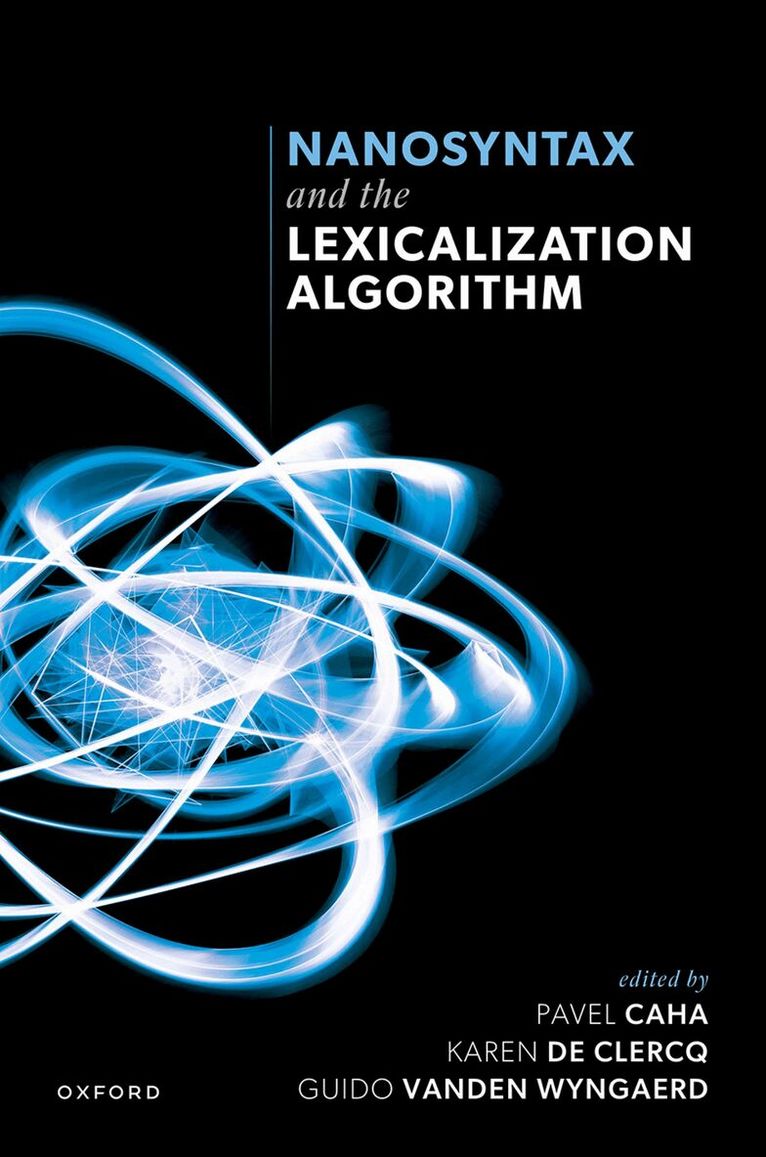
    Nanosyntax and the Lexicalization Algorithm

    AvPavel Caha,Karen de Clercq

    Inbunden, Engelska, 2025

    1 699 kr

    Beställningsvara. Skickas inom 5-8 vardagar. Fri frakt över 249 kr.

    Beskrivning

    This book presents the latest research in the Nanosyntax framework, a late-insertion theory based on the idea that the elementary building blocks of syntactic trees are limited to single features. The features are assembled by means of syntax and lexicalized by means of phrasal lexicalization and the lexicalization algorithm, a simple, constrained, and algorithmic process of externalization of syntactic structures. The chapters in this volume are divided into four parts that each contribute to a better understanding of the framework as a whole and of the lexicalization algorithm in particular. The case studies in Part I use the lexicalization algorithm to probe for the underlying ingredients of the functional sequence, while those in Part II take a closer look at the structural nature of prefixes and how they differ from suffixes, exploring the complications related to their derivation. Part III investigates the finer detail of the algorithm, presenting its most recent innovations, in order to resolve some challenging data patterns relating to (apparent) non-local allomorphy, neutralization, ABA-patterns, and theme vowels. The volume's final part looks forward to new avenues of investigation, with chapters on phonologically-conditioned allomorphy, selection, and multilingual settings.

    Produktinformation

    • Utgivningsdatum:2025-10-21
    • Mått:167 x 243 x 37 mm
    • Vikt:926 g
    • Format:Inbunden
    • Språk:Engelska
    • Antal sidor:528
    • Förlag:OUP OXFORD
    • ISBN:9780198947134

    Utforska kategorier

    • Språkvetenskap och lingvistik inom Språk och ordböcker

    Mer om författaren

    Pavel Caha is an associate professor at Masaryk University. His research focuses on the theoretical implications of case marking, declensions, and degree morphology. His work has been published in journals such as Natural Language & Linguistic Theory, Morphology, Journal of Linguistics, and Glossa, and in reference works including The Oxford Research Encyclopedia of Linguistics, The Wiley-Blackwell Companion to Morphology, and The Cambridge Handbook of Distributed Morphology.Karen De Clercq is a CNRS researcher affiliated with the Laboratoire de Linguistique Formelle at Université Paris Cité. Her main research interest is the morphosyntax of negation, which she approaches from a typological and nanosyntactic perspective. She is the author of The Morphosyntax of Negative Markers (Mouton de Gruyter, 2020), and co-editor of Exploring Nanosyntax (OUP, 2018) and Adverbial Resumption in Verb Second Languages (OUP, 2023).Guido Vanden Wyngaerd is a full-time professor at KU Leuven for the fields of Dutch and General Linguistics. His current research focuses on negation and adjectival degrees from a nanosyntactic perspective. His publications include Dissolving Binding Theory (with Johan Rooryck; OUP, 2011), as well as a number of articles in leading international journals and reference works. He is an Associate Editor of Glossa.

    Innehållsförteckning

    • 1: Karen De Clercq;Pavel Caha;Michal Starke;Guido Vanden Wyngaerd: Nanosyntax: State of the art and recent developments Part I The Functional Sequence 2: Anastasiia Vyshnevska: Comparing Slavic comparatives 3: Fenna Bergsma;Jan Don;Anne Merkuur;Meg Smith: Complex Left Branches in Frisian verbs 4: Furkan Dikmen; Ömer Demirok: Decomposing habituals 5: Antonio Fábregas: Suppletion and affix selection in Nanosyntax: The case of Spanish numerals Part II Prefixes 6: Bartosz Wiland: Polish prefix stacking redux 7: Anne-Li Demonie: Complications of Complex Left Branches: The case of Dutch verbal prefixes 8: Serra Gök;Ömer Demirok: The non-uniform nature of auxiliaries: A case study on Turkish PART III The Algorithm and Subextraction 9: Pavel Caha: A local analysis of an apparent nonlocal allomorphy in Tamil: A perspective from Rutul 10: Daniar Kasenov: ABA patterns and the generative power of Nanosyntax 11: Pavel Caha;Lucie Taraldsen Medová: Syncretism and markedness paradoxes in the Russian demonstrative declension 12: Tarald Taraldsen: The relation between theme vowels and root suppletion Part IV New Explorations 13: Tommaso Balsemin;Francesco Pinzin: A modular approach to Phonologically Conditioned Allomorphy: The case of the Ligurian article system 14: Utku Türk: Controlling morphosyntactic competition through phonology 15: Lena Baunaz;Eric Lander: Lexical structure and subjunctive selection 16: David Natvig;Michael T. Putnam;Emmeline Wilson: Exponency in bilingual grammars: Conflict and compromise