Karl Kirchner – författare
Visar alla böcker från författaren Karl Kirchner. Handla med fri frakt och snabb leverans.
4 produkter
4 produkter
Inbunden, Engelska, 2021
3 583 kr
Skickas inom 10-15 vardagar
This book provides researchers in the fields of organic chemistry, organometallic chemistry and homogeneous catalysis with an overview of significant recent developments in the area of metal-ligand cooperativity, with a focus on pincer architectures. The various contributions highlight the widespread impact of M–L co-operativity phenomena on modern organometallic chemistry and catalyst development. The development of efficient and selective catalytic transformations relies on the understanding and fine control of the various elementary reactions that constitutes a catalytic cycle. Co-operative ligands, which actively participate in bond making and bond breaking together to the metal they support, open up new avenues in this area. In particular, buttressing a weak or reactive metal-ligand bond by flanking coordinating arms in a pincer ligand design is proving a versatile strategy to access robust metal complexes that exhibit unusual and selective reactivity patterns.
E-bok
Engelska, 20214 267 kr
Läs direkt efter köp
This book provides researchers in the fields of organic chemistry, organometallic chemistry and homogeneous catalysis with an overview of significant recent developments in the area of metal-ligand cooperativity, with a focus on pincer architectures. The various contributions highlight the widespread impact of M–L co-operativity phenomena on modern organometallic chemistry and catalyst development. The development of efficient and selective catalytic transformations relies on the understanding and fine control of the various elementary reactions that constitutes a catalytic cycle. Co-operative ligands, which actively participate in bond making and bond breaking together to the metal they support, open up new avenues in this area. In particular, buttressing a weak or reactive metal-ligand bond by flanking coordinating arms in a pincer ligand design is proving a versatile strategy to access robust metal complexes that exhibit unusual and selective reactivity patterns.
Häftad, Engelska, 2022
3 583 kr
Skickas inom 10-15 vardagar
This book provides researchers in the fields of organic chemistry, organometallic chemistry and homogeneous catalysis with an overview of significant recent developments in the area of metal-ligand cooperativity, with a focus on pincer architectures. The various contributions highlight the widespread impact of M–L co-operativity phenomena on modern organometallic chemistry and catalyst development. The development of efficient and selective catalytic transformations relies on the understanding and fine control of the various elementary reactions that constitutes a catalytic cycle. Co-operative ligands, which actively participate in bond making and bond breaking together to the metal they support, open up new avenues in this area. In particular, buttressing a weak or reactive metal-ligand bond by flanking coordinating arms in a pincer ligand design is proving a versatile strategy to access robust metal complexes that exhibit unusual and selective reactivity patterns.
E-bok
PDF, Engelska, 20121 367 kr
Läs direkt efter köp
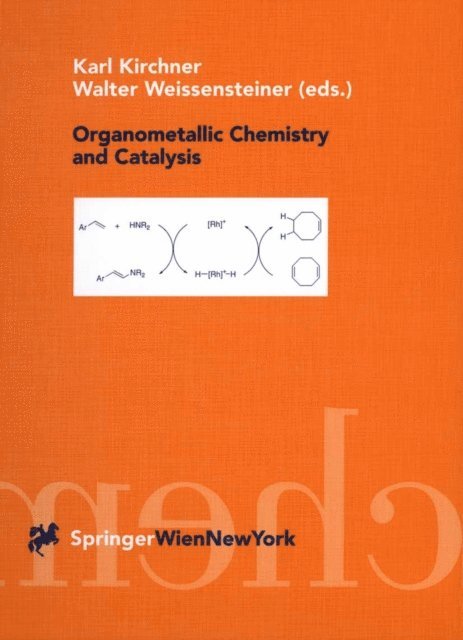
From the beginning of chemistry as an exact (natural) science - almost 200 years ago - there was a more or less distinct differentiation between its various branches such as organic, inorganic, physical, analytical, or biochemistry. With the increasing insight into the connections and governing laws it soon became obvious, however, that such a clear separation could be regarded as more or less obsolete; within almost any field of chemical research one has to deal with most of the branches mentioned. Especially organic and inorganic chemistry are significant examples for this statement, overlapping considerably within the important field of organome tallic chemistry. This regime of chemistry started its advance with the discovery of dimethylzinc 150 years ago, had a highlight with the introduction of Grignard reagents around 1900, developed further with the start of lithium organyls in 1925 and literally exploded after the discovery of the first transition metal cyclopenta dienyl complex ferrocene half a century ago. The chronological sequence of the important steps, i. e. 1850 (Zn) - 1900 (Mg) - 1925 (Li) - 1950 (Fe), seems rather remarkable. The increasing group of metallocenes is not only of high theoretical and, due to the potential chirality of its members, stereochemical interest, but offers also a wide variety of extremely useful catalysts, especially for stereoselective reactions. The Austrian Chemical Society took this development into account by organizing the Twelfth International Conference on Organometallic Chemistry held in Vienna in 1985.