Karl S. Rosengren - Böcker
Visar alla böcker från författaren Karl S. Rosengren. Handla med fri frakt och snabb leverans.
4 produkter
4 produkter
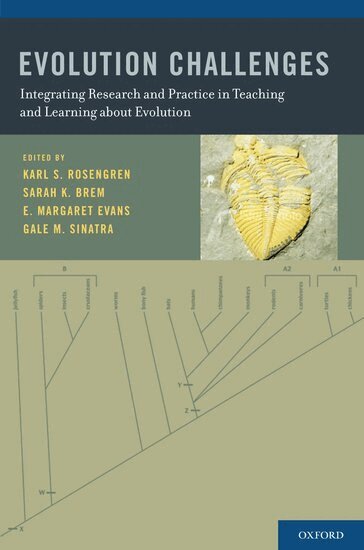
Evolution Challenges
Integrating Research and Practice in Teaching and Learning about Evolution
Inbunden, Engelska, 2012
1 318 kr
Skickas inom 5-8 vardagar
A recent poll revealed that one in four Americans believe in both creationism and evolution, while another 41% believe that creationism is true and evolution is false. A minority (only 13%) believe only in evolution. Given the widespread resistance to the idea that humans and other animals have evolved and given the attention to the ongoing debate of what should be taught in public schools, issues related to the teaching and learning of evolution are quite timely.Evolution Challenges: Integrating Research and Practice in Teaching and Learning about Evolution goes beyond the science versus religion dispute to ask why evolution is so often rejected as a legitimate scientific fact, focusing on a wide range of cognitive, socio-cultural, and motivational factors that make concepts such as evolution difficult to grasp. The volume brings together researchers with diverse backgrounds in cognitive development and education to examine children's and adults' thinking, learning, and motivation, and how aspects of representational and symbolic knowledge influence learning about evolution. The book is organized around three main challenges inherent in teaching and learning evolutionary concepts: folk theories and conceptual biases, motivational and epistemological biases, and educational aspects in both formal and informal settings. Commentaries across the three main themes tie the book together thematically, and contributors provide ideas for future research and methods for improving the manner in which evolutionary concepts are conveyed in the classroom and in informal learning experiences. Evolution Challenges is a unique text that extends far beyond the traditional evolution debate and is an invaluable resource to researchers in cognitive development, science education and the philosophy of science, science teachers, and exhibit and curriculum developers.
Imagining the Impossible
Magical, Scientific, and Religious Thinking in Children
Inbunden, Engelska, 2000
1 466 kr
Skickas inom 7-10 vardagar
This volume, first published in 2000, is about the development of human thinking that stretches beyond the ordinary boundaries of reality. Various research initiatives emerged in the decade prior to publication exploring such matters as children's thinking about imaginary beings, magic and the supernatural. The purpose of this book is to capture something of the larger spirit of these efforts. In many ways, this new work offers a counterpoint to research on the development of children's domain-specific knowledge about the ordinary nature of things that has suggested that children become increasingly scientific and rational over the course of development. In acquiring an intuitive understanding of the physical, biological or psychological domains, even young children recognize that there are constraints on what can happen. However, once such constraints are acknowledged, children are in a position to think about the violation of those very same constraints - to contemplate the impossible.
Imagining the Impossible
Magical, Scientific, and Religious Thinking in Children
Häftad, Engelska, 2000
570 kr
Skickas inom 7-10 vardagar
This volume, first published in 2000, is about the development of human thinking that stretches beyond the ordinary boundaries of reality. Various research initiatives emerged in the decade prior to publication exploring such matters as children's thinking about imaginary beings, magic and the supernatural. The purpose of this book is to capture something of the larger spirit of these efforts. In many ways, this new work offers a counterpoint to research on the development of children's domain-specific knowledge about the ordinary nature of things that has suggested that children become increasingly scientific and rational over the course of development. In acquiring an intuitive understanding of the physical, biological or psychological domains, even young children recognize that there are constraints on what can happen. However, once such constraints are acknowledged, children are in a position to think about the violation of those very same constraints - to contemplate the impossible.
Children's Understanding of Death
Toward a Contextualized and Integrated Account
Häftad, Engelska, 2014
481 kr
Skickas inom 11-20 vardagar
In this monograph we (1) provide an account of young children's socialization with respect to death and (2) develop a conception of children’s understanding of death that encompasses affective and cognitive dimensions. Conducted in a small city in the Midwest, the project involved several component studies employing quantitative and qualitative methods. Middle-class, European American children (3-6 years, N = 101) were interviewed about their cognitive/affective understandings of death; their parents (N = 71) completed questionnaires about the children's experiences and their own beliefs and practices. Other data included ethnographic observations, interviews, focus groups, and analyses of children's books. Parents and teachers shared a dominant folk theory, believing that children should be shielded from death because they lack the emotional and cognitive capacity to understand or cope with death. Even the youngest children knew basic elements of the emotional script for death, a script that paralleled messages available across socializing contexts. Similarly, they showed considerable understanding of the subconcepts of death, providing additional evidence that young children's cognitive understanding is more advanced than previously thought, and contradicting the dominant folk theory held by most parents. Although children's default model of death was biological, many children and parents used coexistence models, mixing scientific and religious elements. A preliminary study of Mexican American families (children: N = 27, parents: N = 17) cast the foregoing fi ndings in relief, illustrating a different set of socializing beliefs and practices. Mexican American children’s understanding of death differed from their European American counterparts' in ways that mirrored these differences.