Katalin Miklóssy - Böcker
Visar alla böcker från författaren Katalin Miklóssy. Handla med fri frakt och snabb leverans.
9 produkter
9 produkter
2 219 kr
Skickas inom 10-15 vardagar
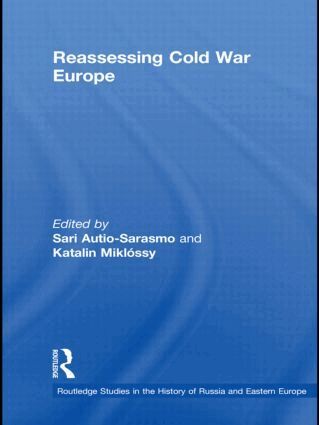
This book presents a comprehensive reassessment of Europe in the Cold War period, 1945-91. Contrary to popular belief, it shows that relations between East and West were based not only on confrontation and mutual distrust, but also on collaboration. The authors reveal that - despite opposing ideologies - there was in fact considerable interaction and exchange between different Eastern and Western actors (such states, enterprises, associations, organisations and individuals) irrespective of the Iron Curtain.This book challenges both the traditional understanding of the East-West juxtaposition and the relevancy of the Iron Curtain. Covering the full period, and taking into account a range of spheres including trade, scientific-technical co-operation, and cultural and social exchanges, it reveals how smaller countries and smaller actors in Europe were able to forge and implement their agendas within their own blocs. The books suggests that given these lower-level actors engaged in mutually beneficial cooperation, often running counter to the ambitions of the bloc-leaders, the rules of Cold War interaction were not, in fact, exclusively dictated by the superpowers.
2 357 kr
Skickas inom 10-15 vardagar
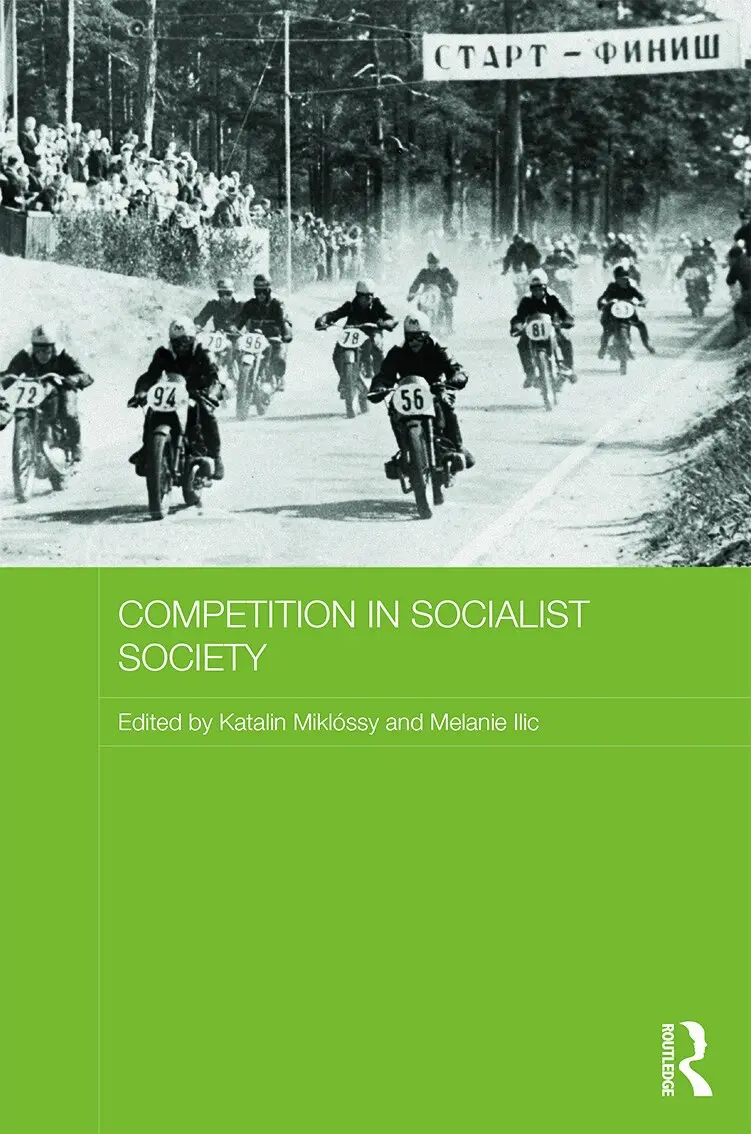
This book explores how the concept of "competition", which is usually associated with market economies, operated under state socialism in the Soviet Union and Eastern Europe, where the socialist system, based on command economic planning and state-centred control over society, was supposed to emphasise "co-operation", rather than competitive mechanisms. The book considers competition in a wider range of industries and social fields across the Soviet bloc, and shows how the gradual adoption and adaptation of Western practices led to the emergence of more open competitiveness in socialist society. The book includes discussion of the state’s view of competition, and focuses especially on how competition operated at the grassroots level. It covers politico-economic reforms and their impact, both overall and at the enterprise level; competition in the cultural sphere; and the huge effect of increasing competition on socialist ways of thinking.
775 kr
Skickas inom 10-15 vardagar
This book presents a comprehensive reassessment of Europe in the Cold War period, 1945-91. Contrary to popular belief, it shows that relations between East and West were based not only on confrontation and mutual distrust, but also on collaboration. The authors reveal that - despite opposing ideologies - there was in fact considerable interaction and exchange between different Eastern and Western actors (such states, enterprises, associations, organisations and individuals) irrespective of the Iron Curtain.This book challenges both the traditional understanding of the East-West juxtaposition and the relevancy of the Iron Curtain. Covering the full period, and taking into account a range of spheres including trade, scientific-technical co-operation, and cultural and social exchanges, it reveals how smaller countries and smaller actors in Europe were able to forge and implement their agendas within their own blocs. The books suggests that given these lower-level actors engaged in mutually beneficial cooperation, often running counter to the ambitions of the bloc-leaders, the rules of Cold War interaction were not, in fact, exclusively dictated by the superpowers.
2 088 kr
Skickas inom 10-15 vardagar
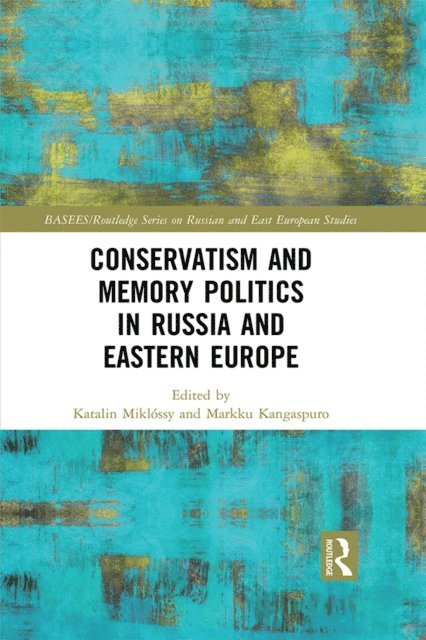
This book discusses the diverse practices and discourses of memory politics in Russia and Eastern Europe. It argues that currently prevailing conservativism has a long tradition, which continued even in Communist times, and is different to conservatism in the West, which can accommodate other viewpoints within liberal democratic systems. It considers how important history is for conservatism, and how history is reconstituted according to changing circumstances. It goes on to examine in detail values which are key to conservatism, such as patriotism, Christianity and religious life, and the traditional model of the family, the importance of the sovereign national state within globalization, and the emphasis on a strong paternal state, featuring hierarchy, authority and political continuity. The book concludes by analysing how far states in the region are experiencing a common trend and whether different countries’ conservative narratives are reinforcing each other or are colliding.
617 kr
Skickas inom 10-15 vardagar
This book discusses the diverse practices and discourses of memory politics in Russia and Eastern Europe. It argues that currently prevailing conservativism has a long tradition, which continued even in Communist times, and is different to conservatism in the West, which can accommodate other viewpoints within liberal democratic systems. It considers how important history is for conservatism, and how history is reconstituted according to changing circumstances. It goes on to examine in detail values which are key to conservatism, such as patriotism, Christianity and religious life, and the traditional model of the family, the importance of the sovereign national state within globalization, and the emphasis on a strong paternal state, featuring hierarchy, authority and political continuity. The book concludes by analysing how far states in the region are experiencing a common trend and whether different countries’ conservative narratives are reinforcing each other or are colliding.
671 kr
Skickas inom 10-15 vardagar
Following the end of the Cold War and European Union enlargement, in what sense does Eastern Europe continue to exist as a meaningful geo-political concept? In addressing this question, contributors to this volume—Alex Cistelecan, Robert Bideleux, Katalin Miklóssy and Dieter Segert—tease out the implications for an ‘Area Studies’ approach to the region. They examine its contradictory situation within discourses of ‘orientalisation’: on one hand, posited as the ‘underdeveloped’ pendant to its western neighbours; on the other, largely Christian by religion and an integral part of a continent that dominated the world. They uncover the roots of area studies in the ‘colonial paradigm’ by which great powers promote the creation of predictive, ‘problem-solving’ knowledge that is immediately apprehendable for decision makers, helping them to take advantage of a region’s resources and strategic position, but which tends to homogenise the region’s geography and history. For critical inquiry, they argue, the challenge is to delineate transparently the reasons underlying Eastern Europe’s construction as an area of study, to identify the epistemological interests of motivated organisations such as funding agencies and political bodies, and to counter the ongoing orientalism of Western perspectives toward the East. This book was originally published as a special issue of the Journal of Contemporary Central and Eastern Europe.
719 kr
Skickas inom 10-15 vardagar
This book explores how the concept of "competition", which is usually associated with market economies, operated under state socialism in the Soviet Union and Eastern Europe, where the socialist system, based on command economic planning and state-centred control over society, was supposed to emphasise "co-operation", rather than competitive mechanisms. The book considers competition in a wider range of industries and social fields across the Soviet bloc, and shows how the gradual adoption and adaptation of Western practices led to the emergence of more open competitiveness in socialist society. The book includes discussion of the state’s view of competition, and focuses especially on how competition operated at the grassroots level. It covers politico-economic reforms and their impact, both overall and at the enterprise level; competition in the cultural sphere; and the huge effect of increasing competition on socialist ways of thinking.
2 021 kr
Skickas inom 10-15 vardagar
Following the end of the Cold War and European Union enlargement, in what sense does Eastern Europe continue to exist as a meaningful geo-political concept? In addressing this question, contributors to this volume—Alex Cistelecan, Robert Bideleux, Katalin Miklóssy and Dieter Segert—tease out the implications for an ‘Area Studies’ approach to the region. They examine its contradictory situation within discourses of ‘orientalisation’: on one hand, posited as the ‘underdeveloped’ pendant to its western neighbours; on the other, largely Christian by religion and an integral part of a continent that dominated the world. They uncover the roots of area studies in the ‘colonial paradigm’ by which great powers promote the creation of predictive, ‘problem-solving’ knowledge that is immediately apprehendable for decision makers, helping them to take advantage of a region’s resources and strategic position, but which tends to homogenise the region’s geography and history. For critical inquiry, they argue, the challenge is to delineate transparently the reasons underlying Eastern Europe’s construction as an area of study, to identify the epistemological interests of motivated organisations such as funding agencies and political bodies, and to counter the ongoing orientalism of Western perspectives toward the East. This book was originally published as a special issue of the Journal of Contemporary Central and Eastern Europe.
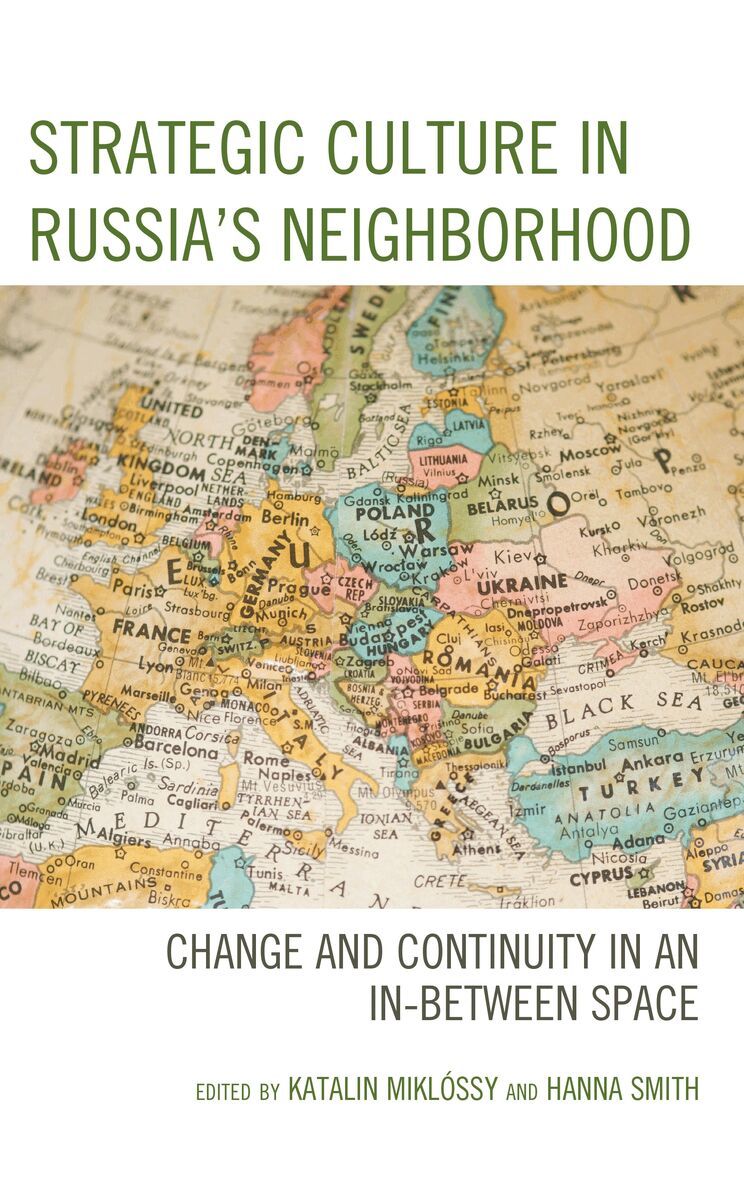
Strategic Culture in Russia’s Neighborhood
Change and Continuity in an In-Between Space
Inbunden, Engelska, 2019
1 476 kr
Skickas inom 10-15 vardagar
This book explains the complex relations and entanglements of Russia and its neighboring countries, an area that changed dramatically after the collapse of communism and the end of the Cold War. The chapters discuss how the strategic cultures of different countries display common characteristics rooted in this special geopolitical space that has been subjected to simultaneous changes over a longer time. Shared historical experiences provide a common ground to interpret outside threats. The spatial context is relevant in this volume because the focus is on a geopolitical in-between-ness. The position in between two ideologically, politically or economically divergent entities affects the states’ security considerations, maneuvering space and policy perspectives. By cross-examining competing Russian and Western influences Miklossy and Smith create a persuasive context of regional political choices.