Kate O'Malley - Böcker
Visar alla böcker från författaren Kate O'Malley. Handla med fri frakt och snabb leverans.
3 produkter
3 produkter
Del 70 - Studies in Imperialism
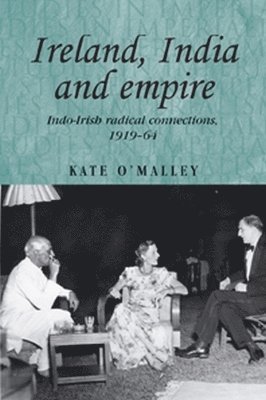
Ireland, India and Empire
Indo–Irish Radical Connections, 1919–64
Inbunden, Engelska, 2008
1 202 kr
Skickas inom 5-8 vardagar
Offering a fresh new perspective on the history of the end of Empire, with the Irish and Indian independence movements as its focus, this book details how each country s nationalist agitators engaged with each other and exchanged ideas. Using previously unpublished sources from the Indian Political Intelligence collection; it chronicles the rise and fall of movements such as the Indian-Irish Independence League and the League Against Imperialism whose histories have, until now, remained deeply hidden in the archives. The maturation of the Indo-Irish nexus documented in this book eventually culminated with the establishment of diplomatic ties between both independent states in the 1960s, yet the British government initially interpreted these transnational links as a potential threat to the Empire and monitored their development through its security services. O Malley highlights opaque aspects of the careers of popular figures from both Irish and Indian history including Subhas Chandra Bose, Jawaharlal Nehru, Eamon de Valera and Maud Gonne McBride at points when their paths crossed and also looks at how many one-time agitators went on to become international statesmen. This book encompasses aspects of Irish, Indian, British, Imperial and intelligence history and will be of interest to students, teachers and general history enthusiasts alike.
Del 70 - Studies in Imperialism
Ireland, India and empire
Indo–Irish radical connections, 1919–64
Häftad, Engelska, 2009
364 kr
Skickas inom 5-8 vardagar
Offering a fresh new perspective on the history of the end of Empire, with the Irish and Indian independence movements as its focus, this book details how each country’s nationalist agitators engaged with each other and exchanged ideas. Using previously unpublished sources from the Indian Political Intelligence collection, it chronicles the rise and fall of movements such as the Indian-Irish Independence League and the League Against Imperialism, whose histories have, until now, remained deeply hidden in the archives. O’Malley also highlights opaque aspects of the careers of popular figures from both Irish and Indian history including Subhas Chandra Bose, Jawaharlal Nehru, Eamon de Valera and Maud Gonne McBride at points when their paths crossed. This book encompasses aspects of Irish, Indian, British, Imperial and intelligence history and will be of interest to students, teachers and general history enthusiasts alike.
Del 13 - Documents on Irish Foreign Policy
Documents on Irish Foreign Policy, v. 13: 1965-1969
Inbunden, Engelska, 2022
657 kr
Skickas
The thirteenth volume in the Documents on Irish Foreign Policy (DIFP) series runs from April 1965 to July 1969. It covers the Fianna Fáil governments of Seán Lemass (April 1965 to November 1966) and Jack Lynch (November 1966 to July 1969) in which Frank Aiken was Minister for External Affairs.The four years and three months covered by DIFP XIII saw significant changes in the international context in which Ireland conducted its foreign policy. In 1965 the hope of the Department of External Affairs was that Ireland would enter the European Economic Community (EEC) before 1970. EEC entry would take place alongside that of Britain, an Anglo-Irish Free Trade Area (AIFTA) having come into operation in 1966, cementing trade between Ireland and its principal trading partner. Overall, the United Nations would remain the benchmark of global Irish foreign policy. Peacekeeping, advocating nuclear non-proliferation and ensuring the proper financing of the United Nations as well as promoting decolonisation and the universality of the United Nations system within the bipolar world of the Cold War remained central to 1960s Irish foreign policy.These assumptions were thrown out of balance by the continuing refusal of France to facilitate the expansion of the EEC and EEC membership remained out of reach for Ireland. Dublin’s fragile relations with Belfast were destabilised with the emergence of new social and political forces in Northern Ireland and the recurrence of sectarian violence. The Department of External Affairs proved initially unable to respond comprehensively to this new environment in Northern Ireland, which was the precursor to the outbreak of the Troubles in 1969. Improved economic and political relations with London were affected by local and international economic difficulties and also as a consequence of events in Northern Ireland. At the United Nations, superpower politics constrained Irish attempts to follow up the success of the 1968 Nuclear Non- Proliferation Treaty with a major policy initiative on the financing of international peacekeeping missions.