Eunan O'Halpin - Böcker
Visar alla böcker från författaren Eunan O'Halpin. Handla med fri frakt och snabb leverans.
7 produkter
7 produkter
784 kr
Skickas inom 3-6 vardagar
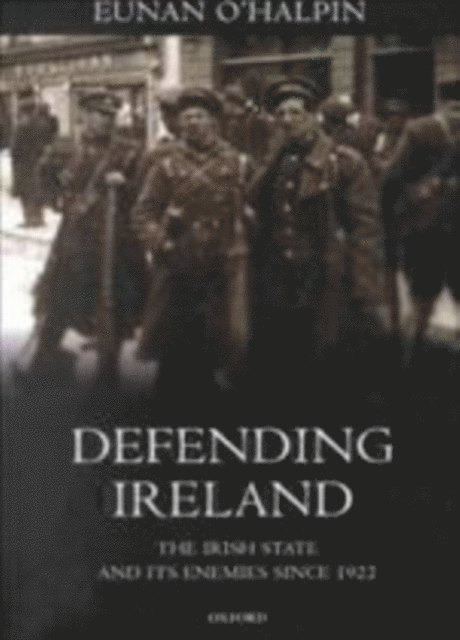
This book is the first to draw together the various strands of Irish national security policy and practice in a single chronological study, from independence in 1922 right up to the present day. Dr O'Halpin analyses the rapid emergence of a complex external security policy combining an absolute commitment to military neutrality and independent defence with close co-operation with Britain over issues of joint concern such as security and immigration. He traces the development of the army and police force in the new Irish state; and examines the state's reaction to the enduring republican threat, casting fresh light on how far the state was willing to put key constitutional protections into abeyance in its conflict with the republican movement. The book also examines the clandestine intelligence activities of belligerent powers during the Second World War, documenting the growth of the state's close wartime security understandings with the Allied powers, and the evolution of Cold War links with MI5 and the CIA. It investigates the evolution of post-war defence policy, and the activities of the defence forces in relation to the Northern Ireland crisis, as well as in their primary tasks of defending the state from external aggression and of contributing to UN peace-keeping operations. Dr O'Halpin highlights continuities as well as innovations in state security policy as the obligations and opportunities of European Union membership grate more and more against the absolutist rhetoric of neutrality. This book is essential reading for anyone wishing to understand the development of the Irish state in the twentieth century.
1 236 kr
Skickas inom 5-8 vardagar
This fascinating and original book is the first to analyse the evolution of internal security policy and external defence policy in Ireland from independence to the present day. Professor O'Halpin examines the very limited concept of external defence understood by the first generation of Irish leaders, going on to chart the state's repeated struggles with the IRA and with other perceived internal and external threats to stability. He explores the state's defence and security relations with Britain and the United States and, drawing extensively on newly released records, he deals authoritatively with problems of subversion, espionage, counterintelligence and codebreaking during the Second World War. In conclusion, the book analyses significant post-Second World War developments, including anti-communist co-operation with Western powers, the emergence of UN service as a key element of Irish foreign and defence policy, the state's response to the Northern Ireland crisis since 1969, and Ireland's difficulties in addressing the collective security dilemmas facing the European Union in the post-Cold War era. It is essential reading for anyone wishing to understand the development of independent Ireland since 1922.
Spying on Ireland
British Intelligence and Irish Neutrality during the Second World War
Inbunden, Engelska, 2008
1 092 kr
Skickas inom 5-8 vardagar
Irish neutrality during the Second World War presented Britain with significant challenges to its security. Exploring how British agencies identified and addressed these problems, this book reveals how Britain simultaneously planned sabotage in and spied on Ireland, and at times sought to damage the neutral state's reputation internationally through black propaganda operations. It analyses the extent of British knowledge of Axis and other diplomatic missions in Ireland, and shows the crucial role of diplomatic code-breaking in shaping British policy. The book also underlines just how much Ireland both interested and irritated Churchill throughout the war.Rather than viewing this as a uniquely Anglo-Irish experience, Eunan O'Halpin argues that British activities concerning Ireland should be placed in the wider context of intelligence and security problems that Britain faced in other neutral states, particularly Afghanistan and Persia. Taking a comparative approach, he illuminates how Britain dealt with challenges in these countries through a combination of diplomacy, covert gathering of intelligence, propaganda, and intimidation. The British perspective on issues in Ireland becomes far clearer when discussed in terms of similar problems Britain faced with neutral states worldwide.Drawing heavily on British and American intelligence records, many disclosed here for the first time, Eunan O'Halpin presents the first country study of British intelligence to describe and analyse the impact of all the secret agencies during the war. He casts fresh light on British activities in Ireland, and on the significance of both espionage and cooperation between intelligence agencies for developing wider relations between the two countries.
Spying on Ireland
British Intelligence and Irish Neutrality during the Second World War
Häftad, Engelska, 2010
524 kr
Skickas inom 7-10 vardagar
Irish neutrality during the Second World War presented Britain with significant challenges to its security. Exploring how British agencies identified and addressed these problems, this book reveals how Britain simultaneously planned sabotage in and spied on Ireland, and at times sought to damage the neutral state's reputation internationally through black propaganda operations. It analyses the extent of British knowledge of Axis and other diplomatic missions in Ireland, and shows the crucial role of diplomatic code-breaking in shaping British policy. The book also underlines just how much Ireland both interested and irritated Churchill throughout the war. Rather than viewing this as a uniquely Anglo-Irish experience, Eunan O'Halpin argues that British activities concerning Ireland should be placed in the wider context of intelligence and security problems that Britain faced in other neutral states, particularly Afghanistan and Persia. Taking a comparative approach, he illuminates how Britain dealt with challenges in these countries through a combination of diplomacy, covert gathering of intelligence, propaganda, and intimidation. The British perspective on issues in Ireland becomes far clearer when discussed in terms of similar problems Britain faced with neutral states worldwide. Drawing heavily on British and American intelligence records, many disclosed here for the first time, Eunan O'Halpin presents the first country study of British intelligence to describe and analyse the impact of all the secret agencies during the war. He casts fresh light on British activities in Ireland, and on the significance of both espionage and cooperation between intelligence agencies for developing wider relations between the two countries.
556 kr
Skickas inom 7-10 vardagar
The first comprehensive account to record and analyze all deaths arising from the Irish revolution between 1916 and 1921“A monumental new book [and] an incredible piece of research. . . . Formidable, authoritative and handsomely produced, The Dead of the Irish Revolution is a fitting memorial.”—Andrew Lynch, Irish Independent“Will surely serve as the indispensable reference work on this topic for the foreseeable future. . . . A truly remarkable feat of close scholarship and calm exposition.”—Gearoid O Tuathaigh, Irish Times WeekendThis account covers the turbulent period from the 1916 Rising to the Anglo-Irish Treaty of December 1921—a period which saw the achievement of independence for most of nationalist Ireland and the establishment of Northern Ireland as a self-governing province of the United Kingdom. Separatists fought for independence against government forces and, in North East Ulster, armed loyalists. Civilians suffered violence from all combatants, sometimes as collateral damage, often as targets. Eunan O’Halpin and Daithí Ó Corráin catalogue and analyze the deaths of all men, women, and children who died during the revolutionary years—505 in 1916; 2,344 between 1917 and 1921. This study provides a unique and comprehensive picture of everyone who died: in what manner, by whose hands, and why. Through their stories we obtain original insight into the Irish revolution itself.
192 kr
Tillfälligt slut
Del 13 - Documents on Irish Foreign Policy
Documents on Irish Foreign Policy, v. 13: 1965-1969
Inbunden, Engelska, 2022
657 kr
Skickas
The thirteenth volume in the Documents on Irish Foreign Policy (DIFP) series runs from April 1965 to July 1969. It covers the Fianna Fáil governments of Seán Lemass (April 1965 to November 1966) and Jack Lynch (November 1966 to July 1969) in which Frank Aiken was Minister for External Affairs.The four years and three months covered by DIFP XIII saw significant changes in the international context in which Ireland conducted its foreign policy. In 1965 the hope of the Department of External Affairs was that Ireland would enter the European Economic Community (EEC) before 1970. EEC entry would take place alongside that of Britain, an Anglo-Irish Free Trade Area (AIFTA) having come into operation in 1966, cementing trade between Ireland and its principal trading partner. Overall, the United Nations would remain the benchmark of global Irish foreign policy. Peacekeeping, advocating nuclear non-proliferation and ensuring the proper financing of the United Nations as well as promoting decolonisation and the universality of the United Nations system within the bipolar world of the Cold War remained central to 1960s Irish foreign policy.These assumptions were thrown out of balance by the continuing refusal of France to facilitate the expansion of the EEC and EEC membership remained out of reach for Ireland. Dublin’s fragile relations with Belfast were destabilised with the emergence of new social and political forces in Northern Ireland and the recurrence of sectarian violence. The Department of External Affairs proved initially unable to respond comprehensively to this new environment in Northern Ireland, which was the precursor to the outbreak of the Troubles in 1969. Improved economic and political relations with London were affected by local and international economic difficulties and also as a consequence of events in Northern Ireland. At the United Nations, superpower politics constrained Irish attempts to follow up the success of the 1968 Nuclear Non- Proliferation Treaty with a major policy initiative on the financing of international peacekeeping missions.