Katy Whitaker - Böcker
Visar alla böcker från författaren Katy Whitaker. Handla med fri frakt och snabb leverans.
3 produkter
3 produkter
781 kr
Skickas inom 5-8 vardagar
591 kr
Skickas inom 7-10 vardagar
Aerofilms Ltd was born on 9 May 1919. An unprecedented business venture, it hoped to marry the still fledgling technology of powered flight to the discipline of photography. Its founders were Claude Grahame-White, an internationally-famous English aviation pioneer, and Francis Lewis Wills, a trained architect who had flown as an observer for the Royal Naval Air Service during the First World War. Together they embarked on a distinctively British tale of derring-do. From developing photographic glass plates in a hotel bathroom at the London Flying Club in Hendon, to producing many thousands of aerial images every year, they took a tool which had first been used for military intelligence, and repackaged it for the mass market. As a result, Aerofilms lived through and recorded one of the most tumultuous periods in British history. After surviving the worldwide economic crash of the Great Depression in the 1930s, and serving their country at the request of Winston Churchill during the Second World War, they were still on hand to help shape the Britain of the future, capturing the major reconstruction projects of the 1940s and 50s. Aerofilms: A History of Britain From Above draws on thousands of images, including many that are rare or previously unseen, to present a vivid picture of the nation in the first half of the twentieth century. Following the company’s enigmatic founders, daredevil pilots, skilled photographers and innovative advertisers, it explores how they manufactured and sold a potent sense of place and identity to the British people. The story of Aerofilms – the men and women behind the company and the photographs that they produced – is a story of innovation, entrepreneurial spirit, war, marketing and the making of ‘Brand Britain’.
1 814 kr
Skickas inom 3-6 vardagar
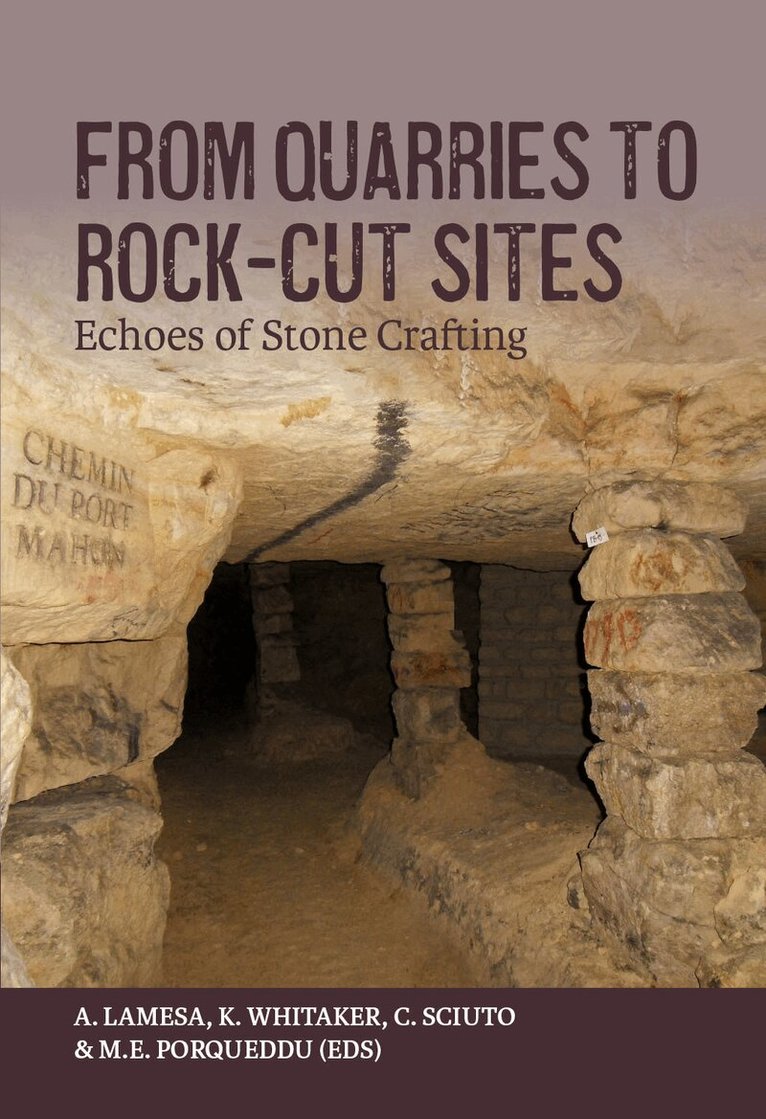
The archaeological study of quarries focuses mainly on the reconstruction of the extraction process, while rock-hewn spaces have often been approached from the point of view of architectural styles or art-history. Nevertheless, a holistic structural approach to the study of these spaces could allow a better understanding of the agency of those who carved the stone. Stone quarries and rock-cut sites have rarely been included in global studies of historical landscapes and few are the forums dedicated to the theoretical and methodological debate over the importance that these sites have for the understanding of past societies. To fill the gap, the proceedings volume aims at providing new data on sites located in Africa (Ethiopia, and Egypt), Europe (France, Croatia, Italy, Spain) and Asia (Turkey, Saudi Arabia) studied with a diachronic approach, as well as new theoretical reflections for the international debate on the archaeological investigation of rock-cut spaces and stone quarries. Two directions structure this volume: the analysis of the individual rock walls, considering the study of tool traces as a proxy for understanding the carving phases, as well as the analysis of the structure (site/quarry) as a whole, by contextualizing the results of the study of the single walls.The volume mainly targets researchers who are willing to discover quarries and rock-cut sites as aspects of the same mining phenomenon: places in which specific empirical and handcrafting knowledge related to stone working is expressed and conveyed, but also a wider audience that is interested in these peculiar and impressive sites.