Keith Simmons – författare
Visar alla böcker från författaren Keith Simmons. Handla med fri frakt och snabb leverans.
6 produkter
Semantic Singularities
Paradoxes of Reference, Predication, and Truth
E-bok, 2018
990 kr
Lägg i varukorg
This book aims to provide a solution to the semantic paradoxes. It argues for a unified solution to the paradoxes generated by our concepts of denotation, predicate extension, and truth. The solution makes two main claims. The first is that our semantic expressions ''denotes'', ''extension'' and …
Semantic Singularities
Paradoxes of Reference, Predication, and Truth
E-bok, 2018
990 kr
Lägg i varukorg
This book aims to provide a solution to the semantic paradoxes. It argues for a unified solution to the paradoxes generated by our concepts of denotation, predicate extension, and truth. The solution makes two main claims. The first is that our semantic expressions ''denotes'', ''extension'' and …
Truth
Av Simon Blackburn, Keith Simmons
Häftad, 1999
804 kr
Lägg i varukorg
The aim of the series is to bring together important recent writing in major areas of philosophical inquiry, selected from a variety of sources, mostly periodicals, which may not be conveniently available to the university student or the general reader. The editors of each volume contribute an …
Semantic Singularities
Paradoxes of Reference, Predication, and Truth
Inbunden, 2018
1191 kr
Lägg i varukorg
This book aims to provide a solution to the semantic paradoxes. It argues for a unified solution to the paradoxes generated by our concepts of denotation, predicate extension, and truth. The solution makes two main claims. The first is that our semantic expressions 'denotes', 'extension' and 'true' …
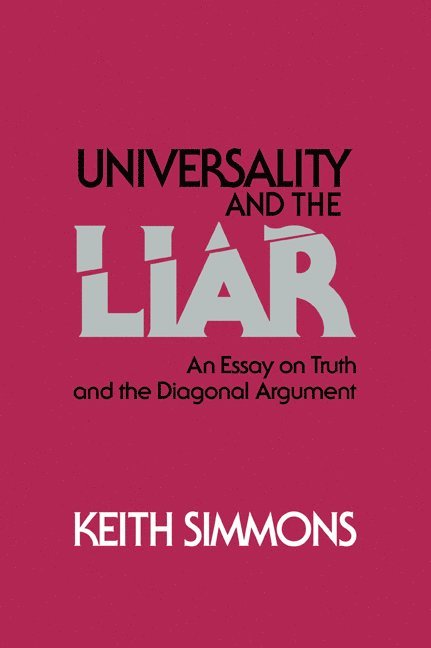
Universality and the Liar
An Essay on Truth and the Diagonal Argument
Häftad, 2008
586 kr
Lägg i varukorg
This book is about one of the most baffling of all paradoxes - the famous Liar paradox. Suppose we say: 'We are lying now'. Then if we are lying, we are telling the truth; and if we are telling the truth we are lying. This paradox is more than an intriguing puzzle, since it involves the concept of …
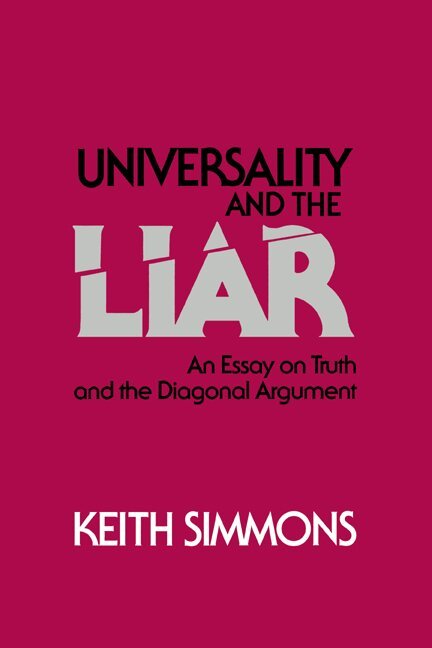
Universality and the Liar
An Essay on Truth and the Diagonal Argument
Inbunden, 1993
1610 kr
Lägg i varukorg
This book is about one of the most baffling of all paradoxes - the famous Liar paradox. Suppose we say: 'We are lying now'. Then if we are lying, we are telling the truth; and if we are telling the truth we are lying. This paradox is more than an intriguing puzzle, since it involves the concept of …